Effectiveness of Short-Term Psychodynamic Therapy on Negative Meta-Emotion and Marital Burnout in Betrayed Women
DOI:
https://doi.org/10.61838/kman.pwj.6.3.11Keywords:
Short-term psychodynamic therapy, marital burnout, negative metaemotionAbstract
Objective: The aim of this study was to investigate the effectiveness of short-term psychodynamic therapy on negative meta-emotion and marital burnout in women who have experienced infidelity.
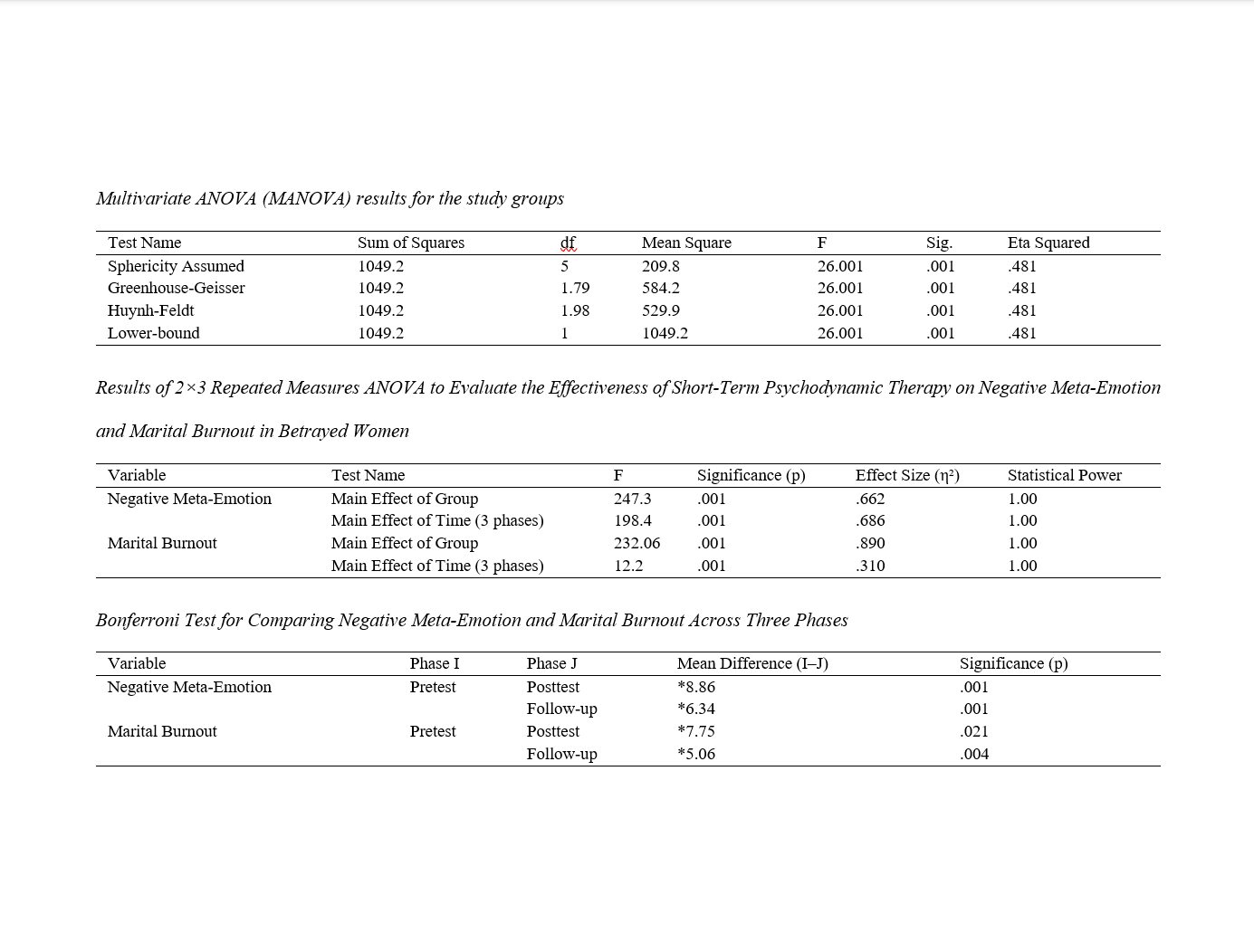
Materials and Methods: This research employed a quasi-experimental design with a pretest-posttest control group format and a two-month follow-up phase. The statistical population included women affected by infidelity who sought counseling services in Borujerd in 2024. The sample consisted of 30 women selected through convenience sampling and randomly assigned to either an experimental or a control group (15 participants per group). The intervention group received short-term psychodynamic therapy in nine weekly sessions lasting 75 minutes each. Data were collected using the Meta-Emotion Scale (MES) developed by Mitmansgruber et al. (2009) and the Couple Burnout Measure (CBM) developed by Pines (1996). Data analysis was conducted using repeated measures analysis of variance (ANOVA).
Findings: The results indicated that short-term psychodynamic therapy significantly improved negative meta-emotion and marital burnout in women who had experienced infidelity (p < .05).
Conclusion: It is concluded that short-term psychodynamic therapy is effective in improving negative meta-emotion and marital burnout in betrayed women.
Downloads
References
Apostolou, M., Samara, A., & Lajunen, T. J. (2025). How People Manage Relationship Problems: An Exploratory Study in the Greek Cultural Context. Behavioral Sciences, 15(2), 218. https://doi.org/10.3390/bs15020218
Bhat, G., & Shastry, A. (2025). Evaluation of efficacy of sexual novelty as a novel therapeutic strategy to treat Hypoactive Sexual Desire Disorder in women in monogamous heterosexual relationships attributing reduced sexual desire to sexual boredom: A prospective randomized study. [Add Journal Title]. https://doi.org/10.21203/rs.3.rs-5861026/v1
de Oliveira, L., Vallejo-Medina, P., & Carvalho, J. (2025). The Mediating Role of Sexual Boredom in Women's Sexual Desire and Satisfaction. Journal of sex & marital therapy, 51(1), 96-109. https://doi.org/10.1080/0092623X.2024.2442958
Di Salvo, G., Perotti, C., Ricci, V., Maina, G., & Rosso, G. (2024). Efficacy and suitability of adding short-term psychodynamic psychotherapy (STPP) to pharmacotherapy in patients with depressive disorders: A systematic review. Trends in Psychiatry and Psychotherapy, 265-279. https://doi.org/10.47626/2237-6089-2023-0764
Diener, M. J., Hilsenroth, M. J., & Giannopoulos, E. (2025). Therapist affect focus and patient outcomes in psychodynamic therapy: An updated systematic review and meta-analysis. Psychotherapy. https://doi.org/10.1037/pst0000568
Felder, J. P., & Machia, L. V. (2024). Direct-proactive communication and the post-infidelity stay-leave decision. Communication Quarterly, 72(2), 148-166. https://doi.org/10.1080/01463373.2023.2293974
Giacobbi, M., & Lalot, F. (2025). Unpacking trust repair in couples: A systematic literature review. Journal of Family Therapy, 47(1), e12483. https://doi.org/10.1111/1467-6427.12483
Hong, S., Ribaudo, J. M., Safyer, P., Routte, I. E., & Watkins, D. C. (2025). Advancing Psychodynamic-Based Clinical Social Work Practice to Address Structural Trauma: Integrating Neuroscience and Attachment Theory. Social Work. https://doi.org/10.1093/sw/swaf003
Hoy, E. Q., & Oh, V. Y. (2024). The consequences of spousal infidelity for long-term chronic health: A two-wave longitudinal analysis. Journal of Social and Personal Relationships, 41(12), 3720-3740. https://doi.org/10.1177/02654075241276713
Jia, L., Antonides, G., & Liu, Z. (2025). Spouses' personalities and marital satisfaction in Chinese families. Frontiers in psychology, 16, 1480570. https://doi.org/10.3389/fpsyg.2025.1480570
Kahraman, S., & Özbay, A. (2025). Examining Mindfulness's Mediating Role in the Relationship Between Infidelity Tendency and Divorce Anxiety. Psychological Reports. https://doi.org/10.1177/00332941241313436
Kovács, G., Van Dijke, A., Leontjevas, R., & Enders-Slegers, M. J. (2025). Equine-assisted short-term psychodynamic psychotherapy and the role of personality functioning, emphasizing self-control and identity integration. Journal of Contemporary Psychotherapy, 55(1), 77-87. https://doi.org/10.1007/s10879-024-09648-4
Lișman, C. G., & Holman, A. C. (2025). Principled Faithfulness: A Measure of Moral Reasons for Fidelity and Its Associations with the Tendency to Engage in Extramarital Relationships, Moral Emotions and Emotion Regulation. Social Sciences, 14(2), 81. https://doi.org/10.3390/socsci14020081
Malkomsen, A., Wilberg, T., Bull-Hansen, B., Dammen, T., Evensen, J. H., Hummelen, B., Løvgren, A., Osnes, K., Ulberg, R., & Røssberg, J. I. (2025). Comparative effectiveness of short-term psychodynamic psychotherapy and cognitive behavioral therapy for major depression in psychiatric outpatient clinics: a randomized controlled trial. BMC psychiatry, 25, 113. https://doi.org/10.1186/s12888-025-06544-6
Martínez Preciado, J. M., Sandoval-Salinas, C., & Corredor Ayala, H. (2025). Infidelity in Men with Erectile Dysfunction and Its Association with the Severity of the Condition: A Comparative Analysis Across Six Ibero-american Countries. Journal of sex & marital therapy, 1-8. https://doi.org/10.1080/0092623X.2025.2456317
Miggiels, M., Ten Klooster, P., Beekman, A., Bremer, S., Dekker, J., Janssen, C., & van Dijk, M. K. (2025). The D* Phase-study: Comparing short-term psychodynamic psychotherapy and cognitive behavioral therapy for major depressive disorder in a randomised controlled non-inferiority trial. Journal of affective disorders, 371, 344-351. https://doi.org/10.1016/j.jad.2024.10.122
Milo, F., Imondi, C., D'Amore, C., Angelino, G., Knafelz, D., Bracci, F., Dall’Oglio, L., De Angelis, P., & Tabarini, P. (2024). Short-term Psychodynamic Psychotherapy in Addition to Standard Medical Therapy Increases Clinical Remission in Adolescents and Young Adults with Inflammatory Bowel Disease: a Randomised Controlled Trial. Journal of Crohn's and Colitis, 18(2), 256-263. https://doi.org/10.1093/ecco-jcc/jjad145
Mitmansgruber, H., Beck, T. N., Höfer, S., & Schüßler, G. (2009). When you don't like what you feel: Experiential avoidance, mindfulness and meta-emotion in emotion regulation. Personality and individual differences, 46(4), 448-453. https://doi.org/10.1016/j.paid.2008.11.013
Naderipour, A., Tozandehjani, H., Bagherzadeh Golmakani, Z., & Zendedel, A. (2022). The effectiveness of behavioral activation therapy on distress tolerance and negative meta-emotion dimensions in female patients with multiple sclerosis. Rooyesh-e-Ravanshenasi Journal (Psychology Rising), 11(11), 125-134. https://frooyesh.ir/browse.php?a_id=4191&slc_lang=en&sid=1&printcase=1&hbnr=1&hmb=1
Pines, A. M., & Nunes, R. (2003). The relationship between career and couple burnout: Implications for career and couple counseling. Journal of employment counseling, 40(2), 50-64. https://doi.org/10.1002/j.2161-1920.2003.tb00856.x
Schneider, S. (2025). 'Because like if you feel guilty, then it's usually a sign': on the role of emotions in conceptualising infidelity. Emotions and Society, 1-19. https://doi.org/10.1332/26316897Y2025D000000056
Sharifi, B., Raeisi, F., & Haji Hassani, M. (2024). The relationship between self-compassion and forgiveness with marital burnout: The mediating role of self-criticism in married individuals. Rooyesh-e-Ravanshenasi Journal (Psychology Rising), 13(9), 21-30. https://frooyesh.ir/article-1-5199-en.html
Tan, S. A., Ang, S. M., Pung, P. W., Teoh, X. Y., & Ooh, S. L. (2025). Sex life dissatisfaction contribute to intention toward infidelity among Malaysians: relationship satisfaction as a mediator. BMC psychology, 13(1), 68. https://doi.org/10.1186/s40359-025-02414-8
Tsoi, L. H., Lam, W., Lau, C. K., & Wong, K. C. (2024). Does Absence Make the Heart Grow Fonder? An Exploratory Study of the Marital Quality of Filipina Domestic Helpers in Hong Kong. Sociology Mind, 14(4), 245-265. https://doi.org/10.4236/sm.2024.144014
Ventura-León, J., Tocto-Muñoz, S., Lino-Cruz, C., Sánchez-Villena, A. R., Martinez-Munive, R., Talledo-Sánchez, K., & Casiano-Valdivieso, K. (2025). Myths of Romantic Love, Negative Interactions, Relationship Involvement, Satisfaction, Infidelity, and Jealousy in Peruvian Individuals With Couples: Directed and Undirected Network Analysis. Journal of marital and family therapy, 51(2), e70014. https://doi.org/10.1111/jmft.70014
Viganò, A., Petolicchio, B., Toscano, M., Ruggero, S., Di Giambattista, R., Puma, M., Lanzone, J., Bellinvia, A., Diani, N., Castaldo, M., Valota, C., De Sanctis, R., Tiberio, P., Altieri, M., Gilliéron, E., & Di Piero, V. (2025). Real-world application of Short Term Psychodynamic Psychotherapy (STPP) as chronic migraine preventive therapy: Profiling responders and predictive factors. Neurological Sciences, 1-10. https://doi.org/10.1007/s10072-025-08075-0
Wang, S. S., & Duh, Y. C. (2024). Non-single dating app use and the cognitive and psychological mechanisms of infidelity: gender differences. Chinese Journal of Communication, 1-23. https://doi.org/10.1080/17544750.2024.2409651
Woolley, S. R., & Koren, R. (2025). Using the Woolley Motivation Typology to Heal Infidelity With Emotionally Focused Therapy. European Journal of Mental Health, 20, 1-10. https://doi.org/10.5708/EJMH.20.2025.0035
Zhao, W., Van Someren, E. J., Xu, Z., Ren, Z., Tang, L., Li, C., & Lei, X. (2024). Identifying the insomnia-related psychological issues associated with hyperarousal: A network perspective. International Journal of Psychophysiology, 195, 112276. https://doi.org/10.1016/j.ijpsych.2023.112276
Downloads
Additional Files
Publication Timeline
- Submitted
- Revised
- Accepted
Issue
Section
License
Copyright (c) 2025 Farzam Khodadad (Author); Mojgan Agah Heris (Corresponding Author); Mahdieh Rahmanian, Ezzatollah Kordmirza Nikoozadeh (Author)

This work is licensed under a Creative Commons Attribution-NonCommercial 4.0 International License.