Dimensions of Empowerment in Women Participating in Grassroots Feminist Movements
DOI:
https://doi.org/10.61838/Keywords:
Empowerment, grassroots feminism, feminist activism, women’s agencyAbstract
Objective: This study aimed to explore the multidimensional nature of empowerment as experienced by women engaged in grassroots feminist movements in the United States.
Methods and Materials: A qualitative research design was employed, utilizing semi-structured interviews with 29 women actively involved in feminist grassroots organizing across various regions of the United States. Participants were selected through purposive sampling to ensure diversity in age, ethnicity, and activist experience. Data collection continued until theoretical saturation was achieved. Interviews were conducted virtually, transcribed verbatim, and analyzed using thematic analysis, supported by NVivo software. The analysis followed Braun and Clarke’s six-phase approach to identify key themes and subthemes reflecting participants’ lived experiences of empowerment within activist contexts.
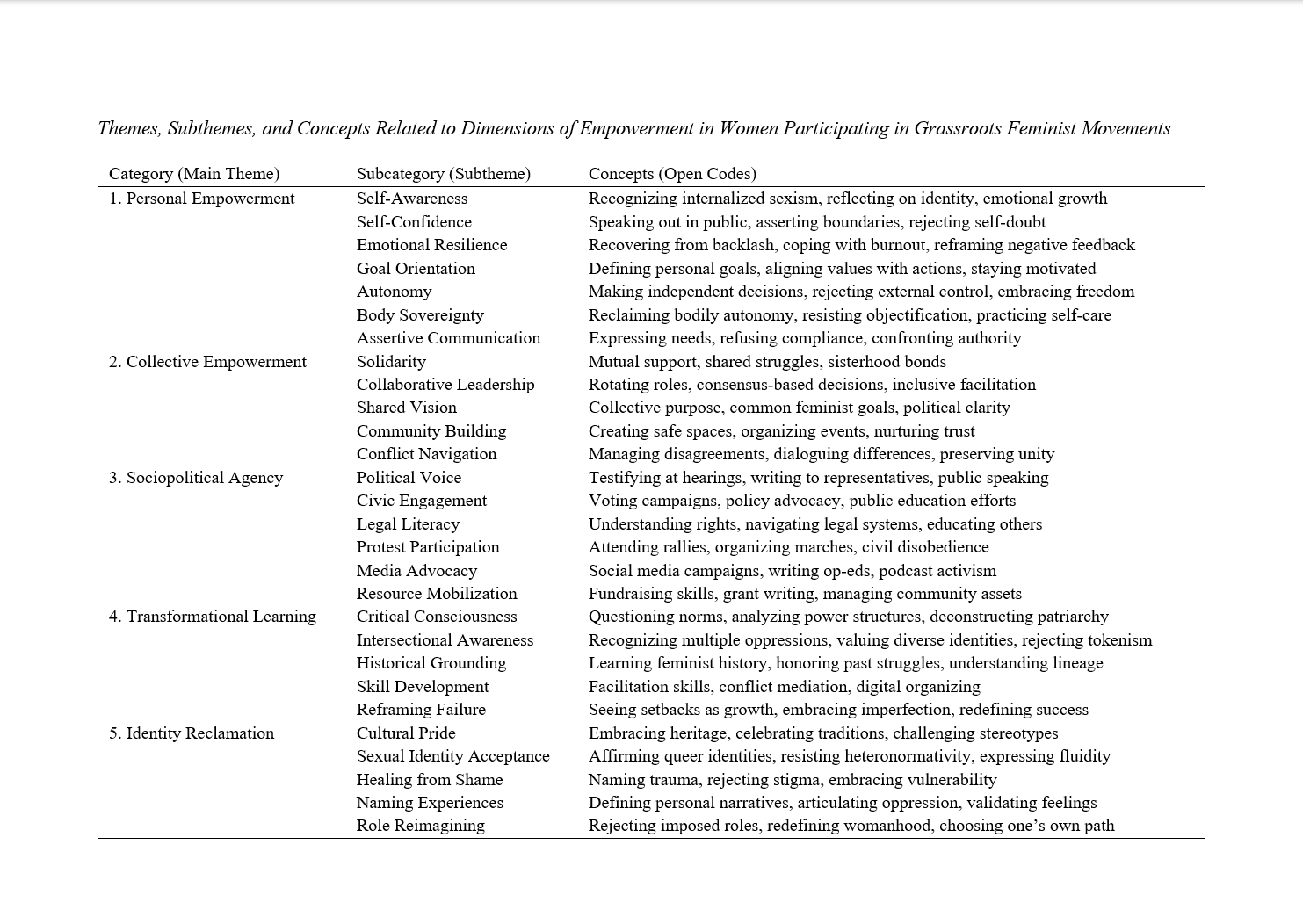
Findings: The analysis revealed five major dimensions of empowerment: personal empowerment, collective empowerment, sociopolitical agency, transformational learning, and identity reclamation. Each category comprised multiple subthemes, such as self-awareness, solidarity, political voice, critical consciousness, and cultural pride. Participants described how grassroots activism facilitated internal growth, strengthened interpersonal connections, and expanded their engagement in civic and political life. The data highlighted how empowerment was not a fixed state but an evolving, contextual process shaped by resistance, relational dynamics, and ongoing learning. Quotations from participants illustrated how even small acts, such as asserting boundaries or sharing personal stories, contributed to broader transformations in identity and agency.
Conclusion: Women’s participation in grassroots feminist movements fosters a dynamic and multifaceted empowerment process that transcends traditional institutional metrics. These findings underscore the importance of recognizing emotional, relational, and symbolic dimensions of empowerment, as well as the sociopolitical mechanisms through which women reclaim agency and challenge systemic inequalities. Supporting grassroots feminist efforts requires attention to sustainability, intersectionality, and collective care to maintain their transformative potential.
Downloads
References
Abasilim, A. N. (2020). Impact of State Government Development Scheme for Economic Empowerment on Community Dwellers of Anambra State Nigeria. Journal of Business Strategy, Finance and Management, 2(1-2), 131-143. https://doi.org/10.12944/jbsfm.02.01-02.13
Alam, M. Z., & Shiuly, A. U. (2023). Driving Grassroots Gender Equality: Empowering Women in Bangladeshi Local Government. International Journal of Advanced Research, 11(10), 363-380. https://doi.org/10.21474/ijar01/17716
Baena, X. R., Langbid-Roda, R., Otano, J., Derogongan, R., & Reyes, J. (2024). Emanating Change Fragments of Micro-Empowerment Among Women Leaders in Mindanao Philippines. TMF, 36(2). https://doi.org/10.62071/tmf.v36i2.714
Bocking-Welch, A., Huzzey, R., Leston‐Bandeira, C., & Miller, H. (2024). Women’s Campaigning, Petitioning, and Grassroots Activism, 1945–1997. Women S History Review, 1-18. https://doi.org/10.1080/09612025.2024.2373507
Clatterbuck, M. (2022). Catholic Sisters and Cornfield Activism. Journal for the Study of Religion Nature and Culture, 16(2). https://doi.org/10.1558/jsrnc.20043
Dudley, R. (2023). Honoring the Enslaved African American Foremothers of Modern Women's Health: Meditations on 40 Years of Black Feminist Praxis. Medical Anthropology Quarterly, 38(4), 445-461. https://doi.org/10.1111/maq.12836
Dulhunty, A. (2023). Women's Empowerment and Feminist Movements. 14-32. https://doi.org/10.4324/9781003356400-2
González-Malabet, M. (2022). Women’s Political Participation Through Social Movements and Nongovernmental Organizations: The Case of Compromiso Ciudadano in Medellín, Colombia. Social Politics International Studies in Gender State & Society, 30(1), 93-114. https://doi.org/10.1093/sp/jxac031
Gordon, R. (2020). Transformative Grassroots Leadership: Understanding the Role of Rojiroti’s Women Leaders in Supporting Social Change. Politics and Governance, 8(4), 180-190. https://doi.org/10.17645/pag.v8i4.3560
Gottardi, F. (2020). Sacred Sites Protection and Indigenous Women’s Activism: Empowering Grassroots Social Movements to Influence Public Policy. A Look Into the “Women of Standing Rock” and “Idle No More” Indigenous Movements. Religions, 11(8), 380. https://doi.org/10.3390/rel11080380
Han, X. (2021). Uncovering the Low-Profile #MeToo Movement: Towards a Discursive Politics of Empowerment on Chinese Social Media. Global Media and China, 6(3), 364-380. https://doi.org/10.1177/20594364211031443
Healy‐Clancy, M. (2020). Women and Popular Politics in Twentieth-Century South Africa. https://doi.org/10.1093/oxfordhb/9780190921767.013.32
Kabira, W., & Maloiy, L. (2019). Feminist and Grassroots Activism Rewriting Women as Victims. 85-97. https://doi.org/10.4324/9781351043601-7
Karakchiev, V. N. (2024). Involving Women in the Apparatus of the Volost Executive Committees of the Komi Autonomous Region in the 1920s. Proceedings of the Komi Science Centre of the Ural Division of the Russian Academy of Sciences, 0(1), 80-86. https://doi.org/10.19110/1994-5655-2024-1-80-86
Khuankaew. (2020). Grassroots Women Transforming Patriarchy With Spiritual Activism. Journal of Feminist Studies in Religion, 36(1), 113. https://doi.org/10.2979/jfemistudreli.36.1.10
Mari Tripp, A. (2024). “We Are Always Each Other's Keeper”: Transformative Dimensions of Women's Local Peacebuilding in Africa. Global Studies Quarterly, 5(1). https://doi.org/10.1093/isagsq/ksaf003
Moohin, A. (2022). Building Social Cohesion Through Community Leadership. Australian Journal of Islamic Studies, 7(3), 101-123. https://doi.org/10.55831/ajis.v7i3.571
Natil, I. (2021). Women’s Grassroots Engagement and Non-Violent Activism. 99-114. https://doi.org/10.1108/978-1-80071-060-320210007
Orisadare, M. A. (2019). An Assessment of the Role of Women Group in Women Political Participation, and Economic Development in Nigeria. Frontiers in Sociology, 4. https://doi.org/10.3389/fsoc.2019.00052
Prasongko, D., & Arti, W. C. (2021). Leading With Compassion: A Story of Women Grassroots Leadership Amidst COVID-19 and Coastal Flooding. PCD Journal, 9(1), 83-99. https://doi.org/10.22146/pcd.v9i1.3464
Santpoort, R., Steel, G., Mkandawire, A., Ntauazi, C., Faye, E. H., & Githuku, F. (2021). The Land Is Ours: Bottom-Up Strategies to Secure Rural Women's Access, Control and Rights to Land in Kenya, Mozambique, Senegal and Malawi. Frontiers in Sustainable Food Systems, 5. https://doi.org/10.3389/fsufs.2021.697314
Scarrow, S. E., Suh, J., & Wright, J. M. (2024). Explaining the Narrowing Gender Gap in Partisan Participation: Women’s Empowerment or Men’s Disengagement? Political Studies. https://doi.org/10.1177/00323217241297628
Thorat, J., Gopal, N., & Deora, K. (2024). Women Leaders' Contribution to UN SDG-16. 104-117. https://doi.org/10.4018/979-8-3693-1834-8.ch006
Waldron, I. (2018). Women on the Frontlines: Grassroots Movements Against Environmental Violence in Indigenous and Black Communities in Canada. Kalfou a Journal of Comparative and Relational Ethnic Studies, 5(2). https://doi.org/10.15367/kf.v5i2.211
Waldrop, A. (2024). Why Women Exit Politics: The Case of Two Grassroots Activists in a Slum in New Delhi. Journal of South Asian Development, 19(3), 408-428. https://doi.org/10.1177/09731741241264069
Downloads
Additional Files
Publication Timeline
- Submitted
- Revised
- Accepted
Issue
Section
License

This work is licensed under a Creative Commons Attribution-NonCommercial 4.0 International License.