Emotional Labor and Gender Norms: Understanding the Experiences of Women in Care Professions
DOI:
https://doi.org/10.61838/Keywords:
Emotional labor, gender norms, care professions, women, qualitative research, emotional exhaustion, professional identityAbstract
Objective: This study aimed to explore how women in care professions in Germany experience and interpret emotional labor within the context of gendered workplace expectations.
Methods and Materials: This qualitative research employed an exploratory design using semi-structured, in-depth interviews with 30 women working in various care professions, including nursing, social work, early childhood education, and eldercare. Participants were recruited through purposive sampling, ensuring diversity in age, professional role, and years of experience. Data collection continued until theoretical saturation was reached. All interviews were transcribed verbatim and analyzed using thematic analysis, following Braun and Clarke’s six-phase approach. NVivo software was utilized to code and organize the data systematically, enhancing the rigor and transparency of the analysis.
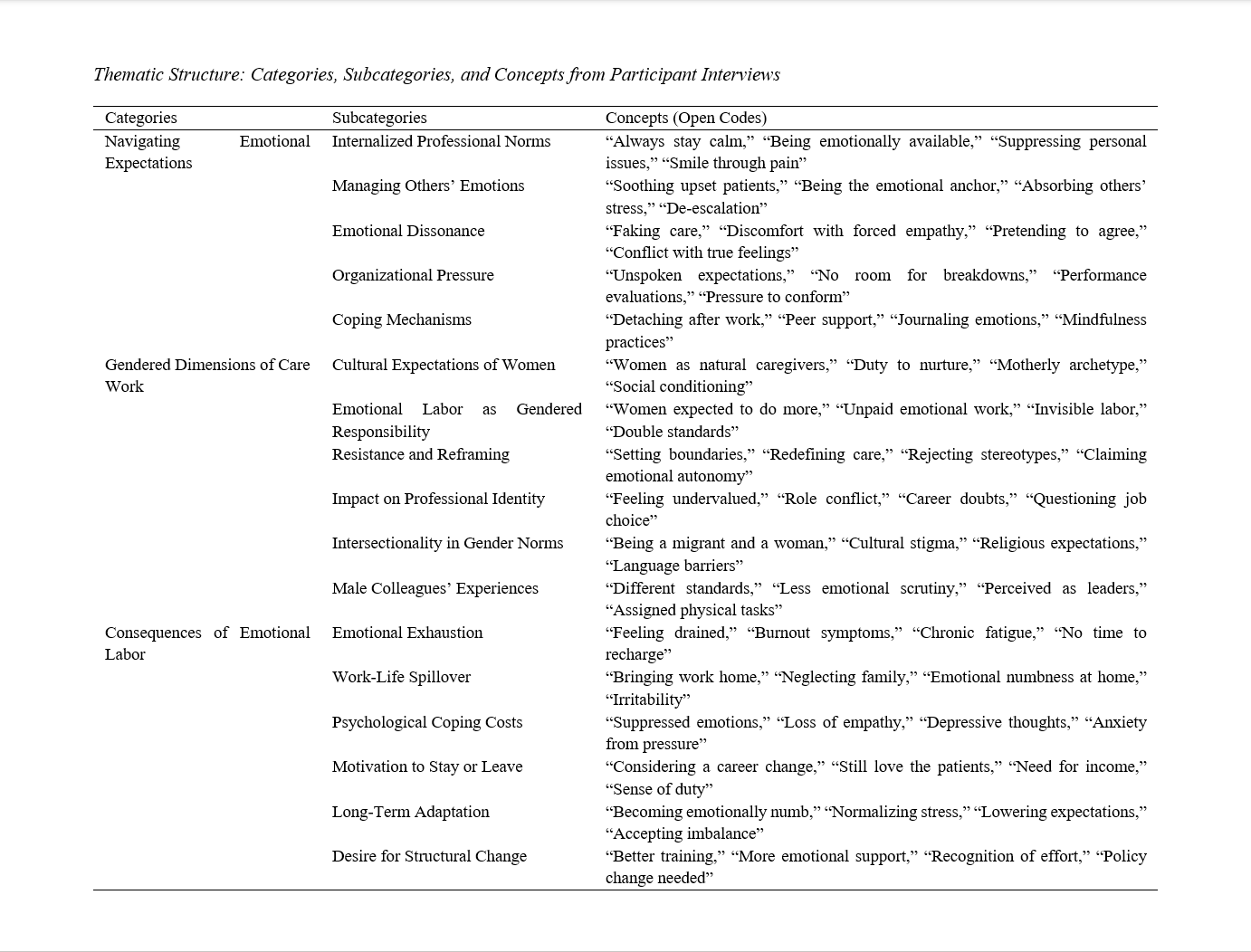
Findings: Three overarching themes emerged from the data: navigating emotional expectations, gendered dimensions of care work, and consequences of emotional labor. Participants described internalized professional norms requiring emotional control, often in conflict with their authentic feelings. They highlighted how emotional labor is disproportionately expected of women, reinforced by cultural narratives of feminine caregiving. Many reported experiencing emotional exhaustion, role spillover into personal life, and diminished motivation to remain in their professions. At the same time, some participants demonstrated acts of resistance by setting boundaries and reframing emotional labor as skilled and valuable work. The findings revealed a clear disconnect between the institutional expectations placed on care workers and the emotional toll of their labor, underscoring the need for systemic recognition and reform.
Conclusion: Emotional labor in care professions is deeply gendered, institutionally underrecognized, and psychologically demanding.
Downloads
References
Ahlmen, A. (2021). “The World Is Stopped, but We Keep Going”: Nurses’ Processes of Emotional Labor During the SARS-COVID19 Pandemic. https://doi.org/10.21203/rs.3.rs-963156/v1
Chen, C.-C., Lan, Y. L., Chiou, S.-L., & Lin, Y.-C. (2022). The Effect of Emotional Labor on the Physical and Mental Health of Health Professionals: Emotional Exhaustion Has a Mediating Effect. Healthcare, 11(1), 104. https://doi.org/10.3390/healthcare11010104
Cummins, M. W., & Huber, A. A. (2022). Documenting Emotional Labor. Journal of Autoethnography, 3(2), 187-202. https://doi.org/10.1525/joae.2022.3.2.187
Doğan, N., Gümüş, K., & Kaçmaz, H. Y. (2022). The Emotional Labor and Caring Behaviors of Nursing Students. Acibadem Universitesi Saglik Bilimleri Dergisi, 13(4). https://doi.org/10.31067/acusaglik.1089934
Hogan, B., & Drentea, P. (2022). Secondary Emotional Labor: How Female Nurses Respond to the Contradictions of Caring. Health an Interdisciplinary Journal for the Social Study of Health Illness and Medicine, 27(6), 924-940. https://doi.org/10.1177/13634593221075952
Jeong, E. H. (2025). Examining the Relationship Between Social Workers’ Emotional Labor and Their Burn-Out Level: Focusing on the Role of Self-Care. Korean Council Soc Welfare Edu, 69, 1-29. https://doi.org/10.31409/kjswe.2025.69.1
Kang, T. R., & Park, J. Y. (2020). Impact of Surface and Deep Acting Emotional Labor on Emotional Dissonance Among Ambulatory Care Nurses. Korean Journal of Health Promotion, 20(3), 108-115. https://doi.org/10.15384/kjhp.2020.20.3.108
Khan, S., Khan, M. I., & Sultan, S. (2022). Examining Emotional Stress That Frontline Medical Health Workers Went Through During Covid-19 Pandemic: A Pakistan’s Case. JRSDS, 1(2), 57-73. https://doi.org/10.56596/jrsds.v1i2.17
Kılınç, K. Ö., Bayrak, B., Özkan, Ç. G., Kurt, Y., & Öztürk, H. (2020). Assessing Nurses’ Emotional Labor Levels. Journal of Academic Research in Nursing. https://doi.org/10.5222/jaren.2020.83723
Kim, J. Y., Choi, E., & Kwon, O. H. (2021). The Effect of Workers' Emotional Lobor in Each Beauty Industry on Their Quality of Work and Life. Journal of the Korean Society of Cosmetology, 27(3), 760-769. https://doi.org/10.52660/jksc.2021.27.3.760
Kwon, M., & Song, Y. (2024). Impact of Emotional Labor and Positive Psychological Capital on the Turnover Intention of Nurses Caring for Patients With COVID-19: A Descriptive Survey Study. Journal of nursing management, 2024, 1-7. https://doi.org/10.1155/2024/5517249
Lawton, A., & Cadge, W. (2024). “Ministry of Presence” as Emotional Labor: Perspectives From Recipients of Care. Religions, 15(9), 1135. https://doi.org/10.3390/rel15091135
Liedo, B., Grunsven, J. v., & Marin, L. (2024). Emotional Labor and the Problem of Exploitation in Roboticized Care Practices: Enriching the Framework of Care Centred Value Sensitive Design. Science and Engineering Ethics, 30(5). https://doi.org/10.1007/s11948-024-00511-2
Malhotra, R. S. (2022). “Not Everyone Can Do This”: Childcare Context and the Practice of Skill in Emotional Labor. International Journal of Child Care and Education Policy, 16(1). https://doi.org/10.1186/s40723-022-00101-4
Newcomb, M. (2021). The Emotional Labour of Academia in the Time of a Pandemic: A Feminist Reflection. Qualitative Social Work, 20(1-2), 639-644. https://doi.org/10.1177/1473325020981089
Porter, J. (2025). Invisible and Undervalued: A Feminist Critical Discourse Analysis of Women Coaches’ Emotional Labor. Journal of Sport Management, 1-12. https://doi.org/10.1123/jsm.2024-0269
Qiu, P., Yan, L., Zhang, Q., Guo, S., Liu, C., Liu, H., & Chen, X. (2023). Organizational Display Rules in Nursing: Impacts on Caring Behaviors and Emotional Exhaustion Through Emotional Labor. International Nursing Review, 71(3), 571-579. https://doi.org/10.1111/inr.12876
Saikia, M., George, L. S., & Unnikrishnan, B. (2024). Nurses’ Emotional Labor and Intrinsic Motivation: Findings From a Cross-Sectional Study. Journal of Datta Meghe Institute of Medical Sciences University, 19(3), 533-539. https://doi.org/10.4103/jdmimsu.jdmimsu_75_24
Tafjord, T. (2021). Managing Strong Emotions: Nurses’ Recognition and Responses to Personal Emotions When Approaching Parents With Cancer and Their Dependent Children. Qualitative Health Research, 31(5), 926-941. https://doi.org/10.1177/1049732320983788
Yan, Z. (2022). “I Tried to Control My Emotions”: Nursing Home Care Workers’ Experiences of Emotional Labor in China. Journal of Cross-Cultural Gerontology, 37(1), 1-22. https://doi.org/10.1007/s10823-022-09452-4
Yıldız, A. T., & Dinç, L. (2022). Emotional Labor Among Turkish Nurses: A Cross‐sectional Study. Nursing Inquiry, 30(3). https://doi.org/10.1111/nin.12544
Zhang, Y., Ghaziri, M. E., Siddique, S., Gore, R., Kurowski, A., Nobrega, S., & Punnett, L. (2021). Emotional Labor and Depressive Symptoms Among Healthcare Workers: The Role of Sleep. Workplace Health & Safety, 69(8), 383-393. https://doi.org/10.1177/21650799211014768
Downloads
Additional Files
Publication Timeline
- Submitted
- Revised
- Accepted
Issue
Section
License

This work is licensed under a Creative Commons Attribution-NonCommercial 4.0 International License.