Mothering Under Surveillance: Psychological Dimensions of Welfare Stigma in Low-Income Mothers
DOI:
https://doi.org/10.61838/Keywords:
Welfare stigma, maternal identity, psychological impact, low-income mothersAbstract
Objective: This study aimed to explore the psychological dimensions of welfare stigma among low-income mothers in Thailand who are subject to institutional surveillance and conditional welfare support.
Methods and Materials: Using a qualitative research design, this study employed semi-structured, in-depth interviews with 27 low-income mothers residing in urban and semi-urban areas of Thailand. Participants were purposively sampled based on their current receipt of state welfare benefits and were interviewed until theoretical saturation was reached. Interviews lasted between 60 and 90 minutes, were audio-recorded with consent, and transcribed verbatim in the original language. Data were analyzed thematically using NVivo software following Braun and Clarke’s six-step framework to identify key categories, subcategories, and recurring concepts related to mothers’ emotional experiences and identity formation in the context of welfare surveillance.
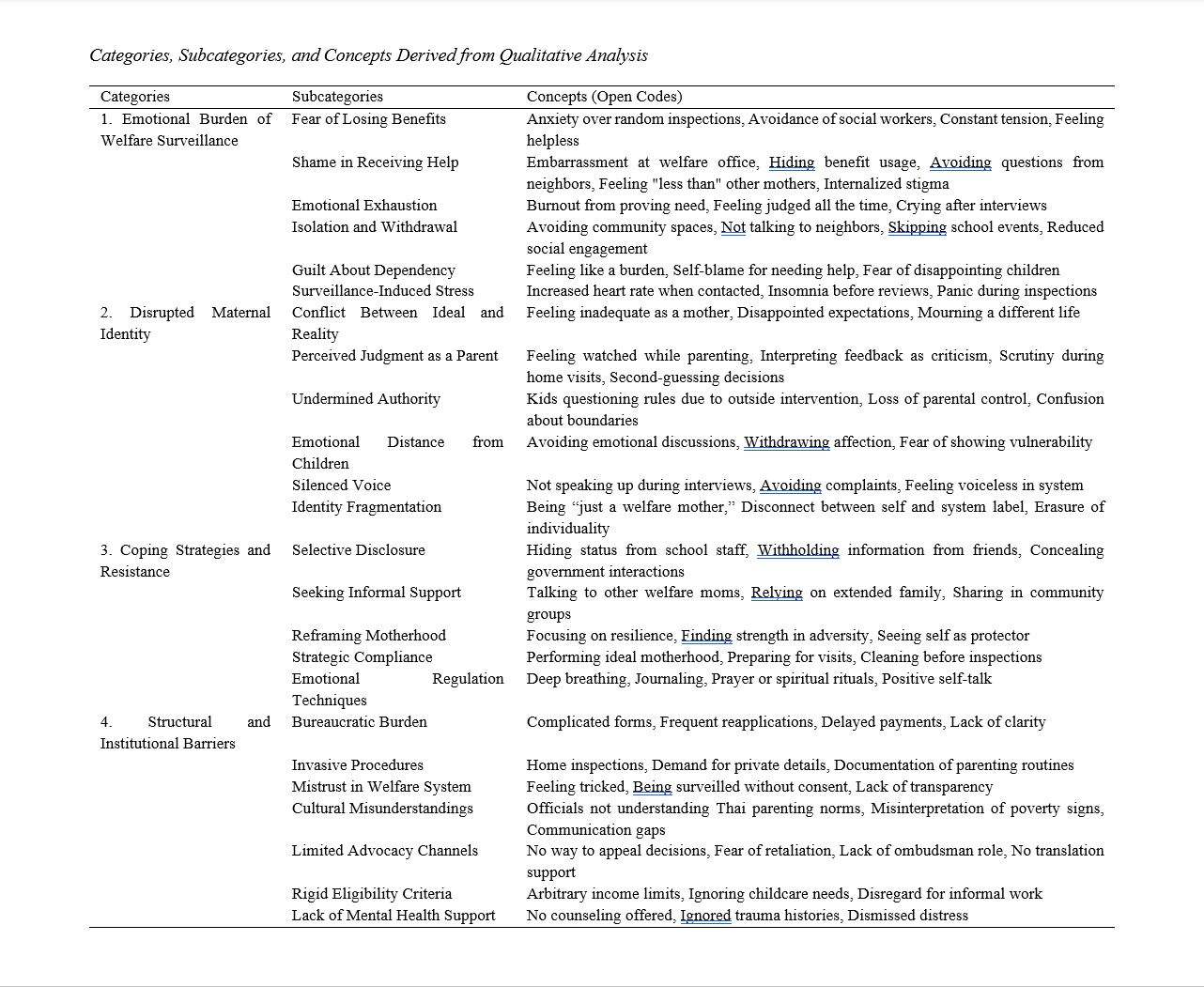
Findings: Thematic analysis revealed four overarching categories: emotional burden of welfare surveillance, disrupted maternal identity, coping strategies and resistance, and structural and institutional barriers. Participants described chronic stress, shame, and emotional exhaustion resulting from bureaucratic scrutiny and moral judgment. Welfare surveillance disrupted their maternal identity, fostering feelings of inadequacy and fragmentation. Despite these pressures, mothers demonstrated resilience through selective disclosure, emotional regulation, and informal peer support. Institutional practices such as invasive inspections and rigid eligibility rules intensified mistrust and left psychological needs unmet. These findings align with existing international research on welfare stigma, while also highlighting context-specific emotional impacts within Thai welfare systems.
Conclusion: Policies and practices must be restructured to prioritize dignity, reduce bureaucratic harm, and provide integrated emotional support to empower welfare-involved mothers and mitigate the long-term impact of stigma.
Downloads
References
Azarova, Y. (2015). Legal Regulation of Social Welfare for Women and Children (Demographic Aspect). Journal of Russian Law, 3(10), 0-0. https://doi.org/10.12737/13253
Dooley, M., & Finnie, R. (2008). Welfare Policy, Language Group, and the Duration of Lone Motherhood Spells. Canadian Public Policy, 34(1), 37-64. https://doi.org/10.3138/cpp.34.1.037
England, E., & Henley, J. (2024). It Matters How They See You: Maternal Activation’ as a Strategy to Navigate Contradictory Discourses of Motherhood and Neoliberal Activism in the Welsh Homelessness System. Social Policy and Society, 1-14. https://doi.org/10.1017/s1474746424000046
Herbst-Debby, A. (2012). Welfare Mom as Warrior Mom: Discourse in the 2003 Single Mothers' Protest in Israel. Journal of Social Policy, 42(1), 129-145. https://doi.org/10.1017/s0047279412000529
Herbst‐Debby, A. (2022). (De)legitimization of Single Mothers’ Welfare Rights: United States, Britain and Israel. Journal of European Social Policy, 32(3), 302-316. https://doi.org/10.1177/09589287221076743
Herland, M. D. (2019). Conceptualizing Motherhood in a Context of Inequality and Vulnerability: Experiences of Being a Mother After a Troubled Upbringing. Qualitative Social Work, 19(5-6), 934-950. https://doi.org/10.1177/1473325019869799
Herland, M. D., & Helgeland, I. M. (2014). Negotiating Motherhood: Women With Troubled Upbringings and Their Self‐conceptions as Mothers. Child & Family Social Work, 22(1), 47-56. https://doi.org/10.1111/cfs.12193
Hung, S. L., & Fung, K.-k. (2011). Gendering Welfare: Lone Mothers’ Experiences of Welfare-to-Work Programmes in Hong Kong. Social Policy and Society, 10(2), 177-189. https://doi.org/10.1017/s1474746410000527
Kang, J. Y., Lee, W., Ham, S., & Wang, J. S. (2023). Motherhood or Marriage Penalty? A Comparative Perspective on Employment and Wage in East Asia and Western Countries. Family Relations, 73(1), 223-246. https://doi.org/10.1111/fare.12935
Kempińska, U. (2017). Causes and Consequences of Early Maternity. International Journal of Pedagogy Innovation and New Technologies, 4(2), 103-115. https://doi.org/10.5604/01.3001.0011.5990
Medina, S., & Magnuson, S. (2009). Motherhood in the 21st Century: Implications for Counselors. Journal of Counseling & Development, 87(1), 90-96. https://doi.org/10.1002/j.1556-6678.2009.tb00553.x
Menashe, A., Possick, C., & Buchbinder, E. (2012). Between the Maternal and the Professional: The Impact of Being a Child Welfare Officer on Motherhood. Child & Family Social Work, 19(4), 391-400. https://doi.org/10.1111/cfs.12029
Nordberg, C. (2015). Invisibilised Visions: ≪i>Migrant Mothers and the Reordering Of Citizenship in a Nordic Welfare State Context</I>. Nordic Journal of Migration Research, 5(2), 67. https://doi.org/10.1515/njmr-2015-0011
Ostanina, E. А. (2023). On (Non)applicability of the General Rules on the Contract and Obligations to the Contract With a Surrogate Mother. Bulletin of Chelyabinsk State University Series Law, 8(4), 15-19. https://doi.org/10.47475/2618-8236-2023-8-4-15-19
Pryce, J., & Samuels, G. M. (2009). Renewal and Risk: The Dual Experience of Young Motherhood and Aging Out of the Child Welfare System. Journal of Adolescent Research, 25(2), 205-230. https://doi.org/10.1177/0743558409350500
Sandberg, S., Agoff, C., & Fondevila, G. (2020). Doing Marginalized Motherhood: Identities and Practices Among Incarcerated Women in Mexico. International Journal for Crime Justice and Social Democracy, 9(2). https://doi.org/10.5204/ijcjsd.v10i1.1538
Sinai‐Glazer, H., Lipshes‐Niv, M., & Peled, E. (2019). The Construction of Maternal Identity Among Israeli Mothers Who Are Welfare Clients. Child & Family Social Work, 25(S1), 28-36. https://doi.org/10.1111/cfs.12709
Smith, K. (2021). A Mother’s Hope in the Midst of Existential Immobility From State and Stigma. Focaal, 2021(90), 36-46. https://doi.org/10.3167/fcl.2021.900104
Søgaard, V. F. (2018). Når Ønsket Om Moderskab Vækker Bekymring. Kvinder Køn & Forskning(4), 23-35. https://doi.org/10.7146/kkf.v26i4.110556
Virokannas, E. (2011). Identity Categorization of Motherhood in the Context of Drug Abuse and Child Welfare Services. Qualitative Social Work, 10(3), 329-345. https://doi.org/10.1177/1473325011408480
Wołowicz, A. (2015). How Polish Women With Disabilities Challenge the Meaning of Motherhood. Psychology of Women Quarterly, 40(1), 80-95. https://doi.org/10.1177/0361684315600390
Downloads
Additional Files
Publication Timeline
- Submitted
- Revised
- Accepted
Issue
Section
License

This work is licensed under a Creative Commons Attribution-NonCommercial 4.0 International License.