Attachment Anxiety and Internalized Misogyny as Predictors of Relationship Instability in Young Women
DOI:
https://doi.org/10.61838/Keywords:
Attachment anxiety, internalized misogyny, relationship instabilityAbstract
Objective: This study aimed to investigate how attachment anxiety and internalized misogyny predict relationship instability among young women.
Methods and Materials: A correlational descriptive design was employed with 460 female participants from Slovenia, aged 18 to 30. Standardized self-report measures were utilized to assess relationship instability (dependent variable), attachment anxiety, and internalized misogyny (independent variables). Data were analyzed using IBM SPSS Statistics version 27, focusing on Pearson correlation to explore bivariate associations and multiple linear regression to determine the combined predictive value of attachment anxiety and internalized misogyny on relationship instability. All participants provided informed consent prior to their inclusion, and anonymity was ensured throughout the study.
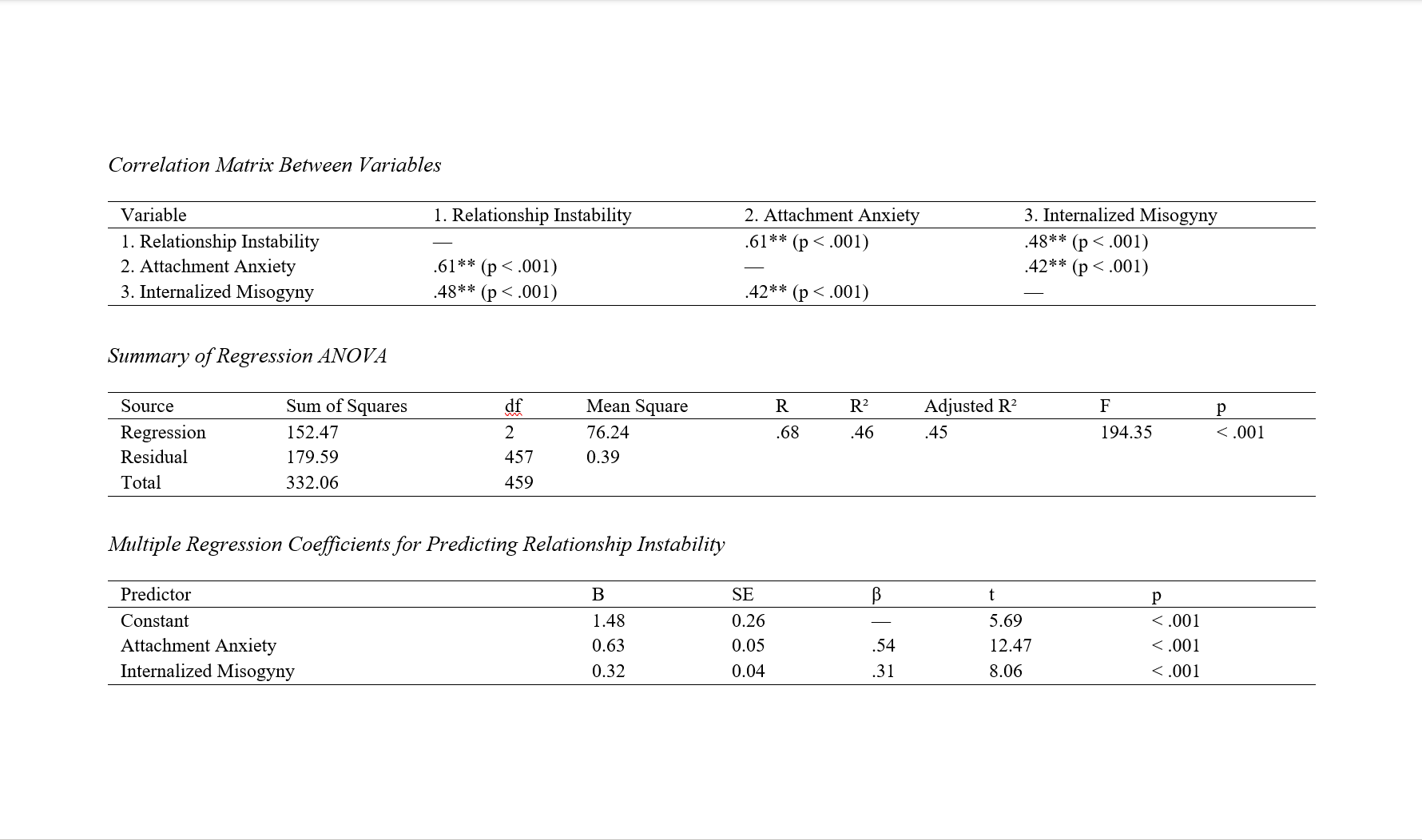
Findings: Pearson correlation analyses indicated that both attachment anxiety and internalized misogyny were significantly and positively associated with relationship instability (p < .001). Multiple linear regression analysis further revealed that attachment anxiety emerged as the stronger predictor (β = .54, p < .001), although internalized misogyny also made a significant contribution (β = .31, p < .001). The overall model was statistically significant, F(2, 457) = 194.35, p < .001, explaining approximately 46% of the variance in relationship instability (R² = .46, adjusted R² = .45). These results highlight the importance of both psychosocial and ideological factors in predicting instability in young women’s romantic relationships.
Conclusion: Attachment anxiety and internalized misogyny significantly contribute to relationship instability, reinforcing the need to address not only individual emotional vulnerabilities but also internalized gender biases when supporting young women in romantic contexts. Interventions targeting the reduction of attachment-related fears and challenging harmful beliefs about women may promote more stable and satisfying romantic partnerships.
Downloads
References
Çarıkçı-Özgül, D. N., & Işık, Ü. (2024). Exploring Adult Attachment and Anxiety: The Role of Intolerance of Uncertainty and Social Support. Current Psychology, 43(20), 18612-18620. https://doi.org/10.1007/s12144-024-05659-5
Chen, X., Li, M., Gong, H., Zhang, Z., & Wang, W. (2021). Factors Influencing Adolescent Anxiety: The Roles of Mothers, Teachers and Peers. International journal of environmental research and public health, 18(24), 13234. https://doi.org/10.3390/ijerph182413234
Clark, G. I., Rock, A. J., Clark, L. H., & Murray‐lyon, K. (2020). Adult Attachment, Worry and Reassurance Seeking: Investigating the Role of Intolerance of Uncertainty. Clinical Psychologist, 24(3), 294-305. https://doi.org/10.1111/cp.12218
Deng, M., Tadesse, E., Khalid, S., Zhang, W., Song, J., & Gao, C. (2023). The Influence of Insecure Attachment on Undergraduates’ Jealousy: The Mediating Effect of Self-Differentiation. Frontiers in psychology, 14. https://doi.org/10.3389/fpsyg.2023.1153866
Douglas, V., Kwan, M. Y., & Gordon, K. H. (2020). Pet Attachment and the Interpersonal Theory of Suicide. https://doi.org/10.31234/osf.io/p67bu
Erenoğlu, R., Sözbir, Ş. Y., & Erenel, A. Ş. (2023). Is There a Relationship Between Internalized Misogyny and Premenstrual Syndrome and Dysmenorrhea in Young Women? A descriptive‐relational Study. Journal of Obstetrics and Gynaecology Research, 49(8), 2157-2163. https://doi.org/10.1111/jog.15719
Gharehbaghy, F., & Tavakoli, H. (2019). Early maladaptive schemas, irrational beliefs about relationship and marriage instability. Analytical Psychology Quarterly, 10(36). http://psy.journals.iau-garmsar.ac.ir/article_668804_e136c0831bb1e9d79d99ab06a7ba945e.pdf
Gholami Gherashiran, Z., Sanaei Zaker, B., Kiamanesh, A., & Zahrakar, K. (2022). The role of marriage attitude and emotional maturity in predicting marriage instability in women and men. Journal of Psychological Science, 21(116), 1581-1598. https://doi.org/10.52547/JPS.21.116.1581
Holte, A. J., Nixon, A., & Cooper, J. R. (2024). Attachment Anxiety Mediates the Relationship of Need to Belong and Fear of Missing Out (FoMO). Discover Psychology, 4(1). https://doi.org/10.1007/s44202-024-00250-2
Kang, Y.-S., & Jo, Y. (2023). The Effects of Adult Attachment on the Satisfaction of Romantic Relationship: The Mediating Effects of Internalized Shame and Perfectionism of Romantic Relationship. Korean Association for Learner-Centered Curriculum and Instruction, 23(2), 345-361. https://doi.org/10.22251/jlcci.2023.23.2.345
Kim, B., & Lee, E. (2023). The Relationship Between Adult Attachment and Emotion Dysregulation in College Students: The Mediating Effects of Mentalization and Rejection Sensitivity. Korean Association for Learner-Centered Curriculum and Instruction, 23(10), 239-253. https://doi.org/10.22251/jlcci.2023.23.10.239
Lee, A., & Chung, Y.-J. (2022). The Effects of Attachment Anxiety and Attachment Avoidance on Parenting Anxiety of Mothers With Children in Early Childhood: The Mediating Effects of the Perceived Marital Support and Self-Compassion. Korean Association for Learner-Centered Curriculum and Instruction, 22(17), 489-508. https://doi.org/10.22251/jlcci.2022.22.17.489
Lee, S., & Kim, S. H. (2023). The Influence of Insecure Adult Attachment on Depression: The Mediating Effect of Internalized Shame and Mentalization. Korean Association for Learner-Centered Curriculum and Instruction, 23(10), 199-214. https://doi.org/10.22251/jlcci.2023.23.10.199
Lee, Y. J. (2023). Analysis of Structural Relationships Among Adult Attachment, Rejection Sensitivity, Ambivalence Over Emotional Expressiveness and Social Anxiety of University Students. Korean Association for Learner-Centered Curriculum and Instruction, 23(15), 931-947. https://doi.org/10.22251/jlcci.2023.23.15.931
Li, X., Sun, P., & Li, L. (2022). Adult Attachment and Trait Anxiety Among Chinese College Students: A Multiple Mediation Model. Frontiers in Public Health, 10. https://doi.org/10.3389/fpubh.2022.912128
Liang, Y. (2024). Attachment Anxiety and Nomophobia: A Moderated Parallel Mediation Model. Psychological Reports. https://doi.org/10.1177/00332941241226907
Lincoln, J., Tip, L., & Sofia de la Fuente, G. (2024). Attachment-Related Anxiety and Social Anxiety: The Mediating Role of Self-Esteem. https://doi.org/10.1101/2024.05.28.24308030
Olsavsky, A. L., Mahambrey, M. S., Berrigan, M. N., & Schoppe‐Sullivan, S. J. (2020). Adult Attachment and Jealousy of the Partner–infant Relationship at the Transition to Parenthood. Journal of Social and Personal Relationships, 37(6), 1745-1765. https://doi.org/10.1177/0265407520908336
Park, Y., Johnson, M. D., MacDonald, G., & Impett, E. A. (2019). Perceiving Gratitude From a Romantic Partner Predicts Decreases in Attachment Anxiety. Developmental Psychology, 55(12), 2692-2700. https://doi.org/10.1037/dev0000830
Reiser, S. J., Power, H. A., & Wright, K. D. (2019). Examining the Relationships Between Childhood Abuse History, Attachment, and Health Anxiety. Journal of Health Psychology, 26(7), 1085-1095. https://doi.org/10.1177/1359105319869804
Rodríguez, A., Ratanasiripong, P., Hardaway, K., Barron, L., & Toyama, S. (2020). Latinx College Students: How Schemas and Attachments Impact Depression and Relationship Satisfaction. Hispanic Journal of Behavioral Sciences, 42(2), 248-263. https://doi.org/10.1177/0739986320910165
Sadafi , E., Monirpour , N., & Hosseini , H. M. (2019). The Model of Marriage Instability based on the Ego Strength with the Mediating Role of Pre-Marital Agreement. Islamic Lifestyle Centered on Health, 3(2), 203-212. https://www.magiran.com/paper/2275660
Sękowski, M., & Prigerson, H. G. (2022). Disorganized Attachment and Prolonged Grief. Journal of Clinical Psychology, 78(9), 1806-1823. https://doi.org/10.1002/jclp.23325
Set, Z. (2019). Potential Regulatory Elements Between Attachment Styles and Psychopathology: Rejection Sensitivity and Self-Esteem. Nöro Psikiyatri Arşivi. https://doi.org/10.29399/npa.23451
Sözbir, Ş. Y., Vural, G., & Toprak, F. Ü. (2020). A Study for Testing the Validity and Reliability of the Turkish Version of the Internalized Misogyny Scale. International journal of mental health and addiction, 19(5), 1705-1715. https://doi.org/10.1007/s11469-020-00257-5
Urban, J. R. (2020). Attachment Theory and Its Relationship With Anxiety. The Kabod, 6(2). https://doi.org/10.70623/lxut7297
Wang, H. (2023). Impact of Attachment Relationships on Anxiety and Depression. SHS Web of Conferences, 180, 02028. https://doi.org/10.1051/shsconf/202318002028
Yan, Z., Zhu, X., Zhou, K., Deng, Q., & Zeng, X. (2022). The Mediating Role of Affective Empathy in the Relationship Between Insecure Attachment and Depressive Symptoms Among Emerging Adult. Journal of Adult Development, 29(4), 279-286. https://doi.org/10.1007/s10804-022-09402-x
Downloads
Additional Files
Publication Timeline
- Submitted
- Revised
- Accepted
Issue
Section
License

This work is licensed under a Creative Commons Attribution-NonCommercial 4.0 International License.