Shame as a Mediator Between Gender Norm Conflict and Emotional Distress in Muslim Women
DOI:
https://doi.org/10.61838/Keywords:
gender norm conflict, shame, emotional distress, Muslim womenAbstract
Objective: This study aimed to investigate the mediating role of shame in the relationship between gender norm conflict and emotional distress among Muslim women.
Methods and Materials: A descriptive correlational research design was used to examine the proposed relationships. The sample consisted of 502 Muslim women residing in Ecuador, selected based on the Krejcie and Morgan sample size table. Participants completed three standardized instruments: the Gender Role Conflict Scale (GRCS) to measure gender norm conflict, the Experience of Shame Scale (ESS) to assess shame, and the Depression Anxiety Stress Scales–21 (DASS-21) to measure emotional distress. Data were analyzed using SPSS-27 for descriptive and Pearson correlation statistics and AMOS-21 for structural equation modeling (SEM) to evaluate direct, indirect, and total effects among variables and assess model fit.
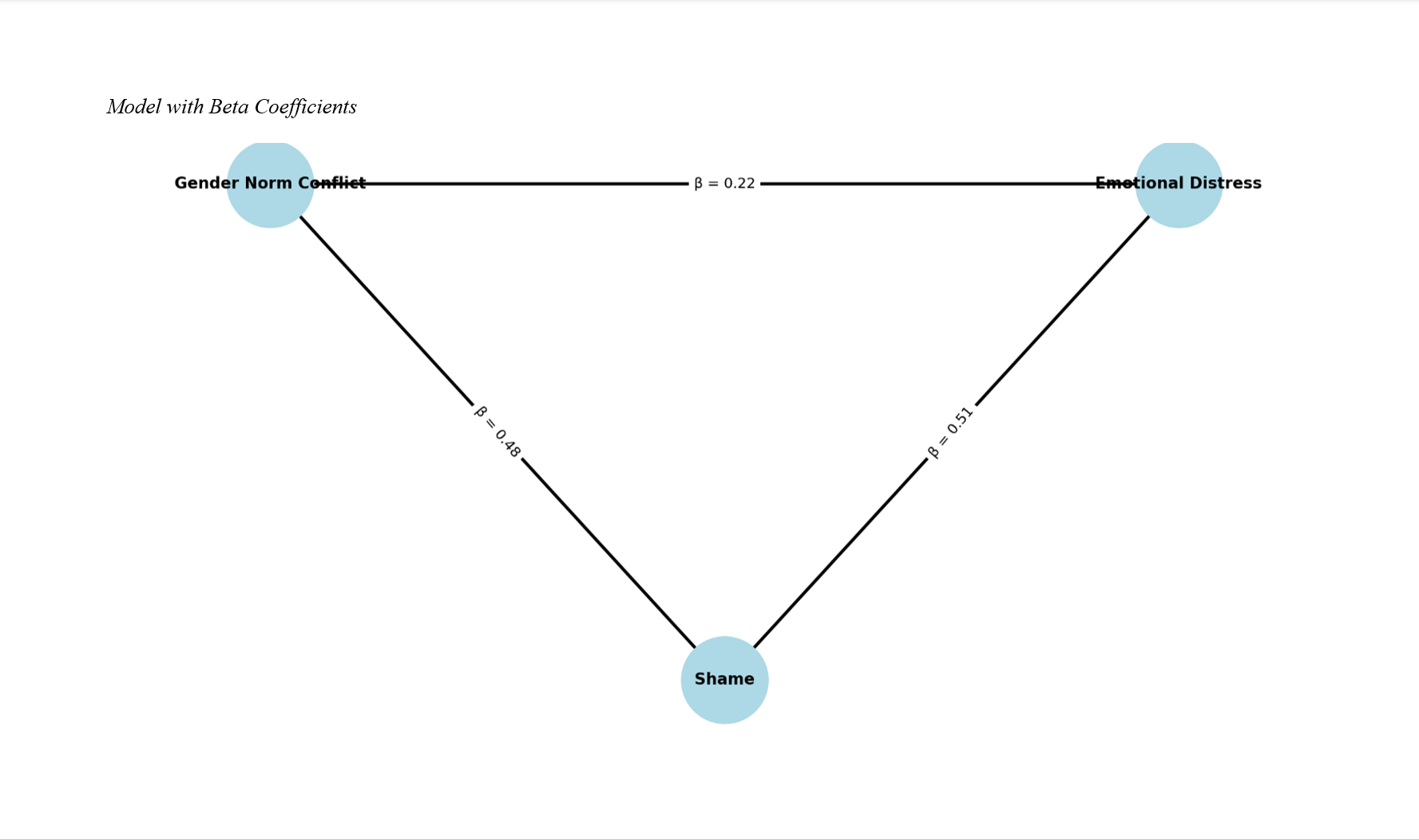
Findings: Pearson correlation results indicated significant positive relationships between gender norm conflict and shame (r = .48, p < .001), shame and emotional distress (r = .55, p < .001), and gender norm conflict and emotional distress (r = .41, p < .001). The SEM analysis confirmed a good model fit (χ²/df = 2.53, CFI = .96, RMSEA = .054, TLI = .95). Gender norm conflict significantly predicted shame (β = .48, p < .001), and shame significantly predicted emotional distress (β = .51, p < .001). The direct effect of gender norm conflict on emotional distress was significant (β = .22, p = .004), and the indirect effect through shame was also significant (β = .24, p < .001), indicating partial mediation.
Conclusion: The findings highlight shame as a significant emotional mechanism that partially mediates the effect of gender norm conflict on emotional distress in Muslim women. Addressing internalized shame may be critical for improving psychological well-being in populations experiencing tension with traditional gender roles.
Downloads
References
Amini, E. (2023). ‘A Good Mother Is a Good Mother and a Good Wife’: Gender Politics and Mothering Practice Among Older Iranian Muslim Women. 41-60. https://doi.org/10.1332/policypress/9781447365624.003.0003
Britton, J. (2024). Gender Relations and Diverse Relationship Practices. 77-96. https://doi.org/10.1332/policypress/9781529221718.003.0006
Fagen, J. L. (2024). In Their Own Words: Muslim Women Reconstruct the Sexual Script. Sexes, 5(4), 638-651. https://doi.org/10.3390/sexes5040041
Griffin, L., Hosking, W., Gill, P., Shearson, K. M., Ivey, G., & Sharples, J. (2022). The Gender Paradox: Understanding the Role of Masculinity in Suicidal Ideation. American Journal of Men S Health, 16(5). https://doi.org/10.1177/15579883221123853
Guvensel, K., Dixon, A., Chang, C., & Dew, B. (2017). The Relationship Among Gender Role Conflict, Normative Male Alexithymia, Men’s Friendship Discords With Other Men, and Psychological Well-Being. The Journal of Men’s Studies, 26(1), 56-76. https://doi.org/10.1177/1060826517719543
Iktilat, K., Isacson, M., Tzemah-Shahar, R., & Agmon, M. (2024). The Link Between Exposure to Violence and Psychological Distress Among Middle-Aged Muslims in Israel: The Role of Gender. Frontiers in Public Health, 12. https://doi.org/10.3389/fpubh.2024.1382053
Karimi Ah, A. A., & Abbasi, G. (2023). The Effectiveness of "Compassion-Focused Therapy" on Guilt and Shame in Women with Eating Disorders. Journal of Health Promotion Management, 13(1), 14-24.
Khan, M. W., & Ebrahim, S. (2024). The Marital Sexual Experiences of South African Muslim Wives of Indian Descent: Interpretative Phenomenological Analysis. Journal for the Study of Religion, 37(1), 1-24. https://doi.org/10.17159/2413-3027/2024/v37n1a5
Lata, L. N., Walters, P., & Roitman, S. (2020). The Politics of Gendered Space: Social Norms and Purdah Affecting Female Informal Work in Dhaka, Bangladesh. Gender Work and Organization, 28(1), 318-336. https://doi.org/10.1111/gwao.12562
Lee, S., & Kim, S. H. (2023). The Influence of Insecure Adult Attachment on Depression: The Mediating Effect of Internalized Shame and Mentalization. Korean Association for Learner-Centered Curriculum and Instruction, 23(10), 199-214. https://doi.org/10.22251/jlcci.2023.23.10.199
Lutz, N., Neufeld, S., Hook, R., Jones, P. B., Bullmore, E. T., Goodyer, I., Chamberlain, S. R., & Wilkinson, P. (2021). Why Is Non-Suicidal Self-Injury More Prevalent Among Women? Mediation and Moderation Analyses of Psychological Distress, Emotion Dysregulation, and Impulsivity. https://doi.org/10.1101/2021.06.01.21258154
Marici, M., Clipa, O., Runcan, R., & Pîrghie, L. (2023). Is Rejection, Parental Abandonment or Neglect a Trigger for Higher Perceived Shame and Guilt in Adolescents? Healthcare, 11, 1724. https://doi.org/10.3390/healthcare11121724
Marmet, S., Bötschi, S., Vetsch, N., Stallmann, L., & Brodbeck, J. (2024). Associations of Exposure Frequencies of Single Adverse Childhood Experiences With Psychological Distress: Evidence From a Cohort Study Among Emerging Adults. https://doi.org/10.31234/osf.io/hq2vy
Mohamed, M. (2023). Queer Muslim Piety: The Hijab Practices of LGBTQ Muslims in Boston. Journal of Feminist Studies in Religion, 39(2), 5-20. https://doi.org/10.2979/jfs.2023.a908292
Mommersteeg, P. M., Irene, G. M. v. V., Lodder, P., Juster, R. P., & Kupper, N. (2023). Gender Roles and Gender Norms Associated With Psychological Distress in Women and Men Among the Dutch General Population. Journal of Health Psychology, 29(8), 797-810. https://doi.org/10.1177/13591053231207294
Motiejūnė, G. S. (2024). Psychological Dynamics and Coping Mechanisms of Women Involved in Islamic Polygamous Marriages. Life International Journal of Health and Life-Sciences, 9, 34-50. https://doi.org/10.20319/lijhls.2024.9.3450
Pangngay, J. J. (2024). The Relationship Between Resilience, Wellbeing, and Psychological Distress as Mediated by Mindfulness and Coping. Philippine Social Science Journal, 6(3), 36-45. https://doi.org/10.52006/main.v6i3.754
Paracha, K., & Khalid, A. (2023). Inclusiveness of Women's Empowerment in Muslim Societies. Islamic Studies, 62(2), 275-288. https://doi.org/10.52541/isiri.v62i2.2362
Safdar, M., & Yasmin, M. (2023). Love and Marriage: Reimagining Muslim Female Subjectivity in Kamila Shamsie’s Salt and Saffron. Cultural Dynamics, 35(3), 201-217. https://doi.org/10.1177/09213740231183426
Sherwood, M. J., Steele, H., & Kathuria, C. (2023). Boys Do Cry: Influences of Masculinity &Amp;amp; Avoidant-Attachment Style on Post-Romantic Breakup Emotional Distress. https://doi.org/10.21203/rs.3.rs-2658238/v1
Stallone, J. (2024). “I Would Have Given Them a Piece of My Mind”: Spatialized Feelings and Emotion Work Among Racialized Muslim Women in Québec. Gender & Society, 38(6), 935-964. https://doi.org/10.1177/08912432241293445
Tolba, H. (2022). Gendering Death: A Study of Oppressive Stereotypes Underlying Muslim Funeral and Burial Rituals in Egypt. Rowaq Arabi - رواق عربي, 27(2). https://doi.org/10.53833/fltw8628
Ummiroh, I. R., Schwab, A., & Dhewanto, W. (2022). Women Social Entrepreneurs in a Muslim Society: How to Manage Patriarchy and Spouses. Social Enterprise Journal, 18(4), 660-690. https://doi.org/10.1108/sej-11-2021-0092
Downloads
Additional Files
Publication Timeline
- Submitted
- Revised
- Accepted
Issue
Section
License

This work is licensed under a Creative Commons Attribution-NonCommercial 4.0 International License.