Examining the Relationship between Actual Self and Ideal Self in Predicting the Tendency Toward Cosmetic Surgery in Young Women with Histrionic Personality Disorder
DOI:
https://doi.org/10.61838/kman.pwj.6.2.11Keywords:
Actual self, Ideal self, Histrionic personality, Cosmetic surgeryAbstract
Objective: This study aimed to investigate the relationship between actual self and ideal self in predicting the tendency toward cosmetic surgery among young women with histrionic personality disorder.
Methods and Materials: This descriptive-correlational study was conducted on a sample of 100 young women aged 18 to 30 years residing in Babol, Iran, in 2024. Participants were selected using convenience sampling from those who had applied for or were on a waiting list for cosmetic surgery through public advertisements or psychological counseling centers. Data collection instruments included the Cosmetic Surgery Tendency Questionnaire (Soheili, 2017), the Ideal Self and Actual Self Assessment Questionnaire (Soodmand, 2004), and the MMPI for diagnosing histrionic personality disorder. Data were analyzed using SPSS-26 with Pearson correlation, multiple regression analysis, independent samples t-test, and structural equation modeling. Ethical standards such as informed consent, confidentiality, and voluntary participation were strictly observed.
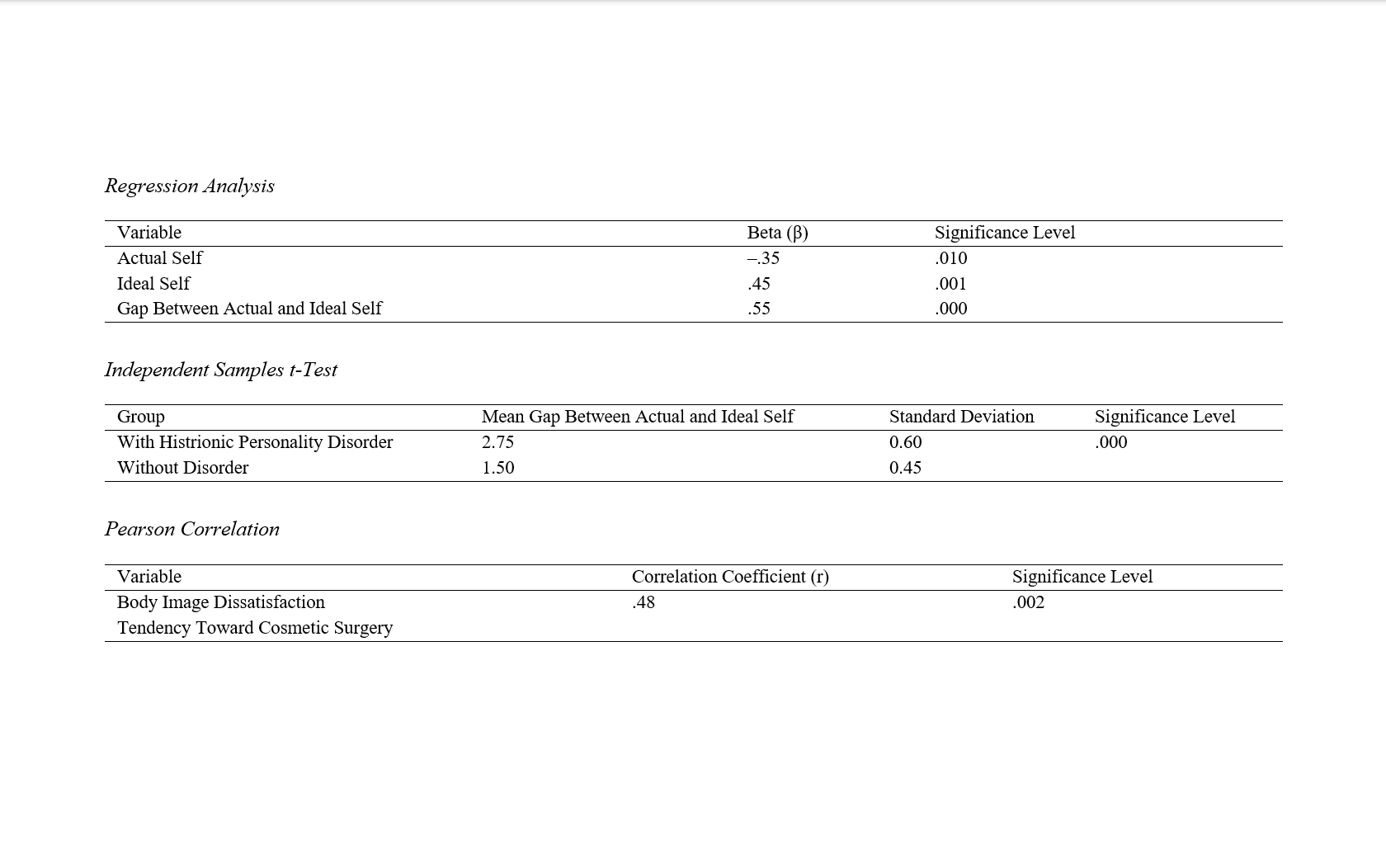
Findings: The results of Pearson correlation analysis indicated a moderate to strong positive relationship between the gap in actual and ideal self and the tendency toward cosmetic surgery (r = .55, p < .001), and a significant positive relationship between body image dissatisfaction and cosmetic surgery tendency (r = .48, p = .002). Multiple regression analysis showed that the gap between actual and ideal self (β = .55, p < .001), actual self (β = –.35, p = .01), and ideal self (β = .45, p = .001) significantly predicted the tendency toward cosmetic surgery. An independent t-test revealed that women with histrionic personality disorder had a significantly larger self-discrepancy (M = 2.75, SD = 0.60) than non-affected women (M = 1.50, SD = 0.45; p < .001).
Conclusion: The findings suggest that self-discrepancy and body image dissatisfaction are significant psychological predictors of cosmetic surgery tendency among young women with histrionic personality disorder. These results highlight the need for targeted psychological interventions to enhance self-acceptance and reduce reliance on aesthetic modification as a means of emotional or social compensation.
Downloads
References
Aquil, A., Mouallif, M., Guerroumi, M., Chokri, A., Jayakumar, A. R., Benider, A., & Elgot, A. (2021). Body Image Dissatisfaction and Lower Self-Esteem as Major Predictors of Poor Sleep Quality in Gynecological Cancer Patients After Surgery: Cross-Sectional Study. BMC Women S Health, 21(1). https://doi.org/10.1186/s12905-021-01375-5
Asimakopoulos, E., Zavrides, H., & Askitis, T. (2019). The impact of aesthetic plastic surgery on body image, body satisfaction and self-esteem. Acta Chirurgiae Plasticae, 61(1‐4), 3-9. https://pubmed.ncbi.nlm.nih.gov/32380836/
Bijan, S., & Behzadipour, S. (2022). One-year Follow-up of Body Image Changes and Sexual Satisfaction in Women Undergoing Cosmetic Breast Surgery. International Journal of Body, Mind and Culture, 9(1), 1-10. https://doi.org/10.22122/ijbmc.v9i1.363
Esmalian Khamseh, L., & Nodargahfard, M. (2020). The Effect of Cosmetic Surgery on Sexual Self-Esteem: Attitudes toward Body Image and Well-Being in Married Women [Original Article]. World Journal of Plastic Surgery, 9(2), 153-159. https://doi.org/10.29252/wjps.9.2.153
GhaeniHesarouiyeh, A., Moosavi, E., Mirzaei, R., & Setoodezadeh, S. (2016). The relationship between body dysmorphic disorder and symptoms of depression, obsessive-compulsive disorder, and social phobia in cosmetic surgery patients in Tehran. Sadra Medical Journal, 4(2), 137-148. https://smsj.sums.ac.ir/article_44088_en.html
Heidarzadeh, A., Shahmohammadipour, P., Azzizadeh Forouzi, M., Dehghan, M., & Khorasani, Z. (2019). Body image, self-esteem, and psychological problems among applicants and non-applicants of cosmetic surgery. Practice in Clinical Psychology, 7(1), 33-42. https://doi.org/10.32598/jpcp.7.1.33
Hoskin, R., Reynolds, K., & Ford, T. (2022). Personality disorders and their influence on cosmetic surgery desires: A review. Psychological Reports, 125(4), 892-905.
Khabaz Thabet, S., Keykhosrowani, M., Pouladi Rishahri, A., & Bahrani, M. R. (2022). The Relationship Between the Tendency Toward Cosmetic Surgery and Attitudes Toward Fashion and Negative Body Image in Women Seeking Cosmetic Surgery, with Emphasis on the Type of Surgery: The Mediating Role of Cognitive Emotion Regulation. Social Psychology Research, 12(46), 37-60. https://www.socialpsychology.ir/article_156046.html
Luo, Y., Zhao, Y., & Sun, S. (2021). The relationship between personality traits and cosmetic surgery intention: The mediating role of self-discrepancy. Journal of Cosmetic Dermatology, 20(2), 345-356.
Meshkouri, M., Bagherzadeh Golmakani, Z., Mansouri, A., & Khodabakhsh, M. R. (2024). Effectiveness of Schema Therapy on Perfectionism, Body Shame, and Symptoms of Body Dysmorphic Disorder in Women Seeking Cosmetic Surgery. Journal of Psychological Sciences, 23(143), 197-216. https://ensani.ir/fa/article/597315/
Mironica, A., Popescu, C. A., George, D., Tegzeșiu, A. M., & Gherman, C. (2024). Social Media Influence on Body Image and Cosmetic Surgery Considerations: A Systematic Review. Cureus. https://doi.org/10.7759/cureus.65626
Mohammadi, N., Sadeghi, H., & Rostami, P. (2021). The Role of Body Image and Emotional Regulation in Predicting the Willingness to Undergo Cosmetic Surgery. Journal of Psychological Research.
Phillips, K., & Hollander, E. (2021). Body dysmorphic disorder and cosmetic procedures: An overview. Aesthetic Surgery Journal, 41(3), 287-295.
Rashidi, S., Gholami, M., & Ranjbaripour, T. (2022). Prediction of the Tendency Toward Cosmetic Surgery Based on Histrionic Personality Disorder Traits and Cognitive Emotion Regulation in University-Educated Women. Quarterly Journal of New Ideas in Psychology, 12(16), 1-13. http://jnip.ir/article-1-694-fa.html
Ribeiro, R. V. E. (2017). Prevalence of Body Dysmorphic Disorder in Plastic Surgery and Dermatology Patients: A Systematic Review with Meta-Analysis. Aesthetic Plastic Surgery, 41(4), 964-970. https://doi.org/10.1007/s00266-017-0869-0
Wang, Y., Qiao, X., Yang, J., Geng, J., & Fu, L. (2023). “I wanna look like the person in that picture”: Linking selfies on social media to cosmetic surgery consideration based on the tripartite influence model. Scandinavian journal of psychology, 64(2), 252-261. https://doi.org/10.1111/sjop.12882
Yap, K., Sang, C., & Yu, R. (2021). Social media exposure and body dissatisfaction: The mediating role of self-image. Cyberpsychology, Behavior, and Social Networking, 24(5), 295-301.
Downloads
Additional Files
Publication Timeline
- Submitted
- Revised
- Accepted
Issue
Section
License
Copyright (c) 2025 Maedeh Asgharpour Miri (Author); Soheil Moazami Goudarzi (Corresponding Author)

This work is licensed under a Creative Commons Attribution-NonCommercial 4.0 International License.