Comparison of the Effectiveness of Cognitive Therapy and Schema Therapy in Weight Reduction among Women with Bulimia Nervosa
Keywords:
Cognitive Therapy, Schema Therapy, Weight Reduction, Bulimia Nervosa, WomenAbstract
Objective: This study aimed to compare the effectiveness of cognitive therapy and schema therapy in reducing weight among women with bulimia nervosa.
Methods and Materials: This experimental study employed a pretest–posttest design with a nonequivalent control group and follow-up assessment. The statistical population consisted of overweight women with bulimia nervosa who attended nutritional counseling and psychological centers in District 13 of Tehran during 2022–2024. Using convenience sampling and based on body mass index (BMI) and diagnostic criteria for bulimia nervosa, 51 eligible participants were selected according to Cochran’s formula. Participants were randomly assigned to two experimental groups and one control group. Weight was assessed at baseline as the pretest measure. Experimental Group A received cognitive therapy, whereas Experimental Group B received schema therapy; the control group was placed on a waiting list and received no intervention during the study period. Following completion of the interventions, posttest and follow-up assessments were conducted. Data were analyzed using repeated-measures analysis of variance and Bonferroni post hoc tests in SPSS version 22.
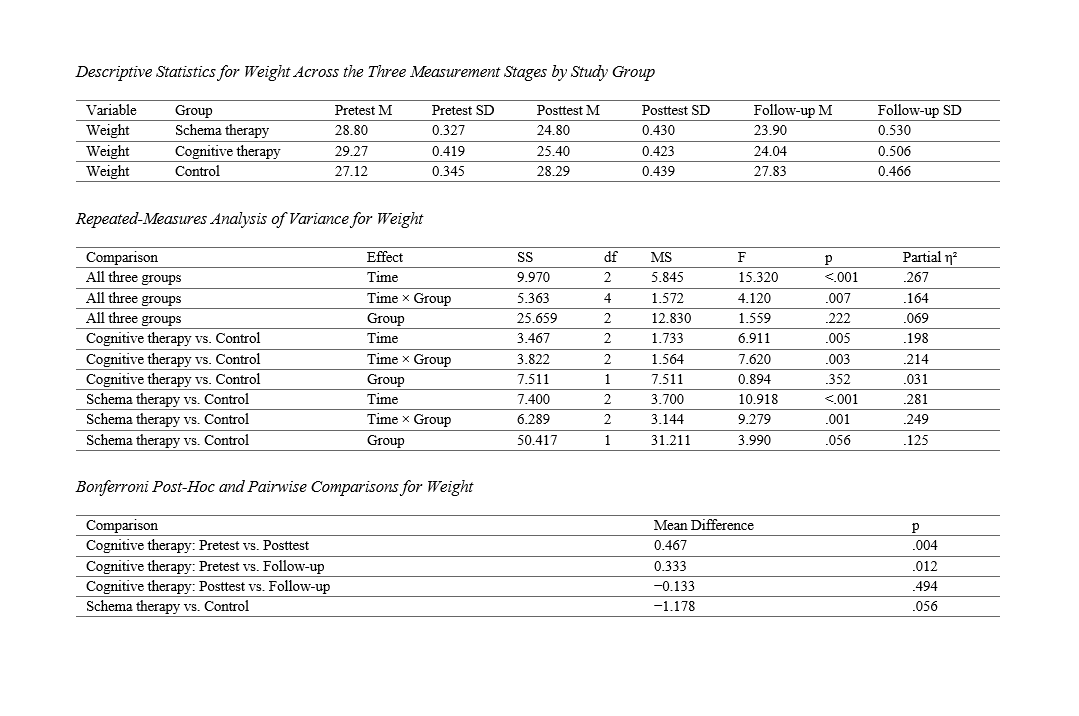
Findings: Repeated-measures analysis of variance demonstrated that both cognitive therapy and schema therapy produced statistically significant reductions in weight among women with bulimia nervosa compared with the control condition. The significant therapeutic effects were maintained at the follow-up assessment, indicating persistence of the treatment gains over time. However, the between-group comparison of the two active interventions revealed no statistically significant difference between cognitive therapy and schema therapy in their effectiveness for weight reduction. Thus, although both interventions were significantly more effective than the control condition, neither therapeutic approach demonstrated statistical superiority over the other.
Conclusion: Cognitive therapy and schema therapy appear to be effective psychological interventions for supporting weight reduction among overweight women with bulimia nervosa, with treatment effects remaining evident during follow-up. The absence of a significant difference between the two interventions suggests that both approaches may represent viable therapeutic options.
Downloads
References
Almasi, K. (2022). Comparison of self-compassion, emotion regulation difficulties, and mindfulness in overweight women with bulimia nervosa and normal overweight women Payame Noor University, Nowshahr Branch].
Bagheri Sheikhangafsheh, F., Rezazadeh Khalghali, F., Savabi Niri, V., Zolfagharnia, M., & Mikelani, N. (2024). Efficacy of schema therapy on rumination, depression, and personality functioning in women with bulimia nervosa. Journal of Applied Psychological Research, 15(3). https://japr.ut.ac.ir/article_95628.html?lang=en
Bani Fatemeh, H., Moeinian, N., Alizadeh Aghdam, M. B., & Abbaszadeh, M. (2020). Examining the Relationship of Self-Concept, Self-Esteem, and Demographic Factors with the Weight-Control Dimension of Body Management in Light of Approaches Based on Teaching Consumer Culture Patterns: A Study of Female Students at Islamic Azad University, Tabriz Branch. Education and Evaluation, 13(51), 133-161.
Cooper, Z., Calugi, S., & Grave, R. (2020). Controlling Binge Eating and Weight: A Treatment for Binge Eating Disorder Worth Researching? Eating and Weight Disorders, 25(4), 1105-1109. https://doi.org/10.1007/s40519-019-00734-4
Fang, A., Steketee, G., Keshaviah, A., Didie, E., Phillips, K. A., & Wilhelm, S. (2020). Mechanisms of Change in Cognitive Behavioral Therapy for Body Dysmorphic Disorder. Cognitive therapy and research, 44(3), 596-610. https://doi.org/10.1007/s10608-020-10080-w
Ghaffari, A., & Ozabli, F. (2021). Comparison of Physical Self-Concept, Sexual Intimacy, and Quality of Life in Menopausal and Non-Menopausal Women. Journal of New Achievements in Humanities Studies, 4(36).
Ghorbannejad, H., Alizadeh, M., Didarloo, A., & Bakhshi Moghadam, F. (2020). The Association Between Eating Habits and Overweight and Obesity Among Adolescent Female Students Aged 12 to 15 Years in Urmia. Scientific-Research Journal of Sabzevar University of Medical Sciences, 27(2), 121-130.
Huckstepp, T. J., Allen, A., Maher, A. L., Houlihan, C., & Mason, J. (2023). Factor Structure of the Young Positive Schema Questionnaire in an Eating Disorder Sample. Eating and Weight Disorders: Studies on Anorexia, Bulimia and Obesity, 28(1), 13. https://doi.org/10.1007/s40519-023-01549-0
Irani, S., Akbari, B., Abolghasemi, A., & Bakhshipour Roudsari, A. (2021). Comparison of the Effectiveness of Schema Therapy and Behavioral Model-Based Diet Therapy on Emotional Adjustment, Body Image, and Weight Loss Among Obese Individuals with Nervous Overweight. Avicenna Journal of Neuro Psycho Physiology, 8(1), 45-51.
Katan, A., & Kelly, A. C. (2023). A Daily Diary Study of Self-Compassion and Adaptive Coping Behaviours in Women With Symptoms of Bulimia Nervosa. Journal of eating disorders, 11(1). https://doi.org/10.1186/s40337-023-00755-6
Khamarniya, G., Zarei, S., Farahabadi, M., Amirsasan, Y., Mirmasoumi, M. S., & Arkani, E. (2024). The effectiveness of schema therapy on self-worth and cognitive flexibility in women with bulimia nervosa. Rehabilitation Research in Nursing, 11(2), 88-98. https://ijrn.ir/article-1-883-en.pdf
Maher, A., Cason, L., Huckstepp, T., Stallman, H., Kannis-Dymand, L., Millear, P., Mason, J., Wood, A., & Allen, A. (2022). Early maladaptive schemas in eating disorders: A systematic review. European Eating Disorders Review, 30(1), 3-22. https://doi.org/10.1002/erv.2866
Mohammadian Amiri, A., Hassanzadeh, R., & Heydari, S. (2024). Comparison of the Effectiveness of Schema Therapy and Life Therapy on Emotion Regulation and Attitudes Towards Eating in Women with Obesity. Health Nexus, 2(2), 68-76. https://doi.org/10.61838/kman.hn.2.2.8
Najjar Kakhaki, I., Kalhornia Galkar, M., Nejad Mohammad Nameghi, A., Mohammadi Shirmahalheh, F., & Valizadeh, M. (2024). Comparing the effectiveness of acceptance and commitment therapy and schema therapy on avoidance coping style and body mass index in obese individuals with emotional eating. Journal of Applied Psychological Research, 15(2). https://japr.ut.ac.ir/article_95258.html?lang=en
Narimani, M., & Nemati, S. M. (2021). Examining the Effect of Schema Therapy on Bulimia Nervosa and Stress in Women with Obesity Second National Conference on Psychopathology,
Norrlin, L., & Baumann, O. (2025). The neural correlates of body image processing in anorexia nervosa and bulimia nervosa: An activation likelihood estimation meta-analysis of fMRI studies. International journal of environmental research and public health, 22(1), 55. https://doi.org/10.3390/ijerph22010055
Pakandish, S., Kraskian, A., & Jomhari, F. (2020). Comparison of the Effectiveness of Schema Therapy and Cognitive-Behavioral Therapy on Quality of Life and Body Image in Women with Obesity. Quarterly Journal of Counseling and Psychotherapy Excellence, 9, 20-32.
Rahmani, F., Sedighi Arfaei, F., & Rahmani, M. (2021). Group Schema Therapy on Academic Engagement and Body Dysmorphic Symptoms in Students. Research in School and Virtual Learning, 9(2), 61-74.
Rakhshan Haghighifard, M., & Azad Yekta, M. (2026). The Relationship Between Negative Perfectionism and Bulimia Nervosa in Employed Women: The Mediating Role of Rumination. Scientific Journal of Health Psychology and Behavioral Disorders, 4(1), 1-12. https://doi.org/10.61838/jhpbd.5927
Sartipi, M., Kordestani, D., Goudarzi, K., & Razbehani, M. (2021). Comparison of the Effectiveness of Group Cognitive-Behavioral Therapy and Mindfulness-Based Stress Reduction on Body Image, Anxiety, and Binge Eating in Women with Obesity. Journal of Disability Studies(69), 65-78.
Van Huyssteen, S. (2025). Motivation to Recover from Bulimia Nervosa: An Application of the Theory of Planned Behaviour University of East London].
Vatankhah, S., Bakhshipour Roodsari, A., Hashemi Nosratabad, T., & Shalchi, B. (2025). The Effectiveness of Emotion-Focused Therapy (EFT) on Body Image Dissatisfaction, Cognitive Emotion Regulation and Impulsivity in Women with Bulimia Nervosa: A Single Case Study. Journal of Clinical Psychology, 17(65). https://jcp.semnan.ac.ir
Young, J., Klosko, J., & Weishaar, M. (2019). Schema Therapy: A Practitioner's Guide. Arjmand.
Yousefi, A., Taher, M., Aghaei, H., & Bagherinia, H. (2021). Comparison of the Effectiveness of Interpersonal Psychotherapy and Cognitive-Behavioral Therapy on Body Image in Women Referring to Cosmetic Surgery Centers. Journal of Sabzevar University of Medical Sciences, 17, 57-69.
Zarb, M. J. (2019). Assessment and Cognitive-Behavioral Therapy for Adolescents. Roshd.
Downloads
Additional Files
Publication Timeline
- Submitted
- Revised
- Accepted