Effectiveness of a Lived-Experience-Based Educational Program on Distress Tolerance in Mothers of Children with Leukemia
Keywords:
lived-experience-based educational program, distress tolerance, mothers, childhood leukemia, psychological interventionAbstract
Objective: This study aimed to determine the effectiveness of a lived-experience-based educational program in improving distress tolerance among mothers of children diagnosed with leukemia.
Methods and Materials: This quasi-experimental study employed a pretest–posttest design with a three-month follow-up and a control group. The statistical population consisted of mothers of children with leukemia who attended the Children’s Medical Center Hospital in Tehran during the first half of 2025. Forty eligible mothers were selected through convenience sampling and randomly assigned to an experimental group or a control group, with 20 participants in each group. Data were collected using the Distress Tolerance Scale developed by Simons and Gaher. The experimental group participated in an 11-session lived-experience-based educational program developed according to Behfar’s 2026 protocol. The intervention content was formulated from themes identified through a phenomenological investigation of the lived experiences of mothers caring for children with leukemia. The control group received no intervention during the study period. Data were analyzed using repeated-measures analysis of variance and Bonferroni post hoc comparisons.
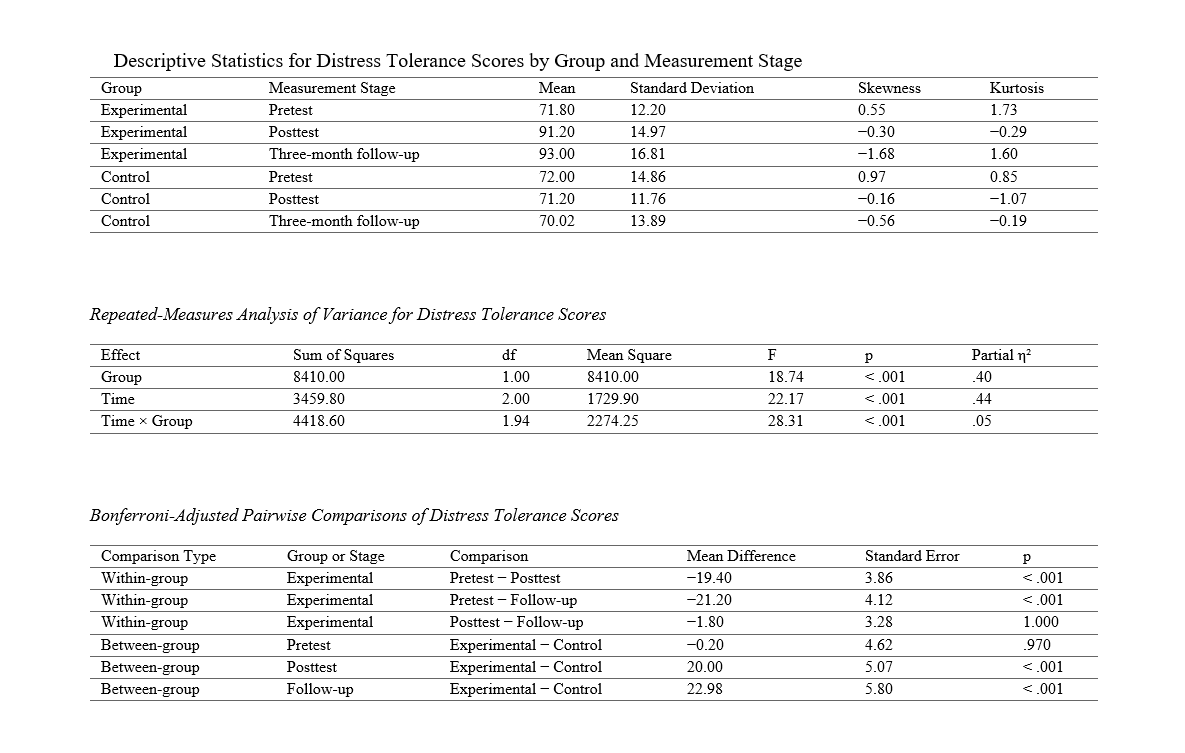
Findings: The results demonstrated significant main effects of time and group on distress tolerance scores. A statistically significant interaction effect between time and group was also observed, indicating that changes in distress tolerance across the assessment stages differed significantly between the experimental and control groups (p < .001). Bonferroni post hoc comparisons showed that distress tolerance significantly improved from pretest to posttest and from pretest to the three-month follow-up in the experimental group. However, the difference between posttest and follow-up scores was not statistically significant, confirming that the intervention effects were maintained over the follow-up period. No significant changes were observed in the control group.
Conclusion: The lived-experience-based educational program was effective in enhancing and maintaining distress tolerance among mothers of children with leukemia. This culturally responsive and needs-based intervention may therefore be used as a practical psychological support program in pediatric oncology settings.
Downloads
References
Akafian, Y., Ateshpour, S. H., & Farhadi, H. (2024). Comparing the effectiveness of solution-focused therapy and narrative therapy on distress tolerance in mothers with a child with celiac disease. Behavioral Sciences Research, 22(4), 725-734.
Al Omari, O., Roach, E. J., Shakman, L., Al Hashmi, A., Sunderraj, S. J., Francis, F., & Joseph, M. A. (2023). The lived experiences of mothers who are parenting children with leukemia. Oman Medical Journal, 38(2), e483.
Barani, M., Hasani, L., Ghanbarnejad, A., & Molavi, M. A. (2019). The relationship between self-efficacy and caring behavior in mothers with a child with cancer. Preventive Medicine, 6(1), 26-35. https://sid.ir/paper/261561/fa
Behfar, Z. (2026). Lived experience of mothers with a child with leukemia: Designing and validating an educational protocol to increase distress tolerance and empathy quotient Islamic Azad University, Science and Research Branch, Tehran]. Tehran.
Famili Khalili, F., & Salehi, S. (2021). The effect of implementing Orem's self-care model on health-promoting behaviors in mothers with a child with leukemia referred to the pediatric ward of Seyed Al-Shohada Hospital in Isfahan in 2021. Avicenna Journal of Nursing and Midwifery Care, 30(1), 72-80. https://sid.ir/paper/1009203/fa
Firoozi, M. (2020). Distress tolerance in mothers of children with cancer for predicting her parenting style and child's attachment behaviors: A cross sectional study. International Journal of Cancer Management, 13(3), e88905. https://doi.org/10.5812/ijcm.88905
Ghanbari, N., Mohammadi, E., Khoobi, M., & Shakman, L. (2025). Immersed in fear and doubt: Mothers' experiences of caring transition for children with cancer: A qualitative study. Journal of clinical nursing. https://doi.org/10.1111/jocn.70174
Giahi, Z., Sadoughi, M., & Tamannai-Far, M. (2024). The effectiveness of self-compassion training on cognitive emotion regulation and distress tolerance in mothers with a child with intellectual disability. Child Mental Health, 11(3), 52-67.
Golestan Kalateh, S. N., Rajaei, A., Farhangi, H., & Bayazi, M. H. (2024). The effectiveness of acceptance and commitment therapy on identity crisis and distress tolerance in mothers of children with cancer. Journal of education and health promotion, 13, 190. https://doi.org/10.4103/jehp.jehp_371_23
Jafarzadeh, N., & Khaleghipour, S. (2025). The effectiveness of a crisis intervention model enriched with acceptance and commitment therapy on distress tolerance, resilience, and death anxiety in mothers of children with cancer. Journal of Education and Health in Childhood, 6(3), 388-405. https://doi.org/10.32598/JECHE.6.3.348.1
Jones, B. L., Contro, N., & Koch, K. D. (2014). Pediatric palliative care: A review of the literature and implications for social work practice. Social Work in Health Care, 53(5), 459-474. https://doi.org/10.1080/00981389.2014.896848
Kazak, A. E., Alderfer, M., Enlow, P. T., Lewis, A. M., Vega, G., Barakat, L., Hocking, M. C., Rourke, M. T., Pai, A., Canter, K. S., & Wiener, L. (2021). Psychosocial care for children with cancer and their families: A clinical practice guideline. Journal of Clinical Oncology, 39(18), 2133-2145. https://doi.org/10.1200/JCO.20.03306
Kazak, A. E., Schneider, S., & Didonato, S. (2015). Family psychosocial risk screening guided and evidence-based intervention in pediatric oncology. Cancer, 121(12), 2062-2070. https://doi.org/10.1002/cncr.29269
Mohajeri Tehrani, M., Hasani, J., & Akbari, M. (2024). Conceptualizing emotion regulation strategies in mothers with a child with cancer. Journal of Mashhad University of Medical Sciences Faculty of Medicine, 67(5), 1416-1432.
Paulus, D. J., Gallagher, M. W., & Zvolensky, M. J. (2019). Distress tolerance and anxiety sensitivity in relation to social anxiety and depression. Cognitive therapy and research, 43(4), 731-741. https://doi.org/10.1007/s10608-019-10005-0
Rashid, T., & Seligman, M. E. P. (2018). Positive Psychotherapy: Clinical Manual. Oxford University Press.
Rosenberg, A. R., Dussel, V., Kang, T., Geyer, J. R., Gerhardt, C. A., Feudtner, C., & Wolfe, J. (2014). Psychological distress in parents of children with advanced cancer. JAMA Pediatrics, 168(6), 537-543. https://doi.org/10.1001/jamapediatrics.2013.4566
Rosenberg, A. R., Orellana, L., Kang, T., Geyer, J. R., & Feudtner, C. (2020). The impact of parental hope on communication in pediatric advanced cancer. Cancer, 126(3), 645-653. https://doi.org/10.1002/cncr.32580
Sahler, O. J. Z., Dolgin, M. J., Phipps, S., Fairclough, D. L., Askins, M. A., Katz, E. R., Noll, R. B., & Butler, R. W. (2013). Specificity of problem-solving skills training in mothers of children newly diagnosed with cancer: Results of a multisite randomized clinical trial. Journal of Clinical Oncology, 31(10), 1329-1335. https://doi.org/10.1200/JCO.2011.39.1870
Shahsavari, Y., Hosseini, S. H., Sayadi, A. R., & Sadeghi, T. (2022). The effect of empowerment based on the Gibson model on self-efficacy and quality of life in mothers with a child with thalassemia. Hayat, 28(1), 28-42. https://sid.ir/paper/999960/fa
Shamli, R., & Hasani, F. (2017). The effectiveness of reality therapy on resilience in mothers with a child with cancer. Thought and Behavior in Clinical Psychology, 11(43), 77-86. https://sid.ir/paper/172206/fa
Shaygani, F., Jalali, K., Javanmardi Fard, H., Afrasiabi, Z., & Ahmadi Marzaleh, M. (2024). Exploring the lived experience of mothers of children with leukemia: A qualitative study from Iran. BMC Women's Health, 24, 457. https://doi.org/10.1186/s12905-024-03300-y
Siegel, R. L., Giaquinto, A. N., & Jemal, A. (2024). Cancer statistics, 2024. CA: A Cancer Journal for Clinicians, 74(1), 12-49. https://doi.org/10.3322/caac.21820
Sung, H., Ferlay, J., Siegel, R. L., Laversanne, M., Soerjomataram, I., Jemal, A., & Bray, F. (2021). Global cancer statistics 2020: GLOBOCAN estimates of incidence and mortality worldwide for 36 cancers in 185 countries. CA: A Cancer Journal for Clinicians, 71(3), 209-249. https://doi.org/10.3322/caac.21660
Wiener, L., Viola, A., Kearney, J. A., Mullins, L. L., Sherman-Bien, S., Zadeh, S., Farkas Patenaude, A., & Pao, M. (2020). Impact of a web-based educational program on distress in parents of children with cancer. Journal of Pediatric Psychology, 45(6), 625-636. https://doi.org/10.1093/jpepsy/jsaa022
Downloads
Additional Files
Publication Timeline
- Submitted
- Revised
- Accepted