
Predicting Social Anxiety Based on Quality of Life, Loneliness, and Distress Tolerance in Female Students
Keywords:
Social Anxiety, Quality of Life, Loneliness, Distress Tolerance, Female StudentsAbstract
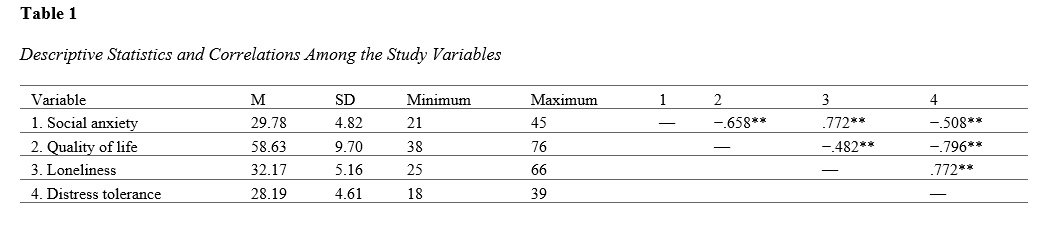
The present study aimed to predict social anxiety based on quality of life, loneliness, and distress tolerance among female students of Islamic Azad University, Science and Research Branch, Tehran. This study was fundamental in purpose and descriptive-correlational in design. The statistical population consisted of all female students enrolled at Islamic Azad University, Science and Research Branch, Tehran, during the 2025–2026 academic year, totaling approximately 28,000 students. Using convenience sampling, 130 female students were selected. Data were collected using the Social Anxiety Scale for Adolescents developed by La Greca and Lopez, the World Health Organization Quality of Life Questionnaire, the UCLA Loneliness Scale, and the Distress Tolerance Scale developed by Simons and Gaher. Data analysis was performed using SPSS version 23. Descriptive statistics were used to summarize the study variables, while Pearson correlation coefficients and multiple linear regression were applied to test the research hypotheses after examining the required statistical assumptions. Social anxiety was significantly and negatively correlated with quality of life (r = −.658, p < .01) and distress tolerance (r = −.508, p < .01), while it was significantly and positively correlated with loneliness (r = .772, p < .01). The overall regression model was statistically significant, F(3, 126) = 99.135, p < .001, and quality of life, loneliness, and distress tolerance collectively explained 70.2% of the variance in social anxiety (R = .838, R² = .702, adjusted R² = .695). Quality of life significantly and negatively predicted social anxiety (β = −.365, p < .001), loneliness significantly and positively predicted social anxiety (β = .459, p < .001), and distress tolerance significantly and negatively predicted social anxiety (β = −.224, p < .001). The findings indicate that social anxiety among female university students is strongly associated with lower quality of life, greater loneliness, and lower distress tolerance, with loneliness emerging as the strongest predictor; therefore, interventions aimed at strengthening social connectedness, improving quality of life, and increasing distress tolerance may help reduce social anxiety in this population.
Downloads
Publication Timeline
- Submitted
- Revised
- Accepted