The Relationship Between Childhood Trauma and Peer Bullying Victimization in Adolescents: The Mediating Role of Parenting Styles
Keywords:
Childhood trauma, Peer bullying victimization, Parenting styles, Adolescents, Mediation, Structural equation modelingAbstract
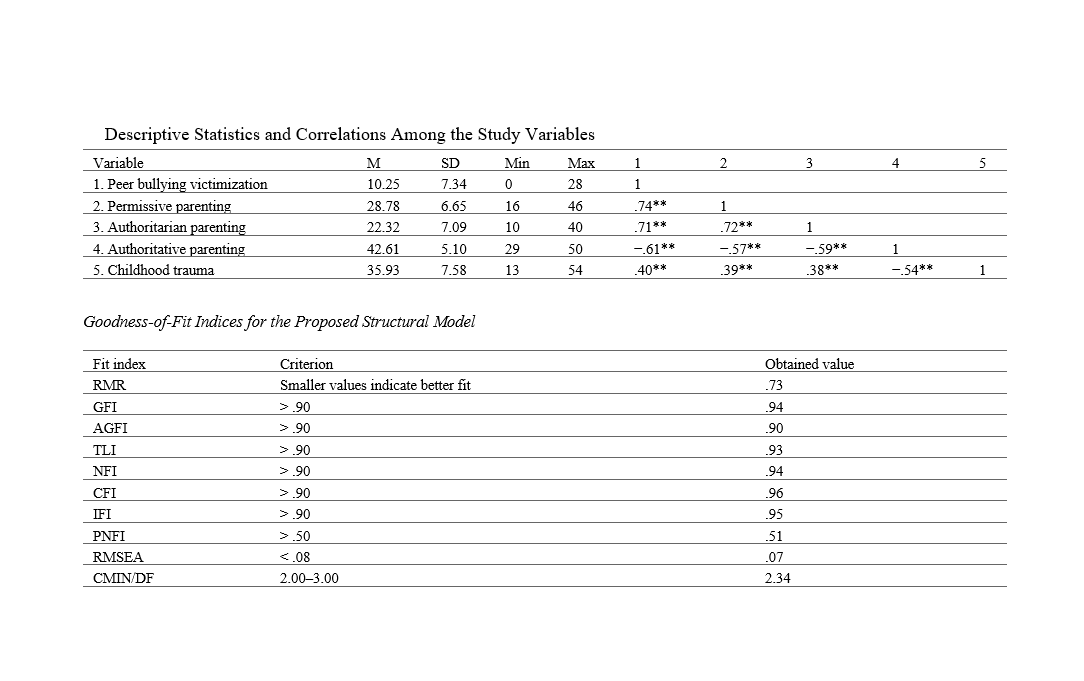
This study aimed to investigate the relationship between childhood trauma and peer bullying victimization among adolescents and to examine the mediating role of parenting styles in this relationship. This descriptive-correlational study was conducted among adolescents enrolled in upper-secondary schools in Shiraz, Iran, during the 2025–2026 academic year. Using multistage cluster sampling, 250 students were selected from educational districts 2 and 4. Data were collected using the Multidimensional Peer-Victimization Scale, the Childhood Trauma Questionnaire, and the Parenting Styles Questionnaire. Data analysis was performed using SPSS version 21 and AMOS version 26. Pearson correlation coefficients, simultaneous multiple regression, path analysis, and structural equation modeling were applied. Indirect effects were assessed using bootstrap resampling with 2,000 samples. Childhood trauma was positively correlated with peer bullying victimization (r = .40, p < .01), permissive parenting (r = .39, p < .01), and authoritarian parenting (r = .38, p < .01), and negatively correlated with authoritative parenting (r = −.54, p < .01). In the structural model, childhood trauma significantly predicted permissive parenting (β = .32, p < .001), authoritarian parenting (β = .32, p < .001), and authoritative parenting (β = −.43, p < .001). Permissive parenting (β = .47, p < .001) and authoritarian parenting (β = .33, p < .001) positively predicted peer bullying victimization, whereas authoritative parenting negatively predicted victimization (β = −.22, p < .001). The direct effect of childhood trauma on peer victimization was not significant (β = .04, p = .477), but its indirect effect through parenting styles was significant (β = .35, 99% CI [.22, .48], p < .001). The model showed acceptable fit (CMIN/DF = 2.34, RMSEA = .07, CFI = .96). Parenting styles appear to constitute an important mediating pathway linking childhood trauma to peer bullying victimization, suggesting that family-based interventions aimed at promoting authoritative parenting and reducing maladaptive parenting patterns may help decrease adolescents’ vulnerability to bullying.
Downloads
References
Abbasi, F., Abdollahzadeh Rafie, S., & Ariapouran, R. (2025). The relationship between childhood maltreatment and mothers' current parenting: The moderating role of benevolent experiences. Shenakht Journal of Psychology and Psychiatry, 12(2), 32-47. https://doi.org/10.32598/shenakht.12.2.132
Aghajani, T., & Esmaeilpour, K. (2021). Investigating the relationship between attachment styles and parenting styles with risk behaviors in adolescents. National Conference on Professional Research in Psychology and Counseling with a Teacher's Perspective,
Cerezo, F., Ruiz-Esteban, C., Lacasa, C. S., & Gonzalo, J. J. (2018). Dimensions of parenting styles, social climate, and bullying victims in primary and secondary education. Psicothema, 30(1), 59-65. https://doi.org/10.7334/psicothema2016.360
Chu, X., & Chen, Z. (2025). The associations between parenting and bullying among children and adolescents: A systematic review and meta-analysis. Journal of youth and adolescence, 54(4), 928-954. https://doi.org/10.1007/s10964-024-02108-1
Darabian Jiran Aliya, P. (2023). The role of parents' parenting styles in the shyness of elementary school students. 6th National Conference on New Technologies in Education, Psychology, and Counseling of Iran,
De Bellis, M. D., & Ab, A. Z. (2014). The biological effects of childhood trauma. Child and Adolescent Psychiatric Clinics of North America, 23(2), 185. https://doi.org/10.1016/j.chc.2014.01.002
Delvecchio, E., Germani, A., Raspa, V., Lis, A., & Mazzeschi, C. (2020). Parenting styles and child's well-being: The mediating role of the perceived parental stress. Europe's journal of psychology, 16(3), 514. https://doi.org/10.5964/ejop.v16i3.2013
Dewi, Y. A., Soeparno, K., Pertiwi, P. P., & Fuady, M. B. (2025). Multisystem resilience in disaster volunteers: A review of the literature. Jurnal Psikologi, 52(1). https://doi.org/10.22146/jpsi.101230
Durmusoglu Saltali, N., & Imir, H. M. (2018). Parenting styles as a predictor of the preschool children's social behaviours. Participatory educational research, 5(2), 18-37. https://doi.org/10.17275/per.18.10.5.2
Estévez, E., Estévez, J. F., Segura, L., & Suárez, C. (2019). The influence of bullying and cyberbullying in the psychological adjustment of victims and aggressors in adolescence. International journal of environmental research and public health, 16(12), 2080. https://doi.org/10.3390/ijerph16122080
Golmohammadi, S. (2024). Prediction of self-injurious behavior based on peer victimization and suppressed anger with the mediating role of emotional dysregulation University of Urmia].
Hajiyur, M. A., Shiralinia, K., & Abbaspour, Z. (2023). The role of peer victimization and school bonding in predicting suicidal thoughts among adolescent girls. Journal of psychiatric nursing, 11(2), 64-73.
Hayes, S., Johnson, B., Lambert, C., Colla, M., Craik, C., & Martin, R. (2025). Unsettling social work education through lived experience leadership. The British Journal of Social Work, 55(8), 4207-4211. https://doi.org/10.1093/bjsw/bcaf182
Levin, Y., Bar-Or, R. L., Forer, R., Vaserman, M., Kor, A., & Lev-Ran, S. (2021). The association between type of trauma, level of exposure and addiction. Addictive behaviors, 118, 106889. https://doi.org/10.1016/j.addbeh.2021.106889
Moradmand, M., Hassani Ashayeri, H., & Namvar, H. (2023). Prediction of adolescent bullying victimization based on attachment to parents and peers, self compassion, considering the mediating role of problem solving. New Thoughts on Education, 19(1), 71-91.
Qi, K., Hua, L., Tong, J. N., Xiong, J. J., Pan, Z. Y., Li, N., Yu, Y., Xu, M., Zhao, J. J., Chang, W. W., & Fang, Z. M. (2025). A study on sleep quality under the shadow of school bullying: The interwoven effects of depressed mood, low self-esteem, and negative parenting practices. Acta Psychologica, 253, 104717. https://doi.org/10.1016/j.actpsy.2025.104717
Salimi, M., & Kiyani, A. (2023). Determining the role of family communication and bullying/victimization in predicting students' anxiety. Proceedings of the 16th International Conference on Psychology, Counseling, and Educational Sciences,
Schulze, L. N., Van der Auwera, S., Janowitz, D., Hertel, J., Wittfeld, K., Friedrich, N., Völzke, H., Grabe, H. J., & Walk, R. (2019). The impact of childhood trauma and depressive symptoms on body mass index. GLOBAL PSYCHIATRY ARCHIVES, 2(1), 97-106. https://doi.org/10.52095/gpa.2020.1345
Shahvaroughi Farahani, H. (2022). Prediction of adolescents' social skills based on parenting styles and parents' maladaptive schemas. New Ideas in Psychology, 13(17).
Shirabadi, Z. (2022). Investigating the role of family, parenting styles, and attachment styles in children's mental health. Proceedings of the 10th International Conference on Psychology, Educational Sciences and Lifestyle,
Sirgy, M. J., Joshanloo, M., & Yu, G. B. (2025). How does work-life conflict influence wellbeing outcomes? A test of a mediating mechanism using data from 33 European countries. Applied Research in Quality of Life, 20(1), 193-216. https://doi.org/10.1007/s11482-024-10401-1
Su, S., Du, Y., Zuo, Z., Qiao, L., Zeng, Q., & Yang, F. (2025). Association between parenting efficacy and parent-child relationships for parents with one or two preschool children. Women and Children Nursing, 1-7.
Wang, Z., Wang, L., Jiang, S., & Zhang, S. (2024). Examining the pathways between overt and relational victimization, loneliness, phobic anxiety, and suicidal ideation. Children and Youth Services Review, 162, 107699. https://doi.org/10.1016/j.childyouth.2024.107699
Wilson, E., Crudgington, H., Morgan, C., Hirsch, C., Prina, M., & Gayer-Anderson, C. (2023). The longitudinal course of childhood bullying victimization and associations with self-injurious thoughts and behaviors in children and young people: A systematic review of the literature. Journal of adolescence, 95(1), 5-33. https://doi.org/10.1002/jad.12097
Yusri, R. M., Aryani, F., & Hasmawati. (2025). Verbal abuse in schools: Analyzing the features of teachers' verbal abuse from the linguistic perspective. Journal of interpersonal violence, 40(3-4), 828-849. https://doi.org/10.1177/08862605241254135
Zhao, H., Xu, Y., Li, L., Liu, J., & Cui, F. (2024). The neural mechanisms of identifiable victim effect in prosocial decision-making. Human Brain Mapping, 45(2). https://doi.org/10.1002/hbm.26609
Downloads
Additional Files
Publication Timeline
- Submitted
- Revised
- Accepted