Self-Perception and Dark Triad Personality Traits as Predictors of Marital Burnout Among Married Adults
Keywords:
marital burnout, self, perception, Dark Triad, psychopathy, narcissism, marital relationshipsAbstract
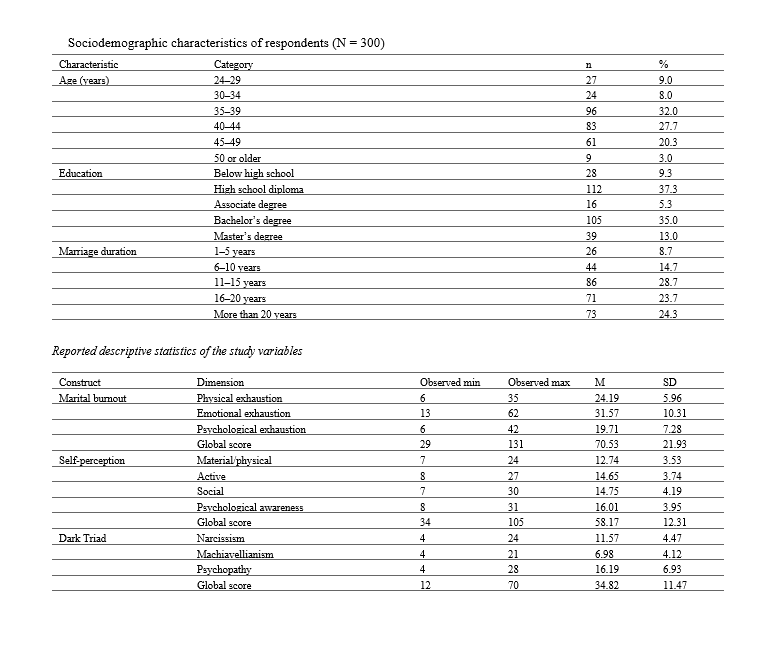
Marital burnout involves cumulative physical, emotional, and psychological exhaustion in an intimate partnership. Individual self-appraisals and socially aversive personality dispositions may be associated with this phenomenon, yet their simultaneous explanatory contributions require clarification, particularly in Iranian samples. This study examined whether self-perception and Dark Triad personality traits were associated with marital burnout among married adults in Isfahan, Iran. Methods: In a cross-sectional survey conducted in 2026, 300 married respondents were recruited by convenience sampling. They completed a self-perception measure developed by Pourhossein, the 12-item Dirty Dozen assessing Machiavellianism, narcissism, and psychopathy, and Pines’s Couple Burnout Measure. Pearson correlations and stepwise multiple linear regression were computed using SPSS 27. Self-perception was inversely associated with marital burnout (r = −.421, p < .001), whereas aggregate Dark Triad scores showed a positive association (r = .317, p < .001). Self-perception alone explained 17.7% of the outcome variance; adding Dark Triad traits increased the reported R² to .211 (ΔR² = .034). In the two-predictor model, standardized coefficients were β = −.354 for self-perception and β = .194 for Dark Triad traits. In domain-specific analyses, material and social self-perception independently contributed to the final stepwise model (β = −.43 and −.13), while psychopathy-related and narcissistic traits were retained in the separate Dark Triad model (β = .27 and .12). More positive self-perception was associated with less marital burnout, whereas greater socially aversive personality tendencies were associated with greater burnout. The cross-sectional, self-report design precludes causal inference; prospective and partner-report studies are needed.
Downloads
References
Honarpisheh, L., & Hashemi, S. (2024). The mediating role of marital frustration in the relationship between dark personality triads and attitudes toward infidelity in women with marital conflict. https://doi.org/10.47176/rjms.30.198
Jafari, A., Alami, A., Charoghchian, E., Delshad Noghabi, A., & Nejatian, M. (2021). The impact of effective communication skills training on the status of marital burnout among married women. BMC Women’s Health, 21, 231. https://doi.org/10.1186/s12905-021-01372-8
Jonason, P. K., & Webster, G. D. (2010). The dirty dozen: A concise measure of the Dark Triad. Psychological assessment, 22(2), 420-432. https://doi.org/10.1037/a0019265
Kazemi, R., & Saadatkhah, M. (2017). Investigating the Relationship Between the Dark Triad of Personality (Narcissism, Machiavellianism, and Psychopathy) and Marital Adjustment Fifth National Scientific-Research Congress on Development and Promotion of Educational Sciences, Psychology, Sociology, and Cultural-Social Sciences in Iran,
Kazemi, R., & Saadatkhah, M. (2022). Investigating the relationship of the Dark Triad of personality (Narcissism, Machiavellianism, and Psychopathy) with marital adjustment. 5th National Scientific Research Congress on Development and Promotion of Educational Sciences and Psychology, Tehran.
Kim, S., & Woo, S. (2025). Indirect effects of self-differentiation and mentalization on family of origin health and marital satisfaction among Korean adults. Journal of marital and family therapy, 51(1), e12756. https://doi.org/10.1111/jmft.12756
Lișman, C. G., & Holman, A. C. (2023). Dark, Dissatisfied and Disengaged: Propensity Towards Marital Infidelity, the Dark Triad, Marital Satisfaction and the Mediating Role of Moral Disengagement. Psihologija, 56(2), 163-177. https://doi.org/10.2298/psi220410003l
Nejatian, M., Alami, A., Momeniyan, V., Delshad Noghabi, A., & Jafari, A. (2021). Investigating the status of marital burnout and related factors in married women referred to health centers. BMC Women’s Health, 21, 25. https://doi.org/10.1186/s12905-021-01172-0
Parsakia, K., & Seyed Alitabar, S. H. (2026). Predicting work–family conflict and marital satisfaction using machine learning: The role of job stress, emotional exhaustion, dyadic coping, and partner support. Research and Practice in Couple Therapy, 4(1), 1-14. https://doi.org/10.61838/rpct.4.1.1
Paulhus, D. L., & Williams, K. M. (2002). The Dark Triad of personality: Narcissism, Machiavellianism, and psychopathy. Journal of research in personality, 36(6), 556-563. https://doi.org/10.1016/S0092-6566(02)00505-6
Pourhossein, R., & Ghasemi, Z. (2007). Investigating major factors contributing to the validity of the Self-Apperception Test. Psychological Sciences(24). https://www.magiran.com/volume/122009
Rabiei, N., Koochak Entesar, R., Ghanbari Panah, A., & Koushki, S. (2023). Predicting marital commitment based on the dark triad traits and the five-factor model of personality. Psychological Sciences, 22, 1103-1120. https://doi.org/10.52547/JPS.22.126.1103
Sadeghkhani, M., Emamipour, S., & Mirhashemi, M. (2023). Developing a Structural Model of Emotional Divorce Based on the Dark Triad Personality Traits and Conflict Resolution Styles with Marital Burnout as a Mediator. Applied Family Therapy, 4(2), 444-471.
Sayed Alitabar, S. H., Habibi, M., Sarvestani, A., & Etesami, M. S. (2018). Reliability, validity, and factor structure of global measure of relationship satisfaction. Journal of Research & Health, 8(6), 499-505. https://doi.org/10.29252/jrh.8.6.499
Downloads
Additional Files
Publication Timeline
- Submitted
- Revised
- Accepted