Emotion Regulation Difficulties and Suicidal Ideation Among Emerging Adults: A Mixed-Methods Investigation of Psychological Mechanisms, Interpersonal Vulnerabilities, and Protective Factors
Keywords:
Emotion Regulation Difficulties, Suicidal Ideation, Emerging Adults, Psychological Distress, Perceived Burdensomeness, Thwarted Belongingness, Social Support, Resilience, Mixed MethodsAbstract
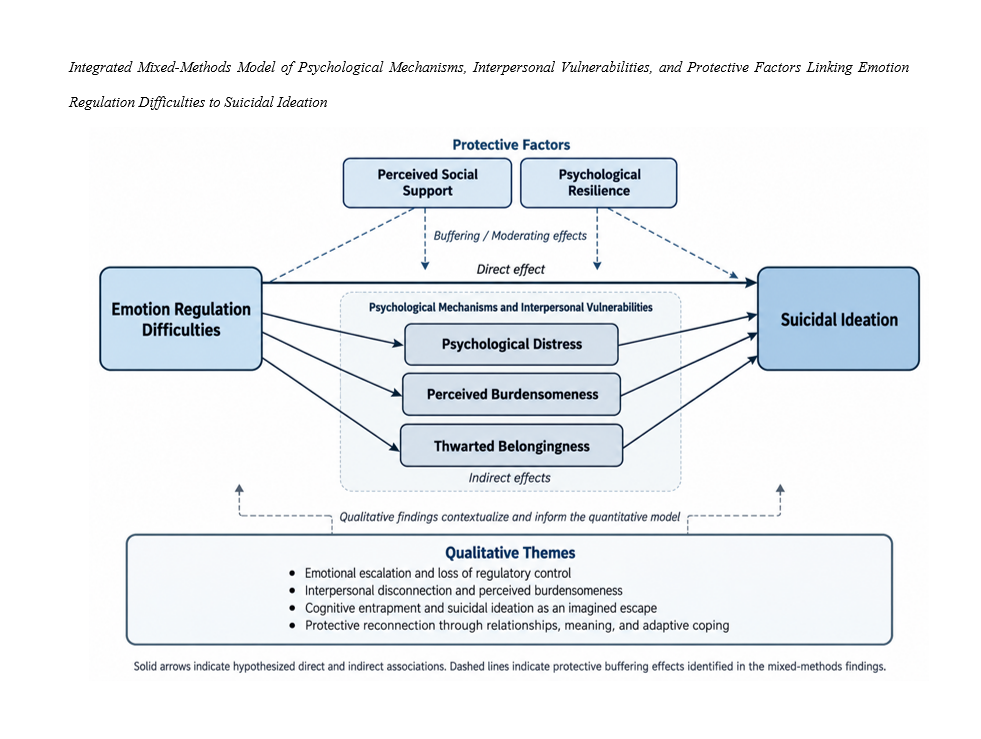
This study aimed to investigate the association between emotion regulation difficulties and suicidal ideation among emerging adults by examining psychological distress, perceived burdensomeness, and thwarted belongingness as explanatory mechanisms and perceived social support and psychological resilience as protective factors. An explanatory sequential mixed-methods design was employed. The quantitative phase included 420 emerging adults aged 18–29 years residing in Tehran, Iran, who completed standardized measures of emotion regulation difficulties, suicidal ideation, psychological distress, interpersonal needs, perceived social support, and resilience. Pearson correlations, hierarchical multiple regression, bootstrapped mediation, and moderation analyses were conducted. Subsequently, 24 participants were purposively selected for semi-structured interviews, and the qualitative data were analyzed using reflexive thematic analysis. Quantitative and qualitative findings were integrated at the interpretation stage. Emotion regulation difficulties were strongly associated with suicidal ideation (r = .61, p < .001) and explained substantial additional variance beyond demographic factors. In the final regression model, emotion regulation difficulties (β = .23, p < .001), psychological distress (β = .17, p < .001), perceived burdensomeness (β = .22, p < .001), and thwarted belongingness (β = .14, p = .001) positively predicted suicidal ideation, whereas perceived social support (β = -.17, p < .001) and resilience (β = -.18, p < .001) negatively predicted it. The model explained 56.7% of the variance. Significant indirect effects were observed through psychological distress, perceived burdensomeness, and thwarted belongingness. Social support and resilience significantly weakened the association between emotion regulation difficulties and suicidal ideation. Qualitative themes converged with these findings by highlighting emotional escalation, interpersonal disconnection, cognitive entrapment, and protective reconnection. Suicidal ideation among emerging adults appears to reflect an interconnected process in which emotion regulation difficulties operate both directly and through psychological and interpersonal vulnerabilities, while social support and resilience provide meaningful protective buffering.
Downloads
References
Carbone, G. A., Nigro, L., Ilen, L., Feller, C., Husmann, J., & Schneider, M. (2026). Cognitive Emotion Regulation, Peer Victimisation, and Stress Reactivity as Multidimensional Pathways to Suicidality and Self-Harm in Autistic Individuals Without Intellectual Disability. Autism, 30(8), 2095-2106. https://doi.org/10.1177/13623613261458864
Chiang, S. C., Ting, S. J., & Yu‐Hsien, S. (2024). Emotional Variability and Late Adolescent Suicidal Ideation: Buffering Role of Parent–youth Connectedness. Suicide and Life-Threatening Behavior, 55(2). https://doi.org/10.1111/sltb.13146
Ekici, F., Güler, H. A., Bayırlı, Ö., Gümüşoluk, T. B., & Kandeğer, A. (2025). Childhood Trauma and Emotional Dysregulation as Risk Factors for Suicidal Ideation in Adults With ADHD: A Case-Control Study. Journal of interpersonal violence, 41(19-20), 8319-8341. https://doi.org/10.1177/08862605251375358
Foye, U., Kakar, S., & Jewell, T. (2025). Reciprocal Longitudinal Associations Between Symptoms of Eating Disorders, Self-Harm and Suicidal Ideation. https://doi.org/10.1101/2025.03.19.25324248
Gaete, J., Martínez, P., Robinson, J., & Núñez, D. E. (2026). Heterogeneous Trajectories of Suicidal Ideation and Depressive Symptoms During an Indicated School-Based CBT Intervention: A Group-Based Trajectory Modeling Study. BMC psychology, 14(1). https://doi.org/10.1186/s40359-026-04644-w
Gagliano, A., Costanza, C., Modica, I. D., Carucci, S., Donno, F., Germanò, E., Abbate, C. S., Roccella, M., & Vetri, L. (2024). Neurodevelopmental Disorders and Suicide: A Narrative Review. Journal of clinical medicine, 13(6), 1627. https://doi.org/10.3390/jcm13061627
Geoffroy, M. C., MacNeil, S., Paquin, V., Inja, A., Girard, A., Chartrand, E., Castellanos‐Ryan, N., Notredame, C.-É., Colman, I., Orri, M., Turecki, G., & Côté, S. M. (2025). Mental Health Antecedents and Correlates of 2 Distinct Developmental Pathways to Suicidal Ideation. JAMA Psychiatry, 82(9), 916. https://doi.org/10.1001/jamapsychiatry.2025.1273
Gifuni, A. J., Spodenkiewicz, M., Laurent, G., MacNeil, S., Jollant, F., & Renaud, J. (2023). Symptoms Characteristics of Personality Disorders Associated With Suicidal Ideation and Behaviors in a Clinical Sample of Adolescents With a Depressive Disorder. Frontiers in Psychiatry, 14. https://doi.org/10.3389/fpsyt.2023.1269744
Gijzen, M., Jeronimus, B., Bergen, D., & Oldehinkel, A. J. (2026). The Course and Remission of Suicidality From Ages 11 to 29: Findings From a Dutch Population-Based Longitudinal Cohort Study. https://doi.org/10.21203/rs.3.rs-9314087/v1
Graham, C., & Fenelon, A. (2023). Health, Suicidal Thoughts, and the Life Course: How Worsening Health Emerges as a Determinant of Suicide Ideation in Early Adulthood. Journal of Health and Social Behavior, 64(1), 62-78. https://doi.org/10.1177/00221465221143768
Granieri, A., Casale, S., Sauta, M. D., & Franzoi, I. G. (2022). Suicidal Ideation Among University Students: A Moderated Mediation Model Considering Attachment, Personality, and Sex. International journal of environmental research and public health, 19(10), 6167. https://doi.org/10.3390/ijerph19106167
Hu, C., & Huang, W. (2025). Childhood Emotional Abuse and Suicidal Ideation in College Students: Exploring the Mediating Role of Alexithymia and the Moderating Effect of Physical Exercise. Frontiers in Psychiatry, 16. https://doi.org/10.3389/fpsyt.2025.1660164
Kaçar‐Başaran, S., & Keklik, E. (2026). Linking Depression to Suicide Risk: The Mediating Role of Emotion Regulation in Individuals With Childhood Maltreatment. Child Abuse Review, 35(5). https://doi.org/10.1002/car.70171
Kelly, L. M., Meeker, E. C., Zajac, K., Bryan, R., & O’Connor, B. C. (2023). Interactive Effect of Adverse Child Experiences and Suicidal Thoughts and Behaviors on Adolescent Alcohol and Cannabis Use Frequency. Psychology of Addictive Behaviors, 37(8), 1019-1029. https://doi.org/10.1037/adb0000947
Lewis, C. P., Klimes‐Dougan, B., Croarkin, P. E., & Cullen, K. R. (2025). Understanding the Emergence of Suicidal Thoughts and Behaviors in Adolescence From a Brain and Behavioral Developmental Perspective. Neuropsychopharmacology, 51(1), 259-272. https://doi.org/10.1038/s41386-025-02168-2
Liu, L., Wu, X., & Wang, W. (2024). Cyber Aggression and Suicidal Ideation in Emerging Adults: Examining the Potential Roles of Depressive Symptoms and Nonsuicidal Self‐Injury. Aggressive Behavior, 50(6). https://doi.org/10.1002/ab.70011
Liu, L., Yang, L., & Wang, W. (2025). Childhood Maltreatment, Positive Childhood Experiences, and Suicidal Ideation in Emerging Adults: The Roles of Complex Posttraumatic Stress Symptom Trajectories. Psychological Trauma Theory Research Practice and Policy. https://doi.org/10.1037/tra0002050
Lu, S., Zeng, J., & Liu, Z. (2026). A Study on the Relationship Between Online Gaming Behavior and Suicidal Ideation Among College Students. Family Relations, 75(4), 3044-3067. https://doi.org/10.1111/fare.70188
Ma, Y., Liao, W., Ma, S., Lu, L., & Wang, H. (2026). Daily Physical Activity Associated With Suicidal Ideation in College Students: An Ecological Momentary Assessment Study. Frontiers in psychology, 17. https://doi.org/10.3389/fpsyg.2026.1852256
McCollum, D. C., Smathers, S. E., Sullivan, T. R., Jowaheer, Y., & Mereish, E. H. (2024). Associations Among Intimate Partner Violence, Suicidal Ideation, Suicide Behaviors, Non‐suicidal Self‐injury, and Psychological Well‐being in Black American Emerging Adults. Suicide and Life-Threatening Behavior, 55(1). https://doi.org/10.1111/sltb.13102
Morales-Sanhueza, J., Parra, G. M., & Puig-Amores, I. (2026). Attachment, Physical Leisure, and Suicidal Ideation in Emerging Adulthood: Evidence From University Students. Behavioral Sciences, 16(9), 1674. https://doi.org/10.3390/bs16091674
Namlı, Z., Tamam, L., Demirkol, M. E., Karaytuğ, M. O., Yeşiloğlu, C., Demirtaş, S. Ç., & Uğur, K. (2026). Clinical Heterogeneity of Major Depressive Disorder: The Role of Trauma, Dissociation, and Sleep. Journal of clinical medicine, 15(6), 2364. https://doi.org/10.3390/jcm15062364
Polanco‐Roman, L., Ahmad, K., Tigershtrom, A., Jacobson, C. M., & Miranda, R. (2024). Emotion Expressivity, Suicidal Ideation, and Explanatory Factors: Differences by Asian American Subgroups Compared With White Emerging Adults. Cultural diversity & ethnic minority psychology, 30(1), 11-21. https://doi.org/10.1037/cdp0000313
Rahnemo, S. S., Yaghmaei, S., & Mohaghegh, A. H. (2026). How Meaning in Life and Childhood Trauma Shape Suicidal Ideation, the Mediating Pathways of Coping Styles. https://doi.org/10.21203/rs.3.rs-9792821/v1
Ryder, A., Fite, P. J., & Bortolato, M. (2025). Understanding Associations Between Childhood Maltreatment, Biological Sex, and Emotion Reactivity Among Emerging Adults. Emerging Adulthood, 13(4), 808-820. https://doi.org/10.1177/21676968251324077
Shepard, C. A., Rufino, K. A., Daza, P., Pearson, A., Cuenod, M., & Patriquin, M. A. (2022). Emotion Regulation Mediates the Relationship Between Therapeutic Alliance and Anxiety in Emerging Adults During Inpatient Psychiatric Treatment. Journal of Psychiatric Practice, 28(5), 383-390. https://doi.org/10.1097/pra.0000000000000656
Stutts, M., & Cohen, J. R. (2022). The Role of Hopelessness and Procedural Justice on Depressogenic Outcomes in Serious Adolescent Offenders. Law and Human Behavior, 46(6), 415-428. https://doi.org/10.1037/lhb0000502
Tran, M. A. Q., Kukreti, S., Lin, C.-Y., Nguyen, N. D. T., Pham, M. V., Pham, T. V., & L, D. (2026). Body Image, Narcissism, Envy, and Suicidal Ideation Among Vietnamese University Students: The Mediating and Moderating Roles of Loneliness, Depression, and Self-Compassion. Emerging Adulthood, 14(3), 475-489. https://doi.org/10.1177/21676968261423231
Walker, J., Venta, A., Bechelli, J., Brewer, T. M., Boisvert, D., Bick, J., Lewis, R. H., Wells, J. N., & Armstrong, T. A. (2022). Testing the Role of Inflammation in the Relation of Childhood Maltreatment and Suicidal Ideation Among Young Adults. Journal of Clinical Psychology, 78(12), 2484-2496. https://doi.org/10.1002/jclp.23347
Wilson, M. J., Scott, A. J., Pilkington, V., Macdonald, J. A., Rice, S., Oliffe, J. L., & Seidler, Z. E. (2025). Suicidality in Men Following Relationship Breakdown: A Systematic Review and Meta-Analysis of Global Data. Psychological bulletin, 151(7), 819-860. https://doi.org/10.1037/bul0000482
Wong, N. E., Hagan, M. J., & Holley, S. R. (2024). Childhood Maltreatment and Suicidal Thoughts and Behaviors in Young Adults. Crisis, 45(1), 26-32. https://doi.org/10.1027/0227-5910/a000909
Wu, O., Lu, X., Yeo, K. J., Xiao, Y., & Yip, P. S. F. (2022). Assessing Prevalence and Unique Risk Factors of Suicidal Ideation Among First-Year University Students in China Using a Unique Multidimensional University Personality Inventor. International journal of environmental research and public health, 19(17), 10786. https://doi.org/10.3390/ijerph191710786
Wu, W., Liu, L., Ishak, Z., Wang, Z., Sun, J., & Han, Z. (2026). Psychological Resilience Partially Mediates the Relationship Between Negative Life Events and Suicidal Ideation in Chinese Adolescents. Frontiers in Psychiatry, 17. https://doi.org/10.3389/fpsyt.2026.1770147
Xu, F., & Xu, S. (2026). Adolescent Emotional Dysregulation and Suicide. Medicine, 105(36), e43127. https://doi.org/10.1097/md.0000000000043127
Downloads
Additional Files
Publication Timeline
- Submitted
- Revised
- Accepted