Predicting Somatoform Disorder Symptoms Based on Alexithymia, Self-Critical Rumination, and Body Monitoring: Examining the Mediating Role of Interpersonal Sensitivity
Keywords:
somatoform disorder, alexithymia, self-critical rumination, body monitoring, interpersonal sensitivityAbstract
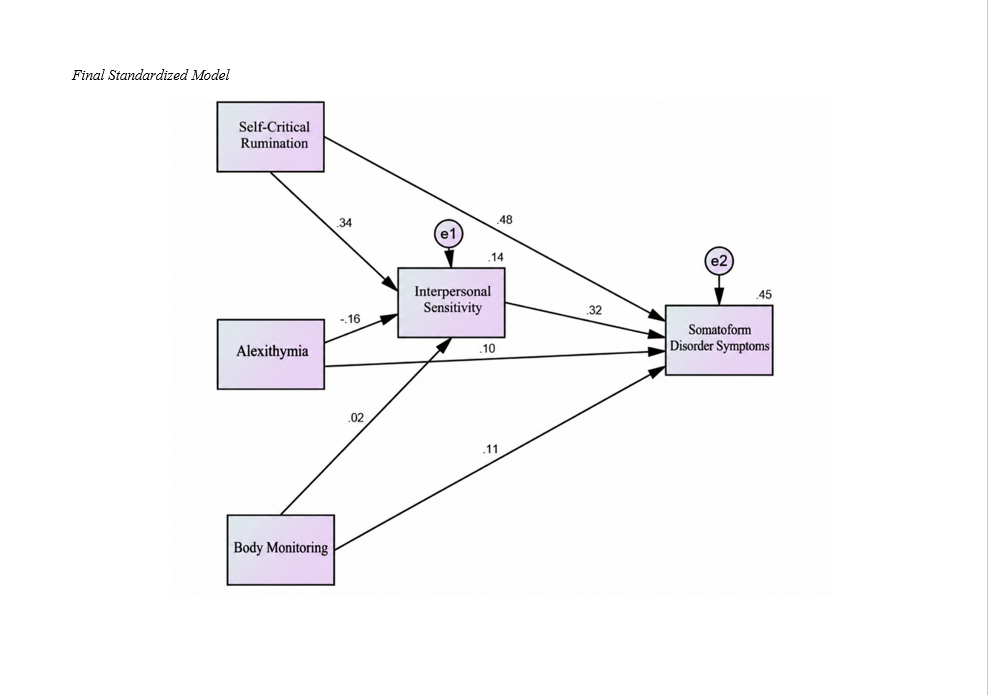
The present study aimed to investigate the roles of alexithymia, self-critical rumination, and body monitoring in predicting somatoform disorder symptoms, with interpersonal sensitivity as a mediator. The statistical population consisted of adults with somatoform disorder who attended specialized mental health centers, psychiatric clinics, and counseling centers in Tehran. A total of 200 eligible individuals were selected using purposive sampling. Data were collected using the Toronto Alexithymia Scale (TAS-20), Self-Critical Rumination Scale (SCRS), Multidimensional Assessment of Interoceptive Awareness (MAIA), Interpersonal Sensitivity Measure (IPSM), and the Powell and Enright Somatic Symptoms Questionnaire. Data were analyzed using SPSS version 23 and AMOS version 24 through descriptive statistics, correlation analyses, and structural equation modeling. The findings indicated that self-critical rumination had a positive and significant indirect effect on somatoform disorder symptoms through interpersonal sensitivity (β = .108, p = .002). Alexithymia also had a negative and significant indirect effect on somatoform disorder symptoms through interpersonal sensitivity (β = −.052, p = .003). In contrast, the indirect effect of body monitoring on somatoform disorder symptoms through interpersonal sensitivity was not significant (β = .008, p = .682). Overall, the findings demonstrated that interpersonal sensitivity mediates the relationships between certain cognitive and emotional factors and somatoform disorder symptoms. Based on these findings, attention to self-critical rumination, emotional processes, and interpersonal sensitivities is recommended in the assessment and psychological treatment of somatic symptoms.
Downloads
References
Adamovic. (2024). Childhood maltreatment and somatic symptoms: Examining the role of specific types of childhood maltreatment and alexithymia. https://doi.org/10.1037/tra0001315
Alipour, A. A. (2026). The Role of Self-Efficacy, Interpersonal Sensitivity, and Rumination in Predicting and Controlling Social Anxiety Disorder. Second International Conference on Applied Studies in Educational Processes,
Amini, S., & Arzami, H. (2023). The Relationship between Parental Bonding and Sexual Function with the Mediating Role of Interpersonal Sensitivity. New Ideas in Psychology, 16(20).
Arshadi, L. (2022). Predicting Interpersonal Sensitivity Based on Mindfulness Components with the Mediating Role of Acceptance and Action. Seventh National Conference on New Research in Educational Sciences and Psychology in Iran, Tehran.
Barak. (2023). A behavioral characteristics observational measure of youth with somatic symptom disorder during physical rehabilitation. https://doi.org/10.3390/life13102078
Creed, F. (2023). Progress in understanding functional somatic symptoms and syndromes in light of the ICD-11 and DSM-5. World Psychiatry, 22(3), 474-475. https://doi.org/10.1002/wps.21118
Faramarzi Rad, B., Robat-Mili, S., Abolmaali Alhosseini, K., & Zare Bahramabadi, M. (2023). A Structural Model for Predicting Alexithymia Based on Early Maladaptive Schemas with the Mediating Role of Emotional Self-Disclosure. Journal of Psychological Science, 123(132), 539-556.
Fearn, M., Marino, C., Spada, M. M., & Kolubinski, D. C. (2022). Self-critical rumination and associated metacognitions as mediators of the relationship between perfectionism and self-esteem. Journal of Rational-Emotive & Cognitive-Behavior Therapy, 40(1), 155-174. https://doi.org/10.1007/s10942-021-00404-4
Fischer, S., Ali, N., Feneberg, A. C., Mewes, R., & Nater, U. M. (2022). Does childhood trauma impact daily psychological stress in somatic symptom disorder? An ambulatory assessment study. Frontiers in Psychiatry, 13, 954051. https://doi.org/10.3389/fpsyt.2022.954051
Hybelius, J., Kosic, A., Salomonsson, S., Wachtler, C., Wallert, J., Nordin, S., & Axelsson, E. (2024). Measurement properties of the Patient Health Questionnaire-15 and Somatic Symptom Scale-8: A systematic review and meta-analysis. JAMA Network Open, 7(11), e2446603. https://doi.org/10.1001/jamanetworkopen.2024.46603
Hybelius, J., Kosic, A., Salomonsson, S., Wachtler, C., Wallert, J., Nordin, S., & Axelsson, E. (2026). Understanding general somatic symptom burden: Insights from a systematic review of factor analyses pertaining to the Patient Health Questionnaire-15 (PHQ-15) and Somatic Symptom Scale-8 (SSS-8). International Journal of Behavioral Medicine, 33(2), 264-273. https://doi.org/10.1007/s12529-025-10365-y
Kara, E., Cimsir, E., & Alcay, A. (2024). The roles of self-compassion and self-coldness in the relationships between inferiority and stress and anxiety among gifted adolescents. Mindfulness, 15(1), 217-229. https://doi.org/10.1007/s12671-023-02266-6
Kuanar Baboo, A. G., Ranjan, P., Kaur, T., Rawat, N., Sarkar, S., Kaloiya, G., Singh, A., Babu, N., Baitha, U., & Prakash, B. (2024). Evaluation of tools to assess symptoms and symptom severity in patients with medically unexplained physical symptoms: A systematic review and narrative synthesis. Cureus, 16(3). https://doi.org/10.7759/cureus.56204
Larkin, F., Ralston, B., Dinsdale, S. J., Kimura, S., & Hayiou-Thomas, M. E. (2023). Alexithymia and intolerance of uncertainty predict somatic symptoms in autistic and non-autistic adults. Autism, 27(3), 602-615. https://doi.org/10.1177/13623613221109717
Liu, Z., Fu, M., Shi, J., Hu, Y., & Gao, X. (2025). The psychological mechanism of self-objectification: The interaction between sociocultural pressures and the self-system. Frontiers in psychology, 16, 1531222. https://doi.org/10.3389/fpsyg.2025.1531222
Löw, C. A., Schauenburg, H., & Dinger, U. (2020). Self-criticism and psychotherapy outcome: A systematic review and meta-analysis. Clinical psychology review, 75, 101808. https://doi.org/10.1016/j.cpr.2019.101808
Maroti, D., Ljótsson, B., Lumley, M. A., Schubiner, H., Hallberg, H., Olsson, P. Å., & Johansson, R. (2021). Emotional processing and its association to somatic symptom change in emotional awareness and expression therapy for somatic symptom disorder: A preliminary mediation investigation. Frontiers in psychology, 12, 712518. https://doi.org/10.3389/fpsyg.2021.712518
Martinez-Sanchis, M., Navarrete, J., Cebolla, A., Molinari, G., Vara, M. D., Banos, R. M., & Herrero, R. (2021). Exploring the mediator role of self-critical rumination between emotion regulation and psychopathology: A validation study of the Self-Critical Rumination Scale (SCRS) in a Spanish-speaking sample. Personality and individual differences, 183, 111-115. https://doi.org/10.1016/j.paid.2021.111115
Milia, C., Kolubinski, D. C., & Spada, M. M. (2021). The effects of self-critical rumination on shame and stress: An experimental study. Behavioural and Cognitive Psychotherapy, 49(3), 272-286. https://doi.org/10.1017/S1352465820000727
Mirshafiei, S. S., & Jafari, A. (2024). Predicting Rumination Based on Anxiety Sensitivity and Alexithymia with the Mediating Role of Lifestyle among Women with Multiple Sclerosis. Feyz Medical Sciences Journal, 28(3), 271-280.
Mokaramifar, Z., & Nouri, J. (2024). Predicting Alexithymia Based on Internalized Shame and Self-Criticism with the Mediating Role of Anxiety Sensitivity among Married Students. New Explorations in Computational Sciences and Behavioral Management, 2(1).
Rady, A., Alamrawy, R. G., Ramadan, I., & El Raouf, M. A. (2021). Prevalence of alexithymia in patients with medically unexplained physical symptoms: A cross-sectional study in Egypt. Clinical Practice & Epidemiology in Mental Health, 17, 136-145. https://doi.org/10.2174/1745017902117010136
Razeghi, N., Dehghani, A., Ghahari, S., & Haghayegh, A. (2025). The Mediating Role of Interpersonal Sensitivity in the Relationship between Schema Modes and Maladaptive Conflict Resolution among Single-Parent Women. Journal of Psychological Science, 24(145), 177-195.
Shahdadian, V., Golshani, F., & Baghdasarians, A. (2025). Predicting Self-Injurious Functioning Based on Mentalization with the Mediating Role of Interpersonal Sensitivity among Adolescents in Tehran [Master's thesis in clinical psychology, Islamic Azad University, Ilam Branch].
Shahi, R., & Zadeh Mohammadi, K. (2024). Examining the Effect of Effective Emotion Regulation Strategies on Alexithymia with the Mediating Role of Self-Compassion. Applied Psychology, 18(1), 180-206.
Shahian, H., Molaei, M., & Saadat, S. (2024). Validation of the Persian Version of the Self-Critical Rumination Scale among Students. Rooyesh-e-Ravanshenasi, 13(6), 231-240.
Sheikh Fendereski, S., Babaei, M., & Shakibarad, A. (2024). The Role of Rumination and Self-Criticism in the Relationship between Self-Compassion and Suicidal Ideation among Adolescents in Tehran. Journal of Health Psychology and Behavioral Disorders, 2(4), 1-14.
Smakowski, A., Hüsing, P., Völcker, S., Löwe, B., Rosmalen, J. G., Shedden-Mora, M., & Toussaint, A. (2024). Psychological risk factors of somatic symptom disorder: A systematic review and meta-analysis of cross-sectional and longitudinal studies. Journal of psychosomatic research, 181, 111608. https://doi.org/10.1016/j.jpsychores.2024.111608
Sohrabi, Z., Taheri-Naghti, S. S., & Mashhadi, M. (2022). Predicting Interpersonal Sensitivity Based on the Believability of Anxious Thoughts and Feelings: The Mediating Role of Cognitive Flexibility. Rooyesh-e-Ravanshenasi, 11(11), 173-184.
Topalalioglu, S. (2025). Role of interpersonal sensitivity and cognitive distortions in the development of psychopathologies. Current Approaches in Psychiatry, 17(2), 261-271. https://doi.org/10.18863/pgy.1484640
Wu, H., Manglike, A., Chen, Y., Liu, Z., Fritzsche, K., & Lu, Z. (2023). Scoping review update on somatic symptom disorder that includes additional Chinese data. General Psychiatry, 36(3), e100942. https://doi.org/10.1136/gpsych-2022-100942
Yazdani, M. (2024). A Causal Model of Childhood Trauma and Psychosomatic Disorder Symptoms with the Mediating Role of Self-Critical Rumination [Master's thesis, Khayyam University, Faculty of Literature and Humanities].
Zdankiewicz-Scigala, E., Scigala, D., Sikora, J., Kwaterniak, W., & Longobardi, C. (2021). Relationship between interoceptive sensibility and somatoform disorders in adults with autism spectrum traits: The mediating role of alexithymia and emotional dysregulation. PLoS One, 16(8), e0255460. https://doi.org/10.1371/journal.pone.0255460
Zhang, B., Li, X., Deng, H., Tan, P., He, W., Huang, S., Wang, L., Xu, H., Cao, L., & Nie, G. (2024). The relationship of personality, alexithymia, anxiety symptoms, and odor awareness: A mediation analysis. BMC psychiatry, 24(1), 185. https://doi.org/10.1186/s12888-024-05653-y
Zhu, Y., Zhang, W., & Shi, X. (2025). Longitudinal associations between childhood emotional abuse and social anxiety in emerging adults: The role of interpersonal sensitivity and insecurity. Psychology research and behavior management, 18, 1787-1179. https://doi.org/10.2147/PRBM.S528300
Downloads
Additional Files
Publication Timeline
- Submitted
- Revised
- Accepted