Explaining the Causal Relationship Between Self-Differentiation and Marital Burnout in Women Who Have Experienced Marital Infidelity: The Mediating Role of Psychological Distress
Keywords:
self-differentiation, psychological distress, marital burnout, marital infidelityAbstract
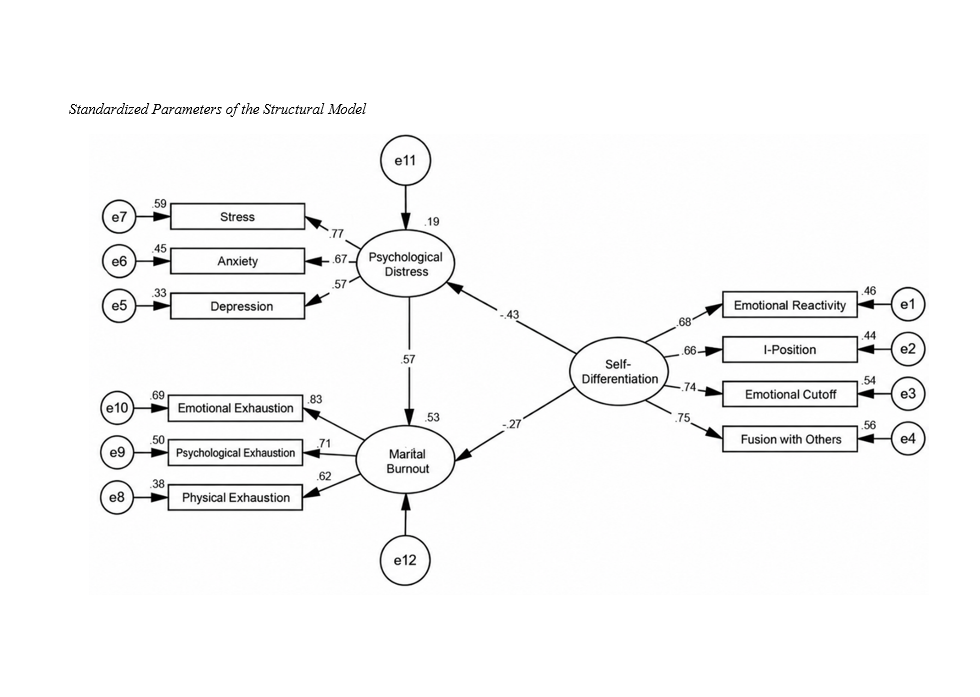
Exposure to marital betrayal and infidelity constitutes a traumatic crisis that can erode psychological functioning and disrupt the emotional bond between spouses. The present study aimed to explain the causal relationship between self-differentiation and marital burnout through the mediating role of psychological distress among women who had experienced marital infidelity by their spouses. This study employed a descriptive-correlational design based on structural equation modeling. The statistical population consisted of all married women who had experienced marital infidelity and attended counseling centers and psychological service clinics in Tehran during the 2025–2026 academic year. From this population, a sample of 252 participants was selected using convenience sampling. The research instruments included the Differentiation of Self Inventory (Skowron & Friedlander, 1998), the Depression Anxiety Stress Scales-21 (Lovibond & Lovibond, 1995), and the Couple Burnout Measure (Pines, 1996). The data were analyzed using structural equation modeling. The results of structural equation modeling indicated that the hypothesized model demonstrated an acceptable fit to the empirical data and that the variables included in the model significantly accounted for variations in marital burnout and psychological distress. Self-differentiation had a significant negative effect on both marital burnout and psychological distress. Furthermore, psychological distress had a significant positive effect on marital burnout. The mediation analysis also confirmed that psychological distress played a significant mediating role in the relationship between self-differentiation and marital burnout. Based on the findings, lower levels of self-differentiation may intensify psychological distress and thereby contribute to increasing exhaustion and burnout in the marital relationships of women affected by infidelity. Therefore, strengthening the components of self-differentiation and reducing symptoms of psychological distress may constitute effective strategies in clinical interventions and couple therapy aimed at reducing marital burnout among victims of marital infidelity.
Downloads
References
April, M., & Schrodt, P. (2019). Person-centered messages, attributions of responsibility, and the willingness to forgive parental infidelity. Communication Studies, 70(1), 79-98. https://doi.org/10.1080/10510974.2018.1469525
Bowen, M. (1978). Family therapy in clinical practice. Jason Aronson.
Hoy, E. Q. W., & Oh, V. Y. S. (2024). The consequences of spousal infidelity for long-term chronic health: A two-wave longitudinal analysis. Journal of Social and Personal Relationships, 41(11), 3245-3266. https://doi.org/10.1177/02654075241276713
Hu, L. t., & Bentler, P. M. (1999). Cutoff criteria for fit indexes in covariance structure analysis: Conventional criteria versus new alternatives. Structural Equation Modeling: A Multidisciplinary Journal, 6(1), 1-55. https://doi.org/10.1080/10705519909540118
Hussain, M., & Lansford, J. E. (2025). Multiple serial mediation modeling of remembered parental acceptance in childhood predicts adults' marital adjustment: The role of self-differentiation, depression, and anxiety. The Family Journal, 33(2), 245-256. https://doi.org/10.1177/10664807251318962
Khatibi, S. (2015). The Effectiveness of Reality Therapy in Differentiation of Self and Codependency among Maladjusted Couples [Master's thesis, Islamic Azad University, Roudehen Branch].
Kline, R. B. (2010). Principles and practice of structural equation modeling (3 ed.). Guilford Press.
Koçyiğit, M., & Uzun, M. (2024). Couple burnout and marital satisfaction: Serial mediation by mindfulness and emotion regulation. The American Journal of Family Therapy, 52(5), 575-593. https://doi.org/10.1080/01926187.2024.2322461
Koçyiğit, M., & Uzun, M. (2025). Emotion regulation and couple burnout in marriage: A moderated moderation model of authenticity, sex of parents and having children. Current Psychology, 44, 3564-3578. https://doi.org/10.1007/s12144-024-07253-1
Murdock, N. L., Flynn, M. C., & Bresin, R. C. (2023). Differentiation of self, anxiety, triangling and distress: A test of Bowen theory. Family Process, 62(4), 1671-1686. https://doi.org/10.1111/famp.12845
Navidi, F. (2005). An Investigation and Comparison of the Relationship between Couple Burnout and Organizational Climate Factors among Education Department Employees and Nurses in Tehran [Master's thesis, Shahid Beheshti University].
Pines, A. M. (1996). Couple burnout: Causes and cures. Routledge.
Pines, A. M., & Nunes, R. (2003). The relationship between career and couple burnout: Implications for career and couple counseling. Journal of employment counseling, 40(2), 50-64. https://doi.org/10.1002/j.2161-1920.2003.tb00856.x
Pouragha, F., & Sotoudeh Nouroudi, S. O. (2023). A Comparison of Differentiation of Self, Couple Burnout, and Emotional Intimacy between Couples Seeking Divorce and Ordinary Couples. Journal of Modern Psychology, 3(3), 18-28. https://doi.org/10.22034/jmp.2023.420006.1076
Rodríguez-González, M., Bell, C. A., Pereyra, S. B., Martínez-Díaz, M. P., Schweer-Collins, M., & Bean, R. A. (2023). Differentiation of self and relationship attachment, quality, and stability: A path analysis of dyadic and longitudinal data from Spanish and U.S. couples. PLoS One, 18(3), e0282482. https://doi.org/10.1371/journal.pone.0282482
Rokach, A., & Chan, S. H. (2023). Love and infidelity: Causes and consequences. International journal of environmental research and public health, 20(5), 3904. https://doi.org/10.3390/ijerph20053904
Shamshirgaran, M., & Homaei, R. (2023). The Role of Communication Skills in the Relationship between Conflict Resolution Styles and Couple Burnout among Married Women. Rooyesh-e-Ravanshenasi, 12(6), 147-158. https://dorl.net/dor/20.1001.1.2383353.1402.12.6.14.7
Worch, S. M., & Bartle-Haring, S. (2024). Couple differentiation and health-related quality of life. Family Process, 63(4), 1739-1752. https://doi.org/10.1111/famp.12977
Downloads
Additional Files
Publication Timeline
- Submitted
- Revised
- Accepted