The Effectiveness of Choice Theory Training on Adolescent Crisis Management and Academic Motivation
Keywords:
choice theory training, adolescent crisis management, academic motivationAbstract
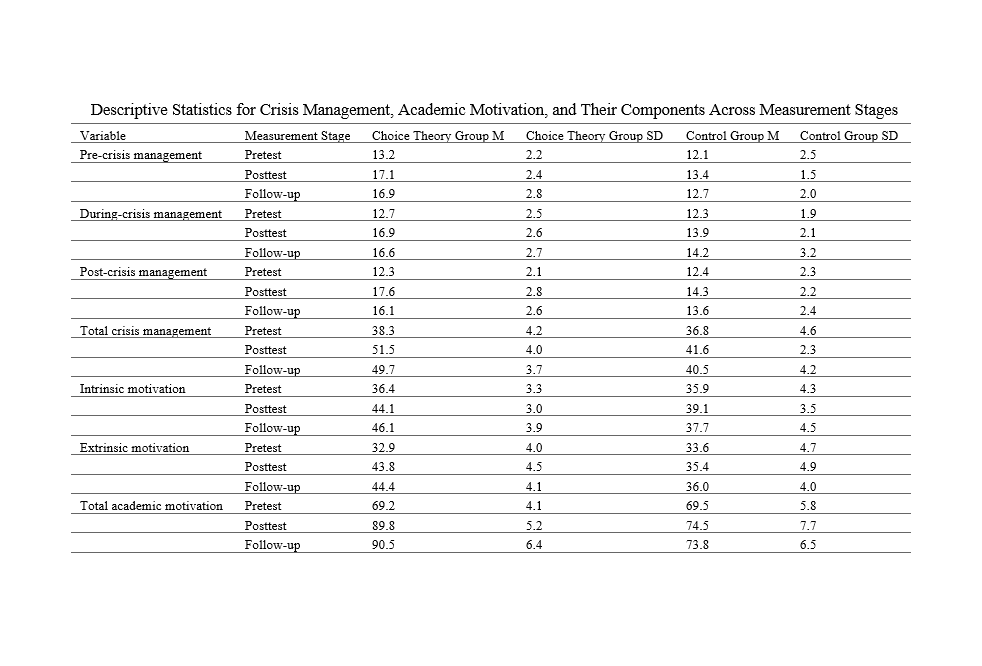
The present study aimed to investigate the effectiveness of choice theory training on adolescent crisis management and academic motivation. This applied study employed a quasi-experimental pretest–posttest design with a control group. The statistical population consisted of female students in Grades 7 and 8 of lower secondary schools in Zahedan during the 2024–2025 academic year. A total of 60 students were selected using multistage cluster sampling and were subsequently randomly assigned to two experimental groups and one control group. The research instruments included the Adolescent Crisis Management Questionnaire (Sarafrazi, 2012), the Academic Motivation Questionnaire (Harter, 1980, 1981), and the Choice Theory Training Package (Ghari Zadeh et al., 2024). The content validity of the instruments was established, and their reliability was assessed using Cronbach’s alpha coefficients, which were .71 for the Adolescent Crisis Management Questionnaire and .89 for the Academic Motivation Questionnaire. Repeated-measures analysis of variance was used to analyze the data. The results indicated significant improvements from pretest to posttest in crisis management and its components, as well as in academic motivation and its components, among participants receiving choice theory training. The effects were also maintained at the follow-up assessment. In both domains, the effect on extrinsic motivation, particularly at follow-up, was greater than that observed for the other components. Overall, the intervention demonstrated stronger effectiveness at posttest; however, this relative advantage was not maintained at follow-up.
Downloads
References
Abdollahi, F. (2023). Predicting responsibility based on academic motivation and academic self-efficacy among female secondary school students in Takestan Takestan Nonprofit Higher Education Institute].
Arab, H. (2022). The mediating role of academic motivation in the relationship between academic well-being and student engagement University of Birjand].
Asadi, L. (2022). The effect of crisis management training on awareness of managing crisis situations among upper secondary school students in Bandar Abbas Islamic Azad University, Bandar Abbas Branch].
Esmaeili, N., & Amanzadeh, A. (2023). The effect of flipped instruction on students' academic resilience and academic motivation. Razi Journal of Medical Sciences, 30(2), 232-239.
Gharizadeh Beyragh, T. (2023). Comparing the effectiveness of spiritual care training and choice theory on academic vitality, differentiation of self, and flourishing among students Semnan University].
Gharizadeh, T., Mohammadifar, M. A., & Fathi Azar, E. (2024). Comparing the effectiveness of spiritual care and choice theory on students' flourishing and academic motivation. Journal of Modern Psychological Research, 19(73), 227-236.
Ghorbani, S. F., & Golmohammadi, J. (2025). Motivational Strategies for Resolving Identity Crisis During Adolescence from the Perspective of Quranic Verses and Hadiths. Educational Teachings in the Quran and Hadith, 11(1), 185-210.
Glasser, W. (2024). Choice theory by Dr. William Glasser (A. Sahebi, Trans.; 46 ed.). Sayeh Sokhan.
Hashemi, N., & Kharouti, F. (2020). Comparing academic motivation, self-regulation, and self-worth among gifted and typically developing students in Karaj. Educational Innovations, 73(19), 147-162.
Kirpik, G. (2024). The role of spirituality in conflict and crisis management. In Spirituality Management in the Workplace (pp. 131-151). https://doi.org/10.1108/978-1-83753-450-020231006
Leverett, P. M., D'Costa, S., Cassella, H., & Shah, M. (2020). Crisis and adolescents: Assessments and initial management. Primary Care Clinics in Office Practice, 47(2), 322-329. https://doi.org/10.1016/j.pop.2020.02.009
Mashayekhifard, D. (2020). Modeling students' academic motivation during the coronavirus pandemic based on parents' and teachers' achievement emotions in virtual education: The mediating role of students' achievement emotions Bahar Higher Education Institute, Mashhad Branch].
Mirhamzeh, P. (2022). Examining crisis management in elementary schools in Alborz Province Alzahra University].
Nooripour, R., Sikström, S., Mokhtarpour, M., Chenarani, H., Emadi, F., Lavie, C., Ilanloo, H., & Hosseinian, S. (2023). Effectiveness of group training based on choice theory on internalizing problems, empathy, and identity transformations among male adolescents. Journal of Research & Health, 13(3), 197-208. https://doi.org/10.32598/JRH.13.3.2096.2
Nosratipour Meybodi, M. (2022). Identifying and leveling factors affecting education crisis management in elementary schools during the coronavirus pandemic using interpretive structural modeling: A case study of Meybod Islamic Azad University, Ardakan Branch].
Orhan, F. G., & Kuloğlu, A. (2026). Teacher Opinions on Students' Academic Motivation and Learning Responsibility in the Context of Digital Game Addiction. Osmangazi Journal of Educational Research, 12(Special Issue), 65-80. https://doi.org/10.59409/ojer.1790196
Partanen, L. (2020). How student-centred teaching in quantum chemistry affects students' experiences of learning and motivation—a self-determination theory perspective. Chemistry Education Research and Practice. https://doi.org/10.1039/C9RP00036D
Paullet, K., & Pinchot, J. (2021). The impact of choice theory on student outcomes in online courses Proceedings of the EDSIG Conference,
Pourfaridoun, M. H., Asgari, P., & Dasht Bozorgi, Z. (2026). Effectiveness of Cognitive and Metacognitive Strategy Training on Digital Self-Efficacy and Academic Procrastination in University Students. Psychology of Motivation, Behavior and Health, 1-12.
Rezazadeh, M. (2022). The relationship between academic motivation and academic achievement among upper secondary school students in Tonekabon Shafagh Higher Education Institute, Tonekabon].
Saffari Bidehendi, S., Asadzadeh, H., Farrokhi, N., & Dortaj, F. (2021). The effectiveness of choice theory-based training on academic resilience and subjective vitality among secondary school students. Cognitive Analytical Psychology(44), 27-39.
Sahebgherani, F. (2021). The roles of coronavirus anxiety, academic motivation, and academic self-efficacy in predicting academic adjustment among secondary school students in Shahin Shahr, Isfahan Payame Noor University, Isfahan].
Sharifkhani, S., Zomorodi, S., & Ghodrati, S. (2020). The effectiveness of choice theory-based training on students' responsibility and procrastination First National Conference on Psychopathology, Ardabil.
Supeni, I., & Jusoh, A. J. (2021). Choice theory and reality therapy to prevent sexual misconduct among youth: A current review of literature. International Journal of Education, Information Technology, and Others, 4(3), 428-436.
Tahiri, M. J. B., Mouratidis, A., Erdem, E., & Karademir, A. U. (2026). Understanding Academic Procrastination Through Perfectionism and Basic Psychological Needs: A Motivational Trait Model. European Journal of Education, 61(2). https://doi.org/10.1111/ejed.70624
Toprak, E., & Yavuz, E. (2026). Academic Motivation, Fear of Negative Evaluation, Self-Efficacy, and Self-Regulated Learning: Role of Affective Mechanisms in the Learning Process. BMC psychology, 14, 671. https://doi.org/10.1186/s40359-026-04602-6
Downloads
Additional Files
Publication Timeline
- Submitted
- Revised
- Accepted