The Relationship of Sense of Coherence, Wisdom, and Mindfulness with Teachers’ Calling: The Mediating Role of Spiritual Ability
Keywords:
spiritual ability, sense of coherence, wisdom, mindfulness, callingAbstract
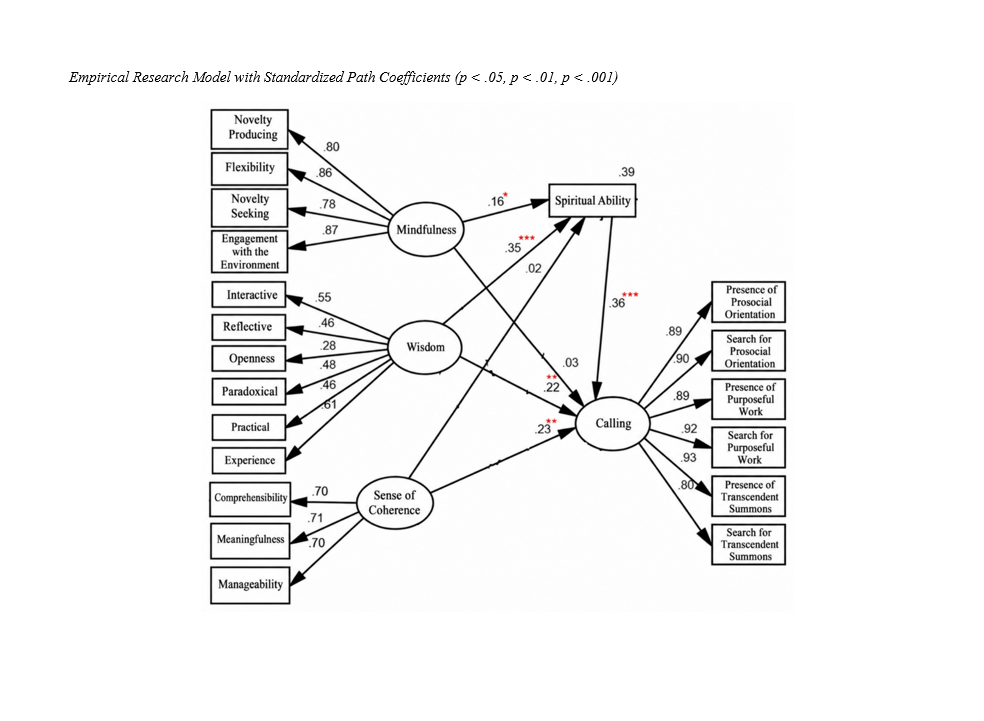
The present study aimed to investigate the relationship of sense of coherence, wisdom, and mindfulness with teachers’ calling, considering the mediating role of spiritual ability. In terms of purpose, the study was applied, and in terms of its nature, it employed a correlational design based on structural equation modeling. The statistical population consisted of all 3,630 female teachers in Urmia during the 2025–2026 academic year, from whom 590 teachers were selected using two-stage cluster sampling. Data were collected using the Calling and Vocation Questionnaire (Dik et al., 2012), Wisdom Scale (Schmit et al., 2012), Langer Mindfulness Scale (Langer, 2004), Sense of Coherence Scale (Antonovsky, 1987), and Spiritual Attitude Questionnaire (Shahidi & Farahnia, 2020). Data were analyzed using descriptive and inferential statistical methods in SPSS and AMOS. The findings indicated that sense of coherence, wisdom, spiritual ability, and workplace spirituality had significant direct effects on teachers’ calling (p < .05), whereas mindfulness did not have a significant direct effect on calling (p > .05). Furthermore, the mediating role of spiritual ability in the relationships of wisdom and mindfulness with calling was confirmed (p < .05), whereas its mediating role in the relationship between sense of coherence and calling was not supported (p > .05). The goodness-of-fit indices of the structural model indicated an acceptable fit of the proposed model to the collected data. Accordingly, strengthening teachers’ wisdom, mindfulness, and spiritual ability may contribute to enhancing their sense of calling.
Downloads
References
Akbari, T., Javidpour, M., & Shabanian, A. H. (2021). A path analysis model of addiction tendency based on sense of coherence with difficulty in emotion regulation as a mediator in male adolescents: A descriptive study. Journal of Rafsanjan University of Medical Sciences, 20(10), 1209-1222. https://journal.rums.ac.ir/article-1-5972-fa.html
Christodoulou, V., Flaxman, P. E., Morris, E. M., & Oliver, J. E. (2024). Comparison of mindfulness training and acceptance and commitment therapy in a workplace setting: Results from a randomized controlled trial. European Journal of work and organizational psychology, 33(3), 368-384. https://doi.org/10.1080/1359432X.2024.2314934
Dubey, S., & Bedi, S. S. (2024). Workplace spirituality: A systematic review and future research agenda. Journal of Management, Spirituality & Religion, 21(1), 83-128. https://doi.org/10.51327/CQER6430
Duffy, R. D., Allan, B. A., & Bott, E. M. (2012). Calling and life satisfaction among undergraduate students: Investigating mediators and moderators. Journal of Happiness Studies, 13(3), 469-479. https://psycnet.apa.org/record/2012-12570-005
Dumulescu, D., Opre, A., Necula, C. V., Cristea, D., & Mara, D. (2025). How does career calling impact teachers' self-efficacy, competencies and satisfaction? A structural equation model. International Journal for Educational and Vocational Guidance, 1-25. https://doi.org/10.1007/s10775-025-09728-4
Glück, J., & Brienza, J. P. (2025). Wisdom in action: A call to bridge fields in psychology (and beyond) to solve complex world problems. American psychologist. https://doi.org/10.1037/amp0001593
Jasiński, A. M., Derbis, R., Rakoczy, J., & Wrzesińska, M. (2025). The sense of coherence scale and relationships between sense of coherence, sociodemographic variables and chronic disease. Scientific reports, 15(1), 18289. https://www.sciencedirect.com/science/article/pii/S0001691826009509
Jinu, R. T. (2025). Workplace spirituality's effect on employee well-being, work-family integration and loyalty in higher education institutions: A holistic model. Global Business & Finance Review, 30(7), 187. https://www.kci.go.kr/kciportal/ci/sereArticleSearch/ciSereArtiView.kci?sereArticleSearchBean.artiId=ART003227133
Moghadam Hosseini, S. (2024). Predicting school principals' performance in empowering teachers and school staff based on spiritual intelligence and workplace spirituality with organizational intelligence as a mediator. Management of Education in Organizations, 13(1), 121-140. https://journalieaa.ir/browse.php?a_id=627&sid=1&slc_lang=fa
Mohammadi, B. S., Naami, A., Zarei, E., & Khalafi, A. (2023). The relationship of career calling with career success and a mastery-oriented teaching style: The mediating roles of job crafting and professional commitment among teachers. Rooyesh Psychology, 12(10), 57-68. https://frooyesh.ir/article-1-4844-fa.html
Mohammadi Fateh, A. (2023). A structural model of mindfulness and job performance: Examining the mediating roles of humble leadership and employee creativity. Military Science and Technology, 19(65), 171-200. https://www.qjmst.ir/article_710215.html
Naami, A., & Askari, M. (2024). Examining the effect of career calling on proactive work behavior and vitality at work: The mediating roles of promotion focus and job crafting among nurses. Psychological Achievements, 32(34), 435-474. https://psychac.scu.ac.ir/article_20783.html
Ran, J., Liu, H., Yuan, Y., Yu, X., & Dong, T. (2023). Linking career exploration, self-reflection, career calling, career adaptability and subjective well-being: A self-regulation theory perspective. Psychology research and behavior management, 16, 2805-2817. https://doi.org/10.2147/PRBM.S420666
Rastgar, A. A., Abedi Jafari, H., & Jabbari, E. (2022). Examining the effect of religiosity and psychological capital on employees' career calling with job meaningfulness as a mediator. Organizational Behavior Studies, 11(1), 31-54. https://obs.iaobm.ir/article_252385.html
Safari, A., Teymouri, H., Ghashghaei, Z., & Aghaei, M. (2019). Examining the behavioral consequences of workplace spirituality. Journal of Change Management Research, 11, 81-104. https://tmj.um.ac.ir/article_29791.html
Schmit, D. E., Muldoon, J., & Pounders, K. (2012). What is wisdom? The development and validation of a multidimensional measure. Journal of Leadership, Accountability and Ethics, 9(2), 39-54.
Shang, W., He, Y., & Bai, B. (2026). Perceived social support and pre-service teachers' career calling: Roles of vocational outcome expectations and professional identity. Frontiers in psychology, 17, 1826997. https://doi.org/10.3389/fpsyg.2026.1826997
Singh, R. K., & Singh, S. (2022). Spirituality in the workplace: A systematic review. Management Decision, 60(5), 1296-1325. https://psycnet.apa.org/record/2022-71420-005
Sode, R., & Chenji, K. (2024). The mediating role of workplace spirituality: Exploring the relationship between self-transcendence, spiritual transcendence, and innovative work behavior. Acta Psychologica, 245, 104228. https://doi.org/10.1016/j.actpsy.2024.104228
Syahir, A. N. A., Abidin, M. S. Z., Sa'ari, C. Z., & Rahman, M. Z. A. (2025). Workplace spirituality and its impact on employee well-being: A systematic literature review of global evidence. Journal of religion and health, 64(5), 3313-3345. https://doi.org/10.1007/s10943-025-02350-2
Wen, Y., Chen, H., Liu, F., & Wei, X. (2023). The relationship between career calling and resilience among rural-oriented pre-service teachers: The chain mediating role of career adaptability and decent work. Behavioral Sciences, 14(1), 11. https://www.mdpi.com/2076-328X/14/1/11
Wnuk, M., & Charzyńska, E. (2025). Organizational spirituality: Refining its measurement and exploring associations with individual spirituality at work and job satisfaction in Poland. Journal of religion and health, 64(6), 4500-4532. https://doi.org/10.1007/s10943-025-02431-2
Wu, J., Ghayas, S., Aziz, A., Adil, A., & Niazi, S. (2024). Relationship between teachers' professional identity and career satisfaction among college teachers: Role of career calling. Frontiers in psychology, 15, 1348217. https://doi.org/10.3389/fpsyg.2024.1348217
Zhang, S., Huang, X., & Sun, C. (2026). From 'meant to be' to 'passionate to be': The roles of calling, transformational leadership, and self-efficacy in teacher work engagement. International Journal of Leadership in Education, 1-24. https://doi.org/10.1080/13603124.2026.2643450
Zhao, X., Wu, K., Sun, B., & Li, W. (2022). Teacher career calling reduces burnout: The mediation effects of work engagement and psychological capital. Frontiers in psychology, 13, 988467. https://doi.org/10.3389/fpsyg.2022.988467
Downloads
Additional Files
Publication Timeline
- Submitted
- Revised
- Accepted