Health Anxiety and Quality of Life in Older Adults With Chronic Illness: The Mediating Roles of Emotion Regulation and Perceived Social Support
Keywords:
Health Anxiety, Quality of Life, Older Adults, Chronic Illness, Emotion Regulation, Perceived Social Support, Structural Equation ModelingAbstract
This study aimed to investigate the relationship between health anxiety and quality of life in older adults with chronic illness and to examine the mediating roles of emotion regulation and perceived social support in this relationship.
Methods and Materials: This cross-sectional descriptive-correlational study was conducted among 360 older adults aged 60 years and above with at least one physician-diagnosed chronic illness who were recruited from selected healthcare and community-based centers in Tehran, Iran, during 2026. Participants completed the Short Health Anxiety Inventory, World Health Organization Quality of Life-OLD instrument, Emotion Regulation Questionnaire, and Multidimensional Scale of Perceived Social Support. Data were analyzed using Pearson correlation coefficients, confirmatory factor analysis, and structural equation modeling in SPSS and AMOS. Model fit was evaluated using χ²/df, CFI, TLI, RMSEA, and SRMR. Indirect effects were tested using a nonparametric bootstrap procedure with 5,000 resamples and bias-corrected 95% confidence intervals.
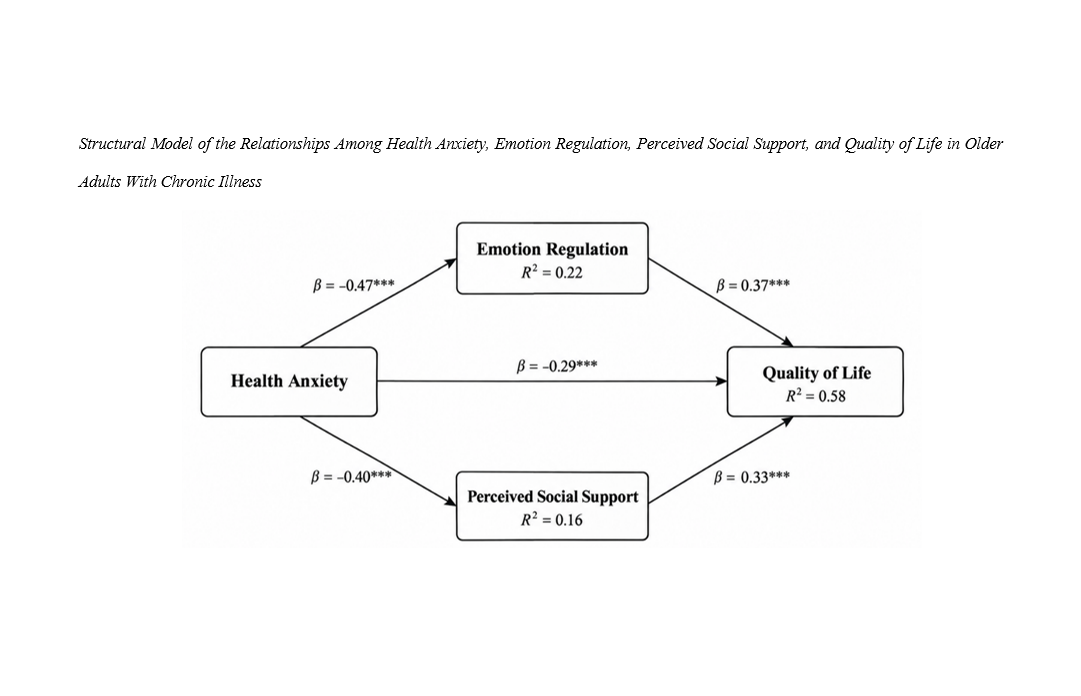
Findings: Health anxiety was negatively associated with quality of life (r = -.58, p < .001), adaptive emotion regulation (r = -.46, p < .001), and perceived social support (r = -.39, p < .001). In the structural model, health anxiety negatively predicted quality of life (β = -.29, p < .001), emotion regulation (β = -.47, p < .001), and perceived social support (β = -.40, p < .001). Emotion regulation (β = .37, p < .001) and perceived social support (β = .33, p < .001) positively predicted quality of life. The indirect effects through emotion regulation (β = -.17, 95% CI [-.24, -.12]) and perceived social support (β = -.13, 95% CI [-.19, -.08]) were significant. The model explained 58% of the variance in quality of life.
Conclusion: Health anxiety is associated with poorer quality of life among older adults with chronic illness both directly and indirectly through reduced adaptive emotion regulation and lower perceived social support, highlighting the importance of integrated psychological and social interventions in chronic disease care.
Downloads
References
Adriani, Y., & Handika, S. (2023). Influence of Self-Compassion, Social Support, and Living Arrangements on Subjective Well-Being of the Elderly. Psympathic Jurnal Ilmiah Psikologi, 10(1), 93-100. https://doi.org/10.15575/psy.v10i1.9918
Ahmadboukani, S., Fathi, D., Karami, M., Bashirgonbadi, S., Mahmoudpour, A., & Molaei, B. (2022). Providing a Health‐promotion Behaviors Model in Elderly: Psychological Capital, Perceived Social Support, and Attitudes Toward Death With Mediating Role of Cognitive Emotion Regulation Strategies. Health Science Reports, 6(1). https://doi.org/10.1002/hsr2.1020
Anand, P., Choudhary, P., Bali, M., & Gupta, R. (2024). Flourishing Among Elderly Population: The Role of Social Support and Gratitude. Psychological Reports, 129(4), 3255-3272. https://doi.org/10.1177/00332941241285845
Bai, J. (2024). The Role of Insecure Attachment in Emotional Disorders: From Children to the Elderly. Lecture Notes in Education Psychology and Public Media, 51(1), 125-134. https://doi.org/10.54254/2753-7048/51/20240960
Cé, R. (2025). The Influence of Emotional Intelligence on Healthy Aging. International Journal of Clinical Case Reports and Reviews, 22(3), 01-10. https://doi.org/10.31579/2690-4861/663
Chai, R. (2023). Research on the Application Value of Positive Psychology in Clinical Practice. International Journal of Clinical and Experimental Medicine Research, 7(4), 609-613. https://doi.org/10.26855/ijcemr.2023.10.016
Chang, K.-O. (2023). Effects of Physical Health Status, Social Support, and Depression on Quality of Life in the Korean Community-Dwelling Elderly. Advances in Public Health, 2023, 1-9. https://doi.org/10.1155/2023/7262390
Che, L., Guo, Z., Yang, Y., Kang, H., & Cao, S. (2022). Life-Cycle Spatial Strategy for Multidimensional Health-Oriented Medical Care Community—From the Perspective of Sustainable Marketing. Sustainability, 14(17), 11081. https://doi.org/10.3390/su141711081
Cui, C. (2026). Comparative Efficacy of Aerobic Exercise and Mind-Body Practices in Improving Sleep Quality and Psychological Distress Among Elderly Breast Cancer Patients: A Systematic Review. Frontiers in Oncology, 16. https://doi.org/10.3389/fonc.2026.1798402
Daniel, W. H., Anwar, C., Fajar, N. A., Sitorus, R. J., & Ghiffari, A. (2021). Improving the Quality of Life for the Elderly With Degenerative Diseases Through to the Charitas Group Virtual Health Education Program During the Pandemic of the COVID-19. Bioscientia Medicina Journal of Biomedicine and Translational Research, 5(8), 803-810. https://doi.org/10.32539/bsm.v5i8.389
Fazio, N. D., Morena, D., Delogu, G., Volonnino, G., Manetti, F., Padovano, M., Scopetti, M., Frati, P., & Fineschi, V. (2022). Mental Health Consequences of COVID-19 Pandemic Period in the European Population: An Institutional Challenge. International journal of environmental research and public health, 19(15), 9347. https://doi.org/10.3390/ijerph19159347
Field, T. (2022). Elderly Problems During COVID-19: A Narrative Review. International Journal of Psychological Research and Reviews. https://doi.org/10.28933/ijprr-2022-05-0507
Guadalupe-Tixi, P., & Santos-Morocho, J. (2024). Plan De Intervención Psicoterapéutica Para Reducir Los Efectos Emocionales Del Síndrome Del Nido Vacío en Adultos Mayores. Psiquemag/ Revista Científica Digital De Psicología, 13(1), 34-47. https://doi.org/10.18050/psiquemag.v13i1.2679
Herdian, H., Septiningsih, D. S., Estria, S. R., Nuryana, Z., Yuniawati, R., & Tarnoto, N. (2024). Beyond the Pandemic: Understanding the Perceived Changes in Mental Health of the Elderly Population. International Journal of Public Health Science (Ijphs), 13(2), 848. https://doi.org/10.11591/ijphs.v13i2.23353
Iswatun, I., Yusuf, A., Susanto, J., Makhfudli, M., Nasir, A., & Mardhika, A. (2022). Depression, Anxiety, Coping Strategies, Quality of Life of the Elderly During the COVID-19 Pandemic. International Journal of Public Health Science (Ijphs), 11(4), 1501. https://doi.org/10.11591/ijphs.v11i4.21768
Jia, C., Ren, P., Jia, J., Xu, J., Chen, M., & Zhang, X. (2025). Research on the Impact Mechanism of Offspring Human Capital Endowment on the Health-Related Quality of Life of Rural Fathers From the Perspective of Digital Integration. https://doi.org/10.21203/rs.3.rs-6299719/v1
Joaquim, S. B., Almeida, R. S. d., & Marques, A. (2023). Transdiagnostic Cognitive Behavioral Group Interventions: A Systematic Review. Cognitive therapy and research, 47(3), 303-326. https://doi.org/10.1007/s10608-023-10372-x
Kim, A., Kim, Y., Rhee, J., Lee, S. Y., Jeong, Y.-I., Lee, J., Yoo, Y., Kim, H., So, H., & Park, J. (2022). A Study on Emotions to Improve the Quality of Life of South Korean Senior Patients Residing in Convalescent Hospitals. International journal of environmental research and public health, 19(21), 14480. https://doi.org/10.3390/ijerph192114480
Li, X., He, Y., & Zhang, J. (2023). The Temporal Relationship Between Social Adaptation and Depression: The Moderating Role of Social Isolation. https://doi.org/10.21203/rs.3.rs-3663952/v1
Li, Z., Zhu, Y., Zhou, Q., Yi, A., Mo, C., Gao, J., Chen, J., Wang, T., Feng, Z., & Mo, X. (2025). Social Support Mediates the Relationship Between Depression and Subjective Well-Being in Elderly Patients With Chronic Diseases: Evidence From a Survey in Rural Western China. PLoS One, 20(6), e0325029. https://doi.org/10.1371/journal.pone.0325029
Lijing, Y., & Tian-Zi, Y. (2024). The Effect of Childbearing on the Subjective Well-Being of the Elderly and Its Psychological Mechanisms. Modern Management Science & Engineering, 6(3), p128. https://doi.org/10.22158/mmse.v6n3p128
Maggino, F. (2023). Well-Being and Quality of Life. 7651-7651. https://doi.org/10.1007/978-3-031-17299-1_304844
Manijeh, H. S., Rostami, M., & Ahmadboukani, S. (2021). Development of the Coronavirus Anxiety Model in the Elderly: Based on Hope and Health-Related Quality of Life With the Mediating Role of Perceived Social Support. Gerontology and geriatric medicine, 7. https://doi.org/10.1177/23337214211048324
Nadzir, Z. M., Fajria, K., Kitabi, I. A. A., & Simanjuntak, M. (2022). Phenomenological Study of Elderly Quality of Life in Pandemic Covid-19. Journal of Family Sciences, 7(1), 1-13. https://doi.org/10.29244/jfs.v7i1.36552
Obi, L. (2024). The Role of Recreational Activities in Enhancing Quality of Life Among the Elderly. International Journal of Arts Recreation and Sports, 3(3), 52-65. https://doi.org/10.47941/ijars.1944
Rosaly, P., & Parashar, N. (2021). The Relationship Between Coping Responses and Quality of Life Among Indian Elderly Population. Pijr, 23-26. https://doi.org/10.36106/paripex/3407826
Sridhar, A., & Kuriakose, H. (2024). Role of Psychological Well-Being, Quality of Life and Distress Tolerance in Caregivers of Geriatric Population: An Indian Exploratory Study. Working With Older People, 29(1), 57-65. https://doi.org/10.1108/wwop-03-2024-0015
Uğur, H. G., & Kabakci, M. (2025). The Perspectives of Elderly Residents in Nursing Home on Gardening Activities: A Qualitative Study. Psychogeriatrics, 25(2). https://doi.org/10.1111/psyg.70020
Ursu, A., & Măirean, C. (2022). Cognitive Emotion Regulation Strategies as Mediators Between Resilience and Stress During COVID-19 Pandemic. International journal of environmental research and public health, 19(19), 12631. https://doi.org/10.3390/ijerph191912631
Wu, S., Dai, F., Jiang, Y., Yang, H., Luo, C., Jiang, L., Gong, J., & Wu, C. (2025). Current Status and Factors Influencing Psychological Resilience and Positive Psychology in Patients With Tuberculosis Combined With Maintenance Hemodialysis: A Cross-Sectional Study. https://doi.org/10.21203/rs.3.rs-6665607/v1
Xue, P., Du, X., & Kong, J. (2025). Age-Dependent Mechanisms of Exercise in the Treatment of Depression: A Comprehensive Review of Physiological and Psychological Pathways. Frontiers in psychology, 16. https://doi.org/10.3389/fpsyg.2025.1562434
Yang, S., Peng, H., Jing, L., Wang, H., & Chen, S. (2025). Exploring the Association Between Physical Activity, Regulatory Emotional Self-Efficacy, Perceived Self-Burden, and Social Isolation Among Older Adults in China. Healthcare, 13(6), 687. https://doi.org/10.3390/healthcare13060687
Yin, H., Quan, Z., & Zhang, Y. (2023). The Relationship Between Frailty, Walking Ability, and Depression in Elderly Chinese People. Medicine, 102(45), e35876. https://doi.org/10.1097/md.0000000000035876
Zhang, X., & Xu, C. (2021). Research Progress on Self-Care Ability of Hemodialysis Patients. Open Journal of Nursing, 11(05), 320-330. https://doi.org/10.4236/ojn.2021.115029
Zhou, J., Wu, B., Su, L., & Ma, X. (2024). The Influence of Tai Chi on the Death Anxiety of Elderly People Living Alone: The Chain Mediating Effect of Social Support and Psychological Capital. Frontiers in psychology, 14. https://doi.org/10.3389/fpsyg.2023.1303524
Downloads
Additional Files
Publication Timeline
- Submitted
- Revised
- Accepted