Predicting Marital Burnout Based on Negative Affect and Psychological Distress: The Mediating Role of Alexithymia in Couples
Keywords:
marital burnout, negative affect, psychological distress, alexithymia, couplesAbstract
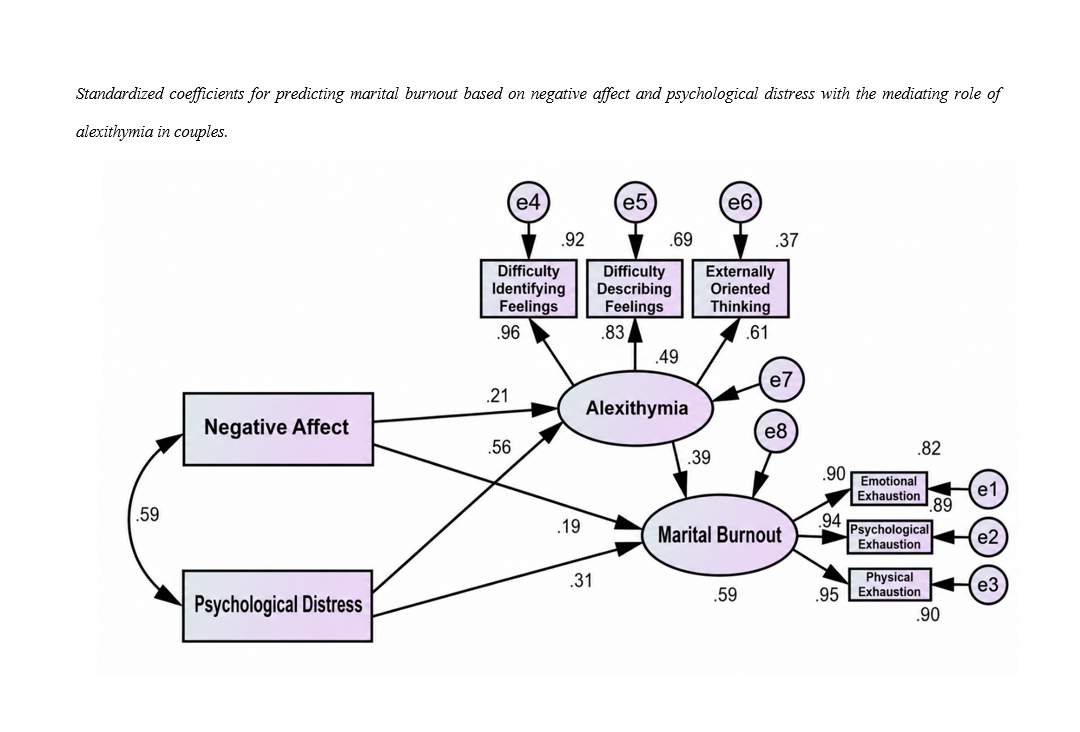
Marital burnout is one of the detrimental consequences of marital relationships that can adversely affect couples’ mental health and quality of life; therefore, identifying the factors contributing to it is of particular importance. The present study aimed to predict marital burnout based on negative affect and psychological distress, with the mediating role of alexithymia in couples. The study population consisted of all couples residing in Yazd. Multistage cluster sampling was employed, and 230 individuals were selected as the final sample. The research instruments included the Pines Marital Burnout Questionnaire (1996), the Positive and Negative Affect Schedule (PANAS; Watson & Tellegen, 1988), the Psychological Distress Scale (Kessler et al., 2002), and the Toronto Alexithymia Scale (Bagby, Parker, & Taylor, 1994). Data were analyzed using Pearson correlation and structural equation modeling (SEM) with SPSS 27 and AMOS 26. The results indicated that the direct effect of negative affect on marital burnout was significant (β = .186, p < .05), the direct effect of psychological distress on marital burnout was significant (β = .312, p < .05), the direct effect of alexithymia on marital burnout was significant (β = .388, p < .05), the direct effect of negative affect on alexithymia was significant (β = .209, p < .05), and the direct effect of psychological distress on alexithymia was significant (β = .559, p < .05). Furthermore, the indirect effect of negative affect on marital burnout through alexithymia was significant (β = .217, p < .05), and the indirect effect of psychological distress on marital burnout through alexithymia was also significant (β = .081, p < .05). Accordingly, the findings highlight the necessity of systematically addressing alexithymia and emotion regulation in the assessment and implementation of couple-therapy interventions aimed at preventing and reducing marital burnout.
Downloads
References
Adeyeye, G. M. (2023). Social Media and Its Influence on Psychological Distress of Married Women: The Aftermath of Marital Trauma. International Journal of Multicultural Education, 25(02), 473-483.
Adnan, H. A., Arshat, Z., Juhari, R., & Ahmad Shahril, N. S. S. A. (2025). Mental Wellbeing of Drug Addicts' Wives: Roles of Economic Strain, Marital Conflict, and Social Support. Akademika, 95(1), 160-183. https://doi.org/10.17576/akad-2025-9501-10
Ahmadi, B., & Rajabi, G. (2022). Emotion regulation difficulties and emotional burnout in marriage. Applied Psychology, 16(3), 180-195.
Ahmadi, B., & Rajabi, G. (2023). Mediating role of emotion regulation difficulties in the relationship between stress and marital burnout. Clinical Psychology, 15(1), 80-95.
Akbari, F. (2023). Alexithymia, stress, and marital dissatisfaction. Journal of Couple and Family Studies, 6(1), 33-50.
Alavi, M., & Rezvan, S. (2022). Predicting marital burnout based on psychological distress. Family Counseling and Psychotherapy, 12(4), 180-199.
Allen, J. P., Costello, M. A., Hellwig, A. F., & Stern, J. A. (2025). Pathways from adolescent close friendship struggles to adult negative affectivity. Development and Psychopathology, 37(1), 241-250. https://doi.org/10.1017/S0954579423001542
Alsawalqa, R. O. (2019). Marriage burnout: When the emotions exhausted quietly quantitative research. Iranian journal of psychiatry and behavioral sciences, 13(2). https://doi.org/10.5812/ijpbs.68833
Amrei Barchalouei, S., Khoshkonash, A., & Fallahzadeh, H. (2021). Predicting marital burnout in couples based on procrastination and lifestyle. Women and Family Studies, 9(3), 129-155.
Bahmani, N., Etemadi, O., Ahmadi, S. A., & Fatehizadeh, M. (2017). Exploring factors affecting marital disillusionment among Iranian couples: A qualitative study. Behavioral Sciences Research, 15(4), 467-473.
Barnett, M. D., & Ruiz, I. A. (2018). Psychological distress and compassion fatigue among hospice nurses: the mediating role of self-esteem and negative affect. Journal of Palliative Medicine, 21(10), 1504-1506. https://doi.org/10.1089/jpm.2017.0662
Battaglini, A. M., Zareian, B., & LeMoult, J. (2025). Intra-versus interpersonal emotion regulation: Associations with affect, relationship quality and closeness, and biological markers of stress. Journal of Experimental Psychology: General. https://doi.org/10.1037/xge0001757
Besharat, M. A., & Shahidi, S. (2021). Alexithymia as a mediator in marital dissatisfaction. Personality and individual differences, 171, 110471. https://doi.org/10.1016/j.paid.2020.110471
Bodenmann, G., Randall, A. K., & Falconier, M. K. (2020). Stress, negative emotions, and couple functioning. Family Process, 59(3), 1034-1049.
Bourassa, K. J., Tackman, A. M., Mehl, M. R., & Sbarra, D. A. (2019). Psychological overinvolvement, emotional distress, and daily affect following marital dissolution. Collabra: Psychology, 5(1). https://doi.org/10.1525/collabra.184
Bovo, A., Smith, P., Karam, M., & Luminet, O. (2026). The association between alexithymia and risk of burnout among nurses during the COVID-19 pandemic in Belgium: A cross-sectional study. Journal of Workplace Behavioral Health, 1-21. https://doi.org/10.1080/15555240.2026.2615422
Destiani, D. M., Izzaty, R. E., & Herwin, H. (2026). Trend Trends and Gaps in Marital Satisfaction Research in Indonesian Psychology: A Systematic Review (2019-2024). G-Couns: Jurnal Bimbingan Dan Konseling, 10(02), 1009-1026. https://doi.org/10.31316/g-couns.v10i02.7761
Dumessa, L., Oliveros, A. D., & Coleman, A. (2020). Attributions of conflict: impact on the relation between parental physical maltreatment and emotion regulation difficulties. Journal of Aggression, Maltreatment & Trauma, 29(1), 57-72. https://doi.org/10.1080/10926771.2018.1544183
Farazmand, M., & Ebrahimi, S. (2018). Effectiveness of quality-of-life therapy on marital burnout and psychological distress in infertile women. Journal of Mashhad University of Medical Sciences, 61(6.1), 320-329.
Fatemi, S. M., Dayari, M. M., & Mousavi, S. E. (2025). Developing a preventive package for marital burnout based on the lived experiences of couples disillusioned with married life. Journal of Psychological Sciences, 24(152), 241-261.
Ghasemi, N., & Ahmadi, S. (2023). Predicting marital burnout based on negative affect and emotion regulation. Journal of Clinical Psychology Studies, 14(1), 77-94.
Hosseini, S. A., & Sharifi, D. (2021). The mediating role of alexithymia in marital burnout. Contemporary Psychology Quarterly, 15(2), 89-106.
Kocyigit, M., & Uzun, M. (2025). Emotion regulation and couple burnout in marriage: A moderated moderation model of authenticity, sex of parents and having children. Current Psychology, 44(5), 3564-3578. https://doi.org/10.1007/s12144-024-07253-1
Lin, Y., Wang, Y., Lin, C., Ni, Q., Jia, R., Chang, Y., & Qi, Y. (2023). The mediating role of perceived social support: alexithymia and parental burnout in parents of children with autism spectrum disorder. Frontiers in psychology, 14, 1139618. https://doi.org/10.3389/fpsyg.2023.1139618
Mafi, S., Tajvar, N., & Jalalvand, S. (2025). The role of emotional intelligence, academic burnout, and alexithymia in shaping academic outcomes for dental students.
Marques, S. C., Couto, M., & Canavarro, M. C. (2024). Emotional unawareness and relationship burnout. Journal of Social and Personal Relationships, 41(2), 389-407.
Neff, L. A., & Karney, B. R. (2020). Stress spillover in early marriage. Journal of personality and social psychology, 117(3), 553-575.
Obioma, I. F., Raina, M., Jaga, A., Asekun, W. A., Misurya, P., & Hernandez Bark, A. S. (2025). Gender and marital burnout within four countries: Examining the effects of conflict negotiation styles. Journal of Social and Personal Relationships, 42(12), 3509-3533. https://doi.org/10.1177/02654075251371383
Pengpid, S., Peltzer, K., Hajek, A., & Gyasi, R. M. (2025). Marital dissatisfaction and adverse health and psychosocial outcomes among community-dwelling persons 45 years and older in Thailand. Health Psychology and Behavioral Medicine, 13(1). https://doi.org/10.1080/21642850.2025.2589568
Rezaei, A. (2020). The relationship between negative affect and marital burnout in urban couples. Family Studies Quarterly, 16(4), 101-118.
Rezaei, A., & Mohammadi, F. (2020). Negative emotions and marital burnout in married women. Journal of Clinical Psychology and Personality, 19(1), 17-30.
Scarzello, D., & Prino, L. E. (2025). Teacher burnout in pre-schools: The role of alexithymia and job satisfaction. Psychology in the Schools. https://doi.org/10.1002/pits.23532
Ścigała, D. K., Sikora-Ścigała, J., & Zdankiewicz-Ścigała, E. (2025). Alexithymia and attachment dimensions in relation to parental burnout: A structural equation modelling approach. PLoS One, 20(11). https://doi.org/10.1371/journal.pone.0334647
Tsubaki, K., & Shimizu, E. (2024). Psychological Treatments for Alexithymia: A Systematic Review. Behavioral Sciences, 14(12), 1173. https://doi.org/10.3390/bs14121173
Verzeletti, C., Rafnsson, F. D., & Roberts, G. W. (2019). Alexithymia and adult attachment. Personality and individual differences, 149, 150-157.
Wang, X. X., Lin, Q., Liu, X., Dong, P., Bao, Y., Que, J. Y., & Liu, J. J. (2025). The association between couple relationships and sleep: A systematic review and meta-analysis. Sleep Medicine Reviews, 79, 102018. https://doi.org/10.1016/j.smrv.2025.102081
Wang, Z., Zhang, X., & Ye, Y. (2024). Does marital satisfaction predict children aggression? Insights from parents' and children's psychological distress. Child & Family Social Work, 29(3), 615-624. https://doi.org/10.1111/cfs.13121
Wu, L., Xie, R., Zhang, Y., & Ding, W. (2025). Actor-partner interdependence of parents' parenting stress on marital satisfaction: The mediating role of emotion dysregulation. Journal of affective disorders, 120831. https://doi.org/10.1016/j.jad.2025.120831
Downloads
Additional Files
Publication Timeline
- Submitted
- Revised
- Accepted