Examining the Predictive Role of Computer Game Use, Impulse Control, and Quality of Family Relationships in the Occurrence of High-Risk Behaviors Among Upper Secondary School Students
Keywords:
high-risk behaviors, computer games, impulsivity, impulse control, quality of family relationshipsAbstract
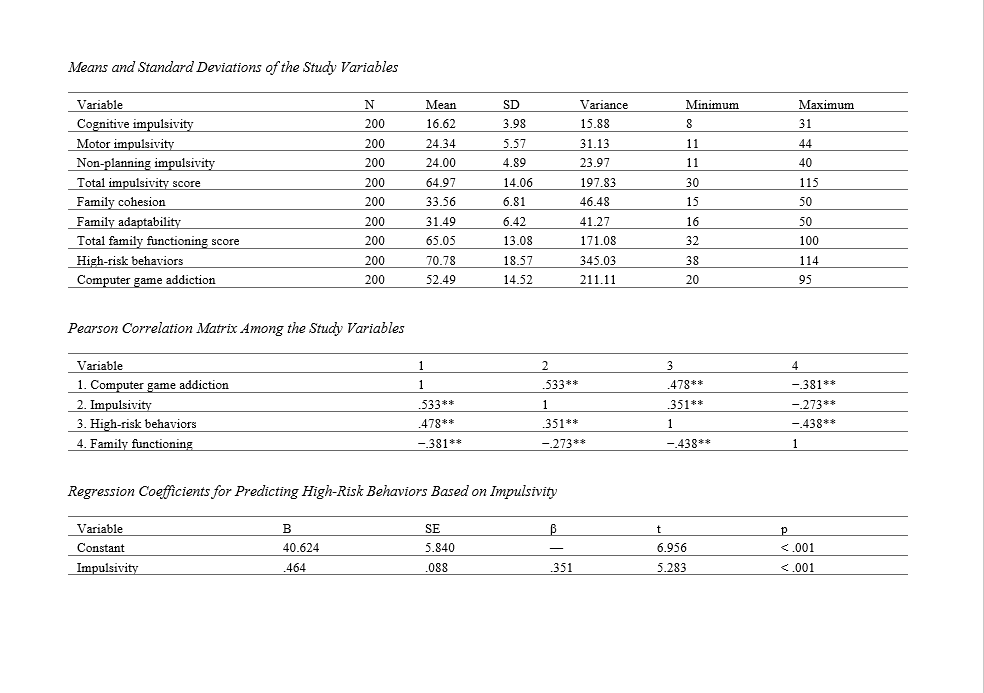
High-risk behaviors during adolescence constitute a major mental health challenge and are influenced by multiple factors. The present study aimed to examine the predictive roles of computer game use, impulsivity, and the quality of family relationships in the occurrence of high-risk behaviors among students. This descriptive-correlational study was conducted with 200 upper secondary school students. Data were collected using the Iranian Adolescents Risk-Taking Scale, the Barratt Impulsiveness Scale, the Family Adaptability and Cohesion Evaluation Scale, and the Computer Game Addiction Questionnaire and were analyzed using Pearson’s correlation coefficient and multiple regression analysis. Findings: The results indicated significant positive relationships between computer game use and high-risk behaviors and between impulsivity and high-risk behaviors (p < .01). In contrast, the quality of family relationships was significantly and negatively associated with high-risk behaviors. The regression model showed that the independent variables collectively explained 31.4% of the variance in high-risk behaviors (p < .01). Furthermore, excessive computer game use significantly increased the likelihood of being classified at a high level of high-risk behaviors. The findings highlight the protective role of the family and the detrimental effects of excessive involvement in computer games and poor impulse control on the occurrence of high-risk behaviors. Therefore, the development of school-based preventive interventions focusing on self-control skills and enhancement of the emotional climate of the family appears necessary.
Downloads
References
Abedi Parija, H., & Sadeghi, E. (2022). Analyzing the Tendency toward Risky Behaviors among Upper-Secondary Students: Assessing Gender Differences Based on Individual, Family, and Peer Factors. Research in Guidance and Counseling Education(17), 34-57.
Alizadeh, L., Momeni, K., & Jebraeili, H. (2023). The Relationship of Brain-Behavioral Systems, Impulsivity, and Delay Discounting with Risky Behaviors in Adolescents: The Mediating Role of Emotion Regulation Difficulties. Quarterly Journal of Educational Psychology, 19(68), 26-45.
Arabnejad, S., Mofakhari, A., & Ranjbar, M. J. (2018). The Role of Family Cohesion and Self-Worth in Predicting the Tendency toward Risky Behaviors in Lower-Secondary Students. Psychological studies, 14(1), 147-162.
Beauchaine, T. P., Zisner, A. R., & Sauder, C. L. (2017). Trait Impulsivity and the Externalizing Spectrum. Annual Review of Clinical Psychology, 13, 343-368. https://doi.org/10.1146/annurev-clinpsy-021815-093447
Boson, K., Gurdal, S., Claesdotter-Knutsson, E., & Kapetanovic, S. (2024). Adolescent Gaming and Parent-Child Emotional Closeness: Bivariate Relationships in a Longitudinal Perspective. Current Psychology, 43. https://doi.org/10.1007/s12144-024-05714-1
Brand, M., Young, K. S., Laier, C., Wölfling, K., & Potenza, M. N. (2016). Integrating Psychological and Neurobiological Considerations Regarding the Development and Maintenance of Specific Internet-Use Disorders: An Interaction of Person-Affect-Cognition-Execution (I-PACE) Model. Neuroscience & Biobehavioral Reviews, 71, 252-266. https://doi.org/10.1016/j.neubiorev.2016.08.033
Chen, S., Liao, J., Wang, X., Li, J., Liu, Y., & Zhang, W. (2025). Longitudinal Relationship between Gaming Disorder Symptoms, Hyperactivity/Inattention Symptoms and Aggression among Chinese Adolescents: Within-Person and Between-Person Effects. Computers in human Behavior, 167, 108608. https://doi.org/10.1016/j.chb.2025.108608
Coyne, S. M., & Stockdale, L. A. (2018). Family Processes and Problematic Media Use among Adolescents.
Ergin, D. A., & Essau, C. A. (2025). Family Factors and Internet Gaming Disorder among Adolescents: A Systematic Review. International Journal of Developmental Science, 19(3-4), 122-135. https://doi.org/10.1177/2192001X251352496
Fong, T. C., Cui, K., & Yip, P. S. (2024). Interaction Effects Between Low Self-Control and Meaning in Life on Internet Gaming Disorder Symptoms and Functioning in Chinese Adolescents. Journal of medical Internet research, 26, e59490. https://doi.org/10.2196/59490
Gelmez Burakgazi, S. (2024). The Ecological Model of Human Development. In. https://doi.org/10.4018/979-8-3693-5812-2.ch013
Ghiaccio, R., Passaro, A., Stasolla, F., Martini, E., De Fortuna, A. M., & De Luca Picione, R. (2025). Exploring the Association Between Problematic Internet Use, Internet Gaming Disorder in Adolescents with ADHD: A Scoping Review. International journal of environmental research and public health, 22(4), 496. https://doi.org/10.3390/ijerph22040496
Gou, S., Yuan, R., Zhang, W., Tang, Y., & Zhang, W. (2024). Problematic Social Media Use in Youths Causes Response Inhibition Impairment. Current Psychology, 43, 13555-13564. https://doi.org/10.1007/s12144-023-05425-z
Habibzadeh, Z., & Ghorban Shiroudi, S. (2022). The Relationship between Online Gaming Dependence and Social Anxiety in Adolescents. Quarterly Journal of New Ideas in Psychology, 15(19).
Hammad, M. A., & Al-Shahrani, H. F. (2024). Impulsivity and Aggression as Risk Factors for Internet Gaming Disorder among University Students. Scientific reports, 14(1), 3712. https://doi.org/10.1038/s41598-024-53807-5
Han, T. S., Cho, H., Sung, D., & Park, M. (2022). A Systematic Review of the Impact of COVID-19 on the Game Addiction of Children and Adolescents. Frontiers in Psychiatry, 13, 976601. https://doi.org/10.3389/fpsyt.2022.976601
Jalali, H. (2023). Examining the Effect of Computer Games on Students' Behavior and Academic Performance Second National Conference on New Developments in Developmental and Educational Psychology, Bandar Abbas, Iran.
Joukar, M., Masoumi, A., Joukar, M., Haghaninejad, H., Akbari, A., & Ardian, N. (2023). Examining the Effect of Computer Game Use and the Presence of Aggression in Adolescents. Toloo-e Behdasht, 22(3), 50-60.
Kaptanovic, A. (2024). Impulsivity as a Predictor of Risk Behaviors and Problematic Media Use among Adolescents. Journal of youth and adolescence.
Kuss, D. J., & Griffiths, M. D. (2012). Online Gaming Addiction in Children and Adolescents: A Review of Empirical Research. Journal of Behavioral Addictions, 1(1), 3-22. https://doi.org/10.1556/JBA.1.2012.1.1
Liu, Z., & Xie, J. (2025). The Development and Validation of the Adolescent Problematic Gaming Scale (PGS-Adolescent). Behavioral Sciences, 15(1), 13. https://doi.org/10.3390/bs15010013
Mina, F., & Aminimanesh, S. (2021). Predictors of the Tendency toward Risky Behaviors in Adolescent Girls: The Role of Emotional Dysregulation, Differentiation, and Assertiveness. Social Psychology Research, 11(44), 183-197.
Oyanadel, C., Worrell, F. C., Pinto-Vigueras, J., Betancur, S., Véliz Tapia, T., Au-Castro, M., Peña-Reyes, G., González-Loyola, M., & Peñate, W. (2023). Time Balance and Family Functioning: The Role of Time Perspective in the Cohesion and Adaptability of Families with Adolescents. European Journal of Investigation in Health, Psychology and Education, 14(1), 117-132. https://doi.org/10.3390/ejihpe14010008
Petrescu, T., Błachnio, A., & Enea, V. (2025). Internet Gaming Disorder in Children and Adolescents: A Systematic Review of Familial Protective and Risk Factors. Addictive behaviors, 167, 108345. https://doi.org/10.1016/j.addbeh.2025.108345
Pivetta, E., Marengo, D., & Settanni, M. (2024). Longitudinal Associations between Parenting Practices, Problematic Gaming, and Cyberaggression in Adolescence. Computers in human Behavior, 150, 107985. https://doi.org/10.1016/j.chb.2023.107985
Pruitt, P. J. (2023). Neurobiological Sensitivity to Social Rewards and Punishments Moderates Link between Peer Norms and Adolescent Risk Taking. Journal of Research on Adolescence.
Rani, K., Khakha, D. C., Karthikeyan, A. K. T., & Patra, B. N. (2025). Association between Gaming Disorders and Psychosocial Correlates among Adolescents. Industrial Psychiatry Journal, 34(3), 450-455. https://doi.org/10.4103/ipj.ipj_68_25
Raybould, J. N., & Tunney, R. J. (2024). Factor Analysis of Impulsivity in Gaming Disorder and Internet Gaming Disorder. BMC psychiatry, 24, 652. https://doi.org/10.1186/s12888-024-06072-9
Sarvari, M., Bayat, A., & Hosseinzadeh, A. (2023). The Relationship between Risky Behaviors and Family Communication Patterns in Adolescents: The Mediating Role of Emotional Security. Journal of Family Research, 19(3), 533-550.
Shapiro, O., Gannot, R. N., Green, G., Zigdon, A., Zwilling, M., Giladi, A., & Harel-Fisch, Y. (2022). Risk Behaviors, Family Support, and Emotional Health among Adolescents during the COVID-19 Pandemic in Israel. International journal of environmental research and public health, 19(7), 3850. https://doi.org/10.3390/ijerph19073850
Stevens, E. S., Funkhouser, C. J., Auerbach, R. P., Talati, A., Gameroff, M. G., Posner, J. E., Weissman, M. M., & Shankman, S. A. (2023). Inhibition Predicts the Course of Depression and Anxiety Symptoms among Adolescents: The Moderating Role of Familial Risk. Journal of Nervous and Mental Disease, 211(2), 100-107. https://doi.org/10.1097/NMD.0000000000001584
Wang, Y., Li, Y., Liu, B., Zhao, X., Geng, X., Zhu, W., & Ding, X. (2024). Adolescent Internet Gaming Disorder and Sensitivity to Money and Social Rewards. Acta Psychologica, 248, 104431. https://doi.org/10.1016/j.actpsy.2024.104431
Weinstein, A., & Lejoyeux, M. (2015). New Developments on the Neurobiological and Pharmaco-Genetic Mechanisms Underlying Internet and Videogame Addiction. https://doi.org/10.1111/ajad.12110
Zandi, P. A., & Mirzaei Doustan, Z. (2019). Predicting Online Gaming Addiction Based on Cognitive Distortion, Parenting Style, and Narcissistic Personality Traits in Students. Iranian Journal of Psychiatry and Clinical Psychology, 25(1), 72-83.
Zhou, J., Zhao, H., Wang, L., & Zhu, D. (2023). The Vicious Cycle of Family Dysfunction and Problematic Gaming and the Mediating Role of Self-Concept Clarity among Early Adolescents: A Within-Person Analysis Using Random Intercept Cross-Lagged Panel Modeling. Journal of Behavioral Addictions, 12(4), 920-937. https://doi.org/10.1556/2006.2023.00054
Downloads
Additional Files
Publication Timeline
- Submitted
- Revised
- Accepted