A Causal Model of Anxiety Symptoms Based on Perceived Social Support and Difficulties in Emotion Regulation: The Mediating Role of Ego Strength Among Afghan Nationals
Keywords:
anxiety, perceived social support, difficulties in emotion regulation, ego strength, Afghan nationalsAbstract
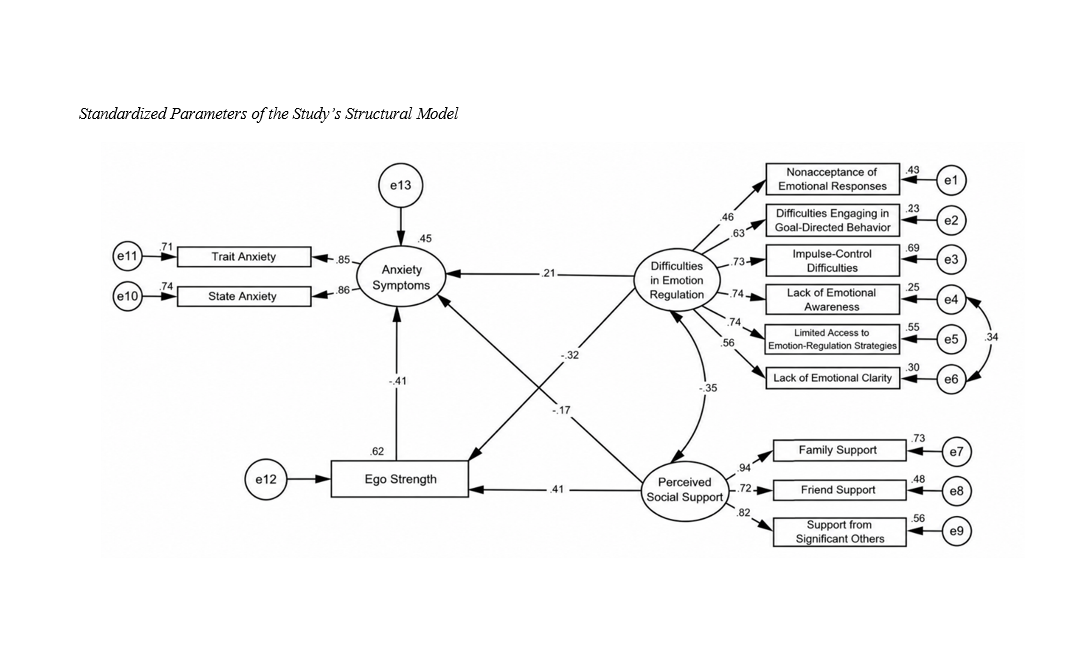
Anxiety is one of the most common mental health problems. In addition to emotional factors, supportive resources and individuals’ psychological capacities play a determining role in its development and persistence. The present study aimed to evaluate a causal model of anxiety symptoms based on perceived social support and difficulties in emotion regulation, with ego strength as a mediator, among Afghan nationals. This study employed a descriptive-correlational design. The statistical population comprised all Afghan women and men living in Tehran during 2024–2025. From this population, 204 individuals were selected through stratified sampling and completed the State–Trait Anxiety Inventory, the Multidimensional Scale of Perceived Social Support, the Difficulties in Emotion Regulation Scale, and the Ego Strength Scale. The data were analyzed using structural equation modeling in AMOS version 26. The results indicated that the proposed model demonstrated an acceptable fit to the data and explained 47% of the variance in anxiety symptoms, indicating the central role of the variables included in the model in explaining anxiety. Within the structural relationships of the model, perceived social support played a determining role in strengthening ego strength and explained approximately 41% of its variance. In contrast, ego strength had a significant negative effect on anxiety symptoms, whereas difficulties in emotion regulation had a significant positive effect on anxiety. Perceived social support also exerted a significant indirect effect on anxiety symptoms through increased ego strength, while difficulties in emotion regulation exerted a significant indirect effect through reduced ego strength. Overall, the pattern of findings indicates that perceived social support, ego strength, and difficulties in emotion regulation are three central components in explaining anxiety symptoms. These results emphasize the simultaneous importance of external supportive resources and internal psychological capacities in understanding the structure of anxiety among Afghan nationals.
Downloads
References
Aardema, F., O'Connor, K. P., Delorme, M. E., & Audet, J. S. (2017). The inference-based approach (IBA) to the treatment of obsessive-compulsive disorder: An open trial across symptom subtypes and treatment-resistant cases. Clinical Psychology & Psychotherapy, 24(2), 289-301. https://doi.org/10.1002/cpp.2024
Balachander, S., Bajaj, A., Hazari, N., Kumar, A., Anand, N., Manjula, M., Sudhir, P. M., Cherian, A. V., Narayanaswamy, J. C., Jaisoorya, T. S., Math, S. B., Kandavel, T., Arumugham, S. S., & Janardhan Reddy, Y. C. (2020). Long-term outcomes of intensive inpatient care for severe, resistant obsessive-compulsive disorder. The Canadian Journal of Psychiatry, 65(11), 779-789. https://doi.org/10.1177/0706743720927830
Bandelow, B., Allgulander, C., Baldwin, D. S., da Costa, D. L. C., Denys, D., Dilbaz, N., Domschke, K., Hollander, E., Kasper, S., Moller, H. J., Eriksson, E., Fineberg, N. A., Hattenschwiler, J., Kaiya, H., Karavaeva, T., Katzman, M. A., Kim, Y. K., Inoue, T., Lim, L., & Zohar, J. (2023). World Federation of Societies of Biological Psychiatry (WFSBP) guidelines for treatment of anxiety, obsessive-compulsive and posttraumatic stress disorders—Version 3. Part II: OCD and PTSD. The World Journal of Biological Psychiatry, 24(2), 118-134. https://doi.org/10.1080/15622975.2022.2086296
Bey, K., Willems, S., Dueren, A. L., Philipsen, A., & Wagner, M. (2025). Help-seeking behavior, treatment barriers and facilitators, attitudes and access to first-line treatment in German adults with obsessive-compulsive disorder. BMC psychiatry, 25, 235. https://doi.org/10.1186/s12888-025-06655-0
Castle, D., Feusner, J., Laposa, J. M., Richter, P. M. A., Hossain, R., Lusicic, A., & Drummond, L. M. (2023). Psychotherapies and digital interventions for OCD in adults: What do we know, what do we need still to explore? Comprehensive Psychiatry, 120, 152357. https://doi.org/10.1016/j.comppsych.2022.152357
Faustino, D., Braga, R., Faria, M. J., Goncalves, M. M., & Oliveira, J. T. (2025). A systematic review on how to combine exposure and response prevention with add-ons for the treatment of obsessive-compulsive disorder. Psychotherapy, 62(2), 132-143. https://doi.org/10.1037/pst0000560
Key, B. L., Rowa, K., Bieling, P., McCabe, R., & Pawluk, E. J. (2017). Mindfulness-based cognitive therapy as an augmentation treatment for obsessive-compulsive disorder. Clinical Psychology & Psychotherapy, 24(5), 1109-1120. https://doi.org/10.1002/cpp.2076
Kulz, A. K., Landmann, S., Cludius, B., Rose, N., Heidenreich, T., Jelinek, L., Alsleben, H., Wahl, K., Philipsen, A., Voderholzer, U., Maier, J. G., & Moritz, S. (2019). Mindfulness-based cognitive therapy in patients with obsessive-compulsive disorder and residual symptoms after cognitive behavioral therapy: A randomized controlled trial. European Archives of Psychiatry and Clinical Neuroscience, 269(2), 223-233. https://doi.org/10.1007/s00406-018-0957-4
Kvale, G., Hansen, B., Hagen, K., Abramowitz, J. S., Bortveit, T., Craske, M. G., Franklin, M. E., Haseth, S., Himle, J. A., Hystad, S., Kristensen, U. B., Launes, G., Lund, A., Solem, S., & Ost, L. G. (2020). Effect of D-cycloserine on the effect of concentrated exposure and response prevention in difficult-to-treat obsessive-compulsive disorder: A randomized clinical trial. JAMA Network Open, 3(8), e2013249. https://doi.org/10.1001/jamanetworkopen.2020.13249
Loureiro, C. P., dos Santos-Ribeiro, S., Moreira-de-Oliveira, M. E., Laurito, L. D., Huhne, V., Torres, B., Twohig, M. P., de Menezes, G. B., & Fontenelle, L. F. (2026). Acceptance and commitment therapy for obsessive-compulsive disorder: Cross-cultural systematic review and meta-analysis. Journal of psychiatric research, 196, 263-273. https://doi.org/10.1016/j.jpsychires.2026.01.035
Mirzapour Alamdari, M., Khanmohammadi, A., & Khaneh Keshi, A. (2025). Comparing exposure and response prevention and emotion-focused therapy on experiential avoidance, intolerance of uncertainty, and emotion regulation in patients with obsessive-compulsive disorder. International Journal of Body, Mind and Culture, 12(9), 195-206. https://doi.org/10.61838/ijbmc.v12i9.1052
Nanjundaswamy, M. H., Arumugham, S. S., Narayanaswamy, J. C., & Janardhan Reddy, Y. C. (2020). A prospective study of intensive in-patient treatment for obsessive-compulsive disorder. Psychiatry research, 291, 113303. https://doi.org/10.1016/j.psychres.2020.113303
Nielsen, S. K. K., Stuart, A. C., Winding, C., Ollgaard, M., Wolitzky-Taylor, K., Daniel, S. I. F., Vangkilde, S., Rosenberg, N., Hageman, I., & Jorgensen, M. B. (2025). Group acceptance and commitment therapy versus cognitive behavioral therapy/exposure response prevention for obsessive compulsive disorder: A block randomized controlled trial. Psychotherapy and psychosomatics, 94(3), 135-146. https://doi.org/10.1159/000544070
Ost, L. G., Enebrink, P., Finnes, A., Ghaderi, A., Havnen, A., Kvale, G., Salomonsson, S., & Wergeland, G. J. (2022). Cognitive behavior therapy for obsessive-compulsive disorder in routine clinical care: A systematic review and meta-analysis. Behaviour Research and Therapy, 159, 104170. https://doi.org/10.1016/j.brat.2022.104170
Rajaei Moshaei, G., & Rasouli, N. (2025). Effectiveness of repetitive transcranial magnetic stimulation on emotion regulation and doubt in adults with obsessive-compulsive disorder. International Journal of Body, Mind and Culture, 12(9), 285-292. https://doi.org/10.61838/ijbmc.v12i9.790
Ramakrishnan, D., Farhat, L. C., Vattimo, E. F. Q., Levine, J. L. S., Johnson, J. A., Artukoglu, B. B., Landeros-Weisenberger, A., Zangen, A., Pelissolo, A., Pereira, C. A. B., Ruck, C., Costa, D. L. C., Mataix-Cols, D., Shannahoff-Khalsa, D., Tolin, D. F., Zarean, E., Meyer, E., Hawken, E. R., Storch, E. A., & Bloch, M. H. (2024). An evaluation of treatment response and remission definitions in adult obsessive-compulsive disorder: A systematic review and individual-patient data meta-analysis. Journal of psychiatric research, 173, 387-397. https://doi.org/10.1016/j.jpsychires.2024.03.044
Reid, J. E., Laws, K. R., Drummond, L., Vismara, M., Grancini, B., Mpavaenda, D., & Fineberg, N. A. (2021). Cognitive behavioural therapy with exposure and response prevention in the treatment of obsessive-compulsive disorder: A systematic review and meta-analysis of randomised controlled trials. Comprehensive Psychiatry, 106, 152223. https://doi.org/10.1016/j.comppsych.2021.152223
Rohani, F., Rasouli-Azad, M., Twohig, M. P., Ghoreishi, F. S., Lee, E. B., & Akbari, H. (2018). Preliminary test of group acceptance and commitment therapy on obsessive-compulsive disorder for patients on optimal dose of selective serotonin reuptake inhibitors. Journal of Obsessive-Compulsive and Related Disorders, 16, 8-13. https://doi.org/10.1016/j.jocrd.2017.10.002
Simpson, H. B., Foa, E. B., Wheaton, M. G., Gallagher, T., Gershkovich, M., Schmidt, A. B., Huppert, J. D., Campeas, R. B., Imms, P. A., Cahill, S. P., DiChiara, C., Tsao, S. D., Puliafico, A. C., Chazin, D., Asnaani, A., Moore, K., Tyler, J., Steinman, S. A., Sanchez-LaCay, A., & Wang, Y. (2021). Maximizing remission from cognitive-behavioral therapy in medicated adults with obsessive-compulsive disorder. Behaviour Research and Therapy, 143, 103890. https://doi.org/10.1016/j.brat.2021.103890
Stein, D. J., Ruscio, A. M., Altwaijri, Y., Chiu, W. T., Sampson, N. A., Aguilar-Gaxiola, S., Al-Hamzawi, A., Alonso, J., Chardoul, S., Gureje, O., Hu, C., Karam, E. G., McGrath, J. J., Navarro-Mateu, F., Scott, K. M., Stagnaro, J. C., Torres, Y., Vladescu, C., Wciorka, J., & Kessler, R. C. (2025). Obsessive-compulsive disorder in the World Mental Health surveys. BMC Medicine, 23, 416. https://doi.org/10.1186/s12916-025-04209-5
Tjelle, K., Hansen, B., Solem, S., Wheaton, M. G., Kvale, G., & Hagen, K. (2025). Concentrated ERP for patients with difficult-to-treat OCD: Insight as a predictor of acute and long-term outcomes. Depression and Anxiety, 2025, 8960147. https://doi.org/10.1155/da/8960147
Trent, E. S., Zhou, R. J., Mammo, L., Goodman, W. K., & Storch, E. A. (2025). High intensity approaches to exposure and response prevention for obsessive-compulsive disorder. Behavioural Brain Research, 481, 115427. https://doi.org/10.1016/j.bbr.2025.115427
Tricco, A. C., Lillie, E., Zarin, W., O'Brien, K. K., Colquhoun, H., Levac, D., Moher, D., Peters, M. D. J., Horsley, T., Weeks, L., Hempel, S., Akl, E. A., Chang, C., McGowan, J., Stewart, L., Hartling, L., Aldcroft, A., Wilson, M. G., Garritty, C., & Straus, S. E. (2018). PRISMA extension for scoping reviews (PRISMA-ScR): Checklist and explanation. Annals of Internal Medicine, 169(7), 467-473. https://doi.org/10.7326/M18-0850
Van Ameringen, M., Fineberg, N. A., Ravindran, A., Arnold, P. D., Beaulieu, S., Brakoulias, V., Brietzke, E., Dowlati, Y., Drummond, L. M., Ferretti, C. J., Feusner, J. D., Freire, R. C. R., Frey, B. N., Gardiner, S., Geller, D. A., Giacobbe, P., Bergmann, C. G., Grassi, G., Greenberg, E., & Dell'Osso, B. M. (2026). Canadian Network for Mood and Anxiety Treatments (CANMAT) and International College of Obsessive-Compulsive Spectrum Disorders (ICOCS) 2025 international guidelines for the management of patients with obsessive-compulsive disorder. Journal of psychiatric research, 199, 404-488. https://doi.org/10.1016/j.jpsychires.2025.12.039
van Roessel, P. J., Grassi, G., Aboujaoude, E. N., Menchon, J. M., Van Ameringen, M., & Rodriguez, C. I. (2023). Treatment-resistant OCD: Pharmacotherapies in adults. Comprehensive Psychiatry, 120, 152352. https://doi.org/10.1016/j.comppsych.2022.152352
Veale, D., Naismith, I., Miles, S., Childs, G., Ball, J., Muccio, F., & Darnley, S. (2016). Outcome of intensive cognitive behaviour therapy in a residential setting for people with severe obsessive compulsive disorder: A large open case series. Behavioural and Cognitive Psychotherapy, 44(3), 331-346. https://doi.org/10.1017/S1352465815000259
Veale, D., Naismith, I., Miles, S., Gledhill, L. J., Stewart, G., & Hodsoll, J. (2016). Outcomes for residential or inpatient intensive treatment of obsessive-compulsive disorder: A systematic review and meta-analysis. Journal of Obsessive-Compulsive and Related Disorders, 8, 38-49. https://doi.org/10.1016/j.jocrd.2015.11.005
Vyskocilova, J., Prasko, J., & Sipek, J. (2016). Cognitive behavioral therapy in pharmacoresistant obsessive-compulsive disorder. Neuropsychiatric Disease and Treatment, 12, 625-639. https://doi.org/10.2147/NDT.S101721
Zemestani, M., Salavati, M., Seyedolshohadayi, A., Petersen, J. M., Ong, C. W., Twohig, M. P., & Ghaderi, E. (2022). A preliminary examination of acceptance and commitment therapy versus exposure and response prevention for patients with obsessive-compulsive disorder on an optimal dose of SSRIs: A randomized controlled trial in Iran. Behavior Modification, 46(3), 553-580. https://doi.org/10.1177/0145445520982977
Downloads
Additional Files
Publication Timeline
- Submitted
- Revised
- Accepted