The Effectiveness of Reality Therapy on Hypochondriasis in Patients with Obsessive-Compulsive Disorder
Keywords:
Reality Therapy, hypochondriasis, obsessive-compulsive disorderAbstract
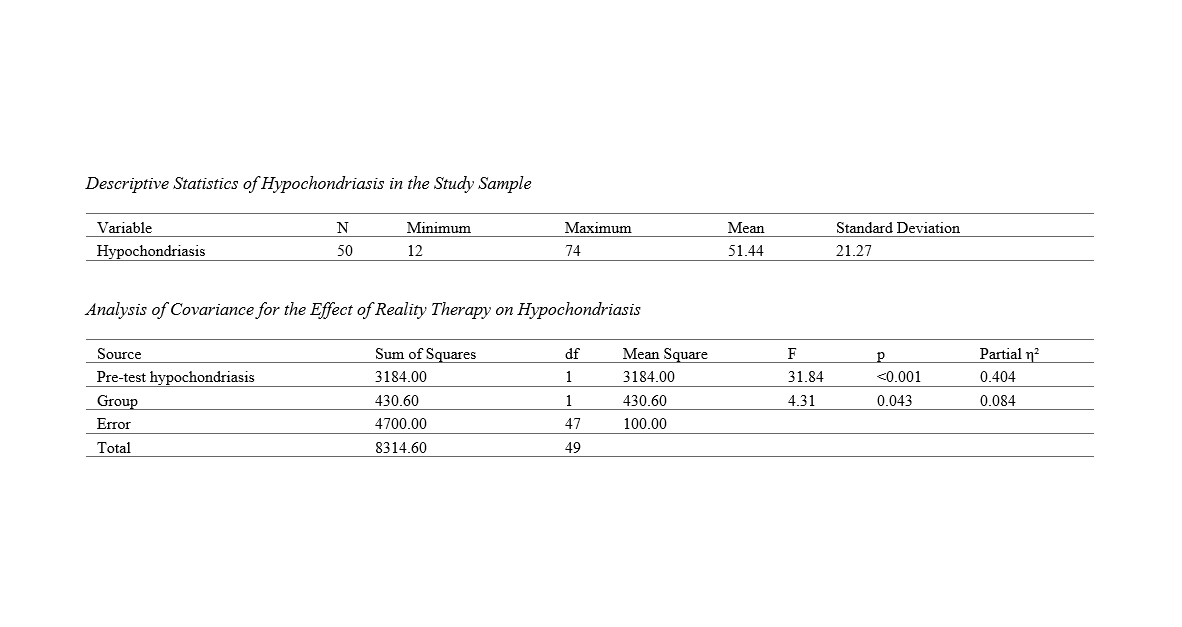
The present study, entitled The Effectiveness of Reality Therapy on Hypochondriasis in Patients with Obsessive-Compulsive Disorder, was designed with the aim of explaining the therapeutic effectiveness of Reality Therapy (RT) as an effective non-pharmacological intervention for this variable. This study was conducted using a quasi-experimental approach and a sample consisting of 50 patients with obsessive-compulsive disorder who referred to clinics in Ahvaz during 2024 and 2025. The instrument used in this study was the Evans Hypochondriasis Questionnaire. Data analysis using the independent-samples t-test showed that Reality Therapy had a significant effect on the study variable. The explanation of these findings indicates that the mean scores of hypochondriasis among patients in the experimental group were significantly different at the post-test compared with the pre-test. The results of the present study demonstrate that Reality Therapy, as a therapeutic model focused on values and conscious choices, is an effective strategy for patients with OCD who experience symptoms of hypochondriasis and provides a basis for integrating this approach into multidimensional treatment protocols for these patients.
Downloads
References
Abbasi, M., Maroofizadeh, S., Ashrafizadeh, H., Golavi, Z., & Haji Babaei, F. (2022). Investigation of Hypochondriasis and Its Related Factors in the General Population of Iran During the COVID-19 Pandemic: A Web-Based Cross-Sectional Study. Iranian Journal of Nursing Research, 17(5), 46-58.
Adamis, A. M., Cole, D. A., & Olatunji, B. O. (2024). Intolerance of Uncertainty and Worry Prospectively Predict COVID-19 Anxiety and Distress: A 4-Year Longitudinal Study. Behavior therapy, 55(2), 320-330. https://doi.org/10.1016/j.beth.2023.07.009
American Occupational Therapy, A. (2021). Standards of Practice for Occupational Therapy. The American journal of occupational therapy, 75(Supplement 3), 7513410030. https://doi.org/10.5014/ajot.2021.75S3004
Benisi, P. (2024). Presenting a Model of Corona Anxiety Based on Personality Traits with the Mediation of Hypochondriasis in Vaccinated Individuals. Journal of Rehabilitation Research in Nursing, 11(2), 29-39.
Farhoosh, M., & Najafi, M. (2023). The Effectiveness of Spiritual Rational Emotive Behavior Therapy on Compulsive Obsession, Obsessive Beliefs, and Thought-Action Fusion. Positive Psychology Research Letter, 9(2), 21-42.
Hannah, K., Marie, K., Olaf, H., Stephan, B., Andreas, D., Wilson Michael, L., & Peter, D. (2023). The Global Economic Burden of Health Anxiety/Hypochondriasis: A Systematic Review. BMC public health, 23(1), 2237. https://doi.org/10.1186/s12889-023-17159-5
Hofer, P. D., Wahl, K., Meyer, A. H., Miché, M., Beesdo-Baum, K., & Lieb, R. (2020). Parental Emotional Warmth Interacts with Traumatic Life Events in Predicting the Onset of Obsessive-Compulsive Disorder. Journal of Obsessive-Compulsive and Related Disorders, 26, 100531. https://doi.org/10.1016/j.jocrd.2020.100531
Liu, Z., Fu, M. R., Shi, J., Hu, Y., & Gao, X. (2025). The Psychological Mechanism of Self-Objectification: The Interaction Between Sociocultural Pressures and the Self-System. Frontiers in psychology, 16. https://doi.org/10.3389/fpsyg.2025.1531222
Mataix-Cols, D., Isomura, K., Sidorchuk, A., Rautio, D., Ivanov, V. Z., Rück, C., & De La Cruz, L. F. (2024). All-Cause and Cause-Specific Mortality Among Individuals with Hypochondriasis. JAMA Psychiatry, 81(3), 284-291. https://doi.org/10.1001/jamapsychiatry.2023.4744
Mousavi, M., Yazdani Rad, S., Sadeghian, M., Abbasi, M., & Jahadi Naeini, M. (2020). Investigating the Relationship Between Resilience and Hypochondriasis Caused by COVID-19: A Case Study in an Occupational Environment. Journal of Occupational Hygiene Engineering, 7(4), 35-43.
Nematollahi, S., Afsharinia, K., Hosseini, S., Kakabaraei, K., & Parandin, S. (2020). The Effectiveness of Metacognitive Therapy in Reducing Rumination and Anxiety in Patients with Obsessive Thoughts. Islamic Lifestyle Centered on Health, 4(3), 75-82.
Sarfaraz, M. R., Bedayat, A., & Derakhshan, S. (2021). The Effectiveness of Mindfulness-Based Stress Reduction Group Therapy on Hypochondriasis and Anxiety in Men with Chronic Pain. Health Psychology, 10(38), 41-56.
Singh, A., Anjankar, V. P., & Sapkale, B. (2023). Obsessive-Compulsive Disorder (OCD): A Comprehensive Review of Diagnosis, Comorbidities, and Treatment Approaches. Cureus, 15(11). https://doi.org/10.7759/cureus.48960
Steinman, S. A., Billingsley, A. L., Edwards, C. B., Snider, M. D., & Hallion, L. S. (2024). Anxiety Disorders and Obsessive-Compulsive and Related Disorders. In Psychopathology (pp. 361-386). Routledge. https://doi.org/10.4324/9781003375982-17
Tabatabaei, A., & Najafi, M. (2022). The Relationship Between Moral Sensitivity and Obsessive-Compulsive Symptoms and Sleep Problems: The Mediating Role of Fear of Self. Psychological studies, 18(2), 47-61.
Zarean, M., Ahadi, H., Jomehri, F., & Sohrabi, F. (2024). Comparison of the Effectiveness of Group Reality Therapy and Cognitive-Behavioral Group Therapy on Coping Strategies in Post-Abortion Women. Razavi International Journal of Medicine, 12(1). https://doi.org/10.61838/kman.aftj.4.1.20
Zhang, H., Li, H., Jiang, C., Tu, Y., & Xi, M. (2025). The Relationship Between Self-Objectification and Adolescent Appearance Anxiety: A Mediated Model With Moderation. Actas espanolas de psiquiatria, 53(2), 359-365. https://doi.org/10.62641/aep.v53i2.1742
Downloads
Additional Files
Publication Timeline
- Submitted
- Revised
- Accepted