Identifying and Ranking Determinants of Emotion–Physiology Synchrony in Stress-Related Health Outcomes
Keywords:
Physiological synchrony, emotional regulation, autonomic reactivity, stress physiology, interpersonal processesAbstract
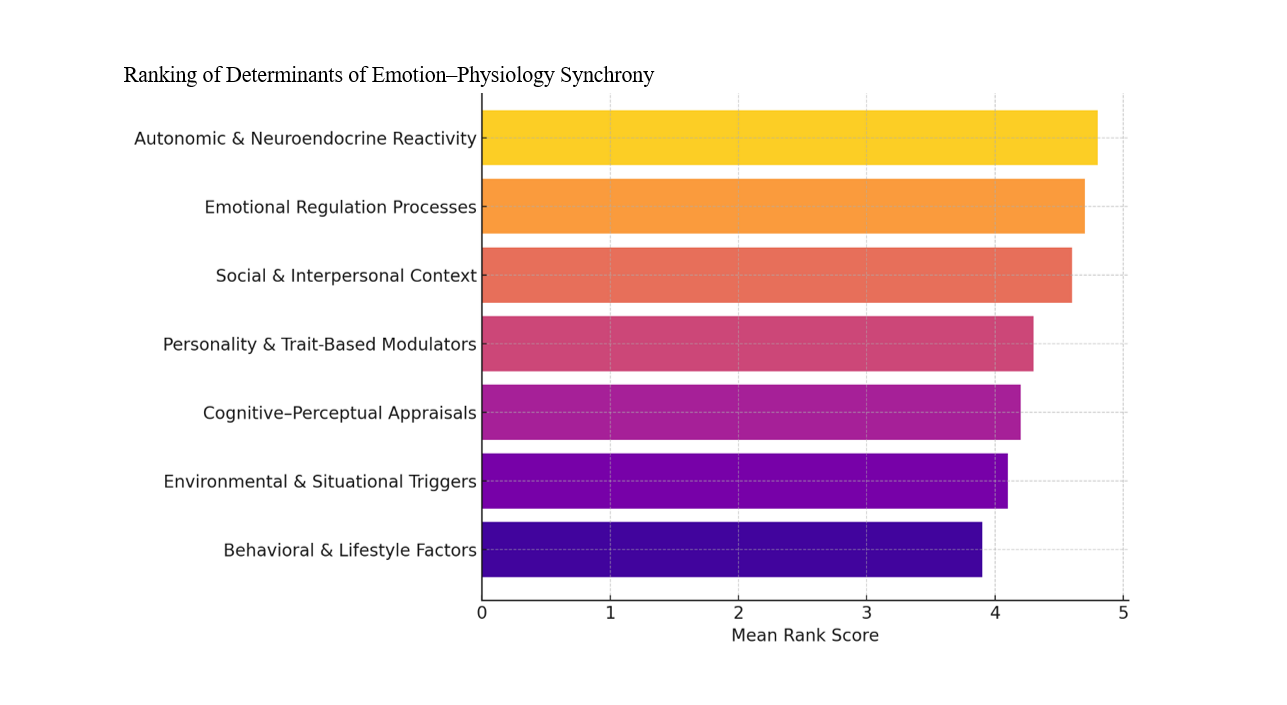
This study aimed to identify and empirically rank the key determinants of emotion–physiology synchrony influencing stress-related health outcomes. A sequential exploratory mixed-methods design was employed. In the first phase, a qualitative literature-based analysis was conducted using NVivo 14 to extract core determinants of emotion–physiology synchrony from published empirical and theoretical studies until theoretical saturation was reached. In the second phase, these determinants were operationalized into a structured questionnaire and administered to 277 adult participants residing in Germany. Quantitative data were analyzed using SPSS-26, employing descriptive statistics, mean ranking procedures, and nonparametric comparative tests to evaluate the relative importance of the extracted determinants. The integrated analysis yielded a comprehensive, hierarchical framework detailing biological, emotional, cognitive, interpersonal, environmental, and behavioral influences on synchrony. Inferential analyses revealed significant differences in the mean ranking scores across determinants, χ²(df = 6) = value, p < .001. Autonomic and neuroendocrine reactivity received the highest mean rank (M = 4.8), followed by emotional regulation processes (M = 4.7) and social–interpersonal context (M = 4.6). Mid-level determinants included personality and trait-based modulators (M = 4.3) and cognitive–perceptual appraisals (M = 4.2). Environmental and situational triggers (M = 4.1) and behavioral and lifestyle factors (M = 3.9) ranked significantly lower than core physiological and regulatory determinants. The overall ranking distribution confirmed a statistically meaningful hierarchical structure in the predictors of emotion–physiology synchrony. The study provides an integrated, empirically grounded framework indicating that physiological and emotional regulation mechanisms exert the strongest influence on emotion–physiology synchrony, while cognitive, social, environmental, and lifestyle factors play important yet secondary roles, offering a structured foundation for future theoretical development and applied intervention design.
Downloads
References
Abney, D. H., daSilva, E. B., & Bertenthal, B. I. (2021a). Associations Between Infant-Mother Physiological Synchrony and 4- To 6-Month-Old Infants’ Emotion Regulation. https://doi.org/10.1101/2021.04.13.439498
Abney, D. H., daSilva, E. B., & Bertenthal, B. I. (2021b). Associations Between Infant–mother Physiological Synchrony and 4‐ and 6‐month‐old Infants’ Emotion Regulation. Developmental Psychobiology, 63(6). https://doi.org/10.1002/dev.22161
Adel, L., Manova, V., Bain, T., Ambwani, D., Dumas, G., Khoury, B., & Lifshitz, M. (2025). Interpersonal Cardiac Synchrony During Emotional Sharing Between Strangers. https://doi.org/10.31234/osf.io/nmj5k_v1
Algumaei, M. Y., Hettiarachchi, I., Veerabhadrappa, R., & Bhatti, A. (2023). Physiological Synchrony Predict Task Performance and Negative Emotional State During a Three-Member Collaborative Task. Sensors, 23(4), 2268. https://doi.org/10.3390/s23042268
Andersen, M. M., Rosas, F. E., Schjoedt, U., Mediano, P. A. M., Price, H., Konvalinka, I., & Clasen, M. (2025). Scared Together: Heart Rate Synchrony and Social Closeness in a High-Intensity Horror Setting. Emotion. https://doi.org/10.1037/emo0001556
Ardizzi, M., Calbi, M., Tavaglione, S., Umiltà, M. A., & Gallese, V. (2020). Audience Spontaneous Entrainment During the Collective Enjoyment of Live Performances: Physiological and Behavioral Measurements. Scientific reports, 10(1). https://doi.org/10.1038/s41598-020-60832-7
Bar‐Kalifa, E., Gören, Ö., Gilboa‐Schechtman, E., Wolff, M., Rafael, D., Heimann, S., Yehezkel, I., Scheniuk, A., Feldman, R., & Atzil‐Slonim, D. (2023). Clients’ Emotional Experience as a Dynamic Context for Client–therapist Physiological Synchrony. Journal of consulting and clinical psychology, 91(6), 367-380. https://doi.org/10.1037/ccp0000811
Cook, E. C. (2020). Affective and Physiological Synchrony in Friendships During Late Adolescence. Journal of Social and Personal Relationships, 37(4), 1296-1316. https://doi.org/10.1177/0265407519895106
Ghilardi, T., & Ossmy, O. (2024). A Pupil-Dilation Technique to Test Developmental Differences in Visual Synchrony During Free Viewing. https://doi.org/10.31234/osf.io/jae6c_v1
Hale, M. E., Morrow, K. E., Steffen, G. M., Wang, H., Jerry, C. M., Xu, J., Han, Z. R., Abney, D. H., & Suveg, C. (2025). Mother-Child Neurophysiological Synchrony Moderates the Relation Between Maternal Affect Experiences and Child Emotion Dysregulation. Research on Child and Adolescent Psychopathology. https://doi.org/10.1007/s10802-025-01380-4
Ito, W., & Morozov, A. (2024). Sex and Stress Interactions in Fear Synchrony of Mouse Dyads. https://doi.org/10.1101/2024.06.09.598132
Lämsä, J., Edwards, J., Haataja, E., Sobocinski, M., Peña, P. R., Nguyen, A., & Järvelä, S. (2024). Learners’ Linguistic Alignment and Physiological Synchrony. Journal of Learning Analytics, 1-18. https://doi.org/10.18608/jla.2024.8287
Li, Z., Sturge‐Apple, M. L., Liu, S., & Davies, P. T. (2020). Parent‐adolescent Physiological Synchrony: Moderating Effects of Adolescent Emotional Insecurity. Psychophysiology, 57(9). https://doi.org/10.1111/psyp.13596
Mayo, O., & Gordon, I. (2020). In and Out of Synchrony—Behavioral and Physiological Dynamics of Dyadic Interpersonal Coordination. Psychophysiology, 57(6). https://doi.org/10.1111/psyp.13574
Mayo, O., Horesh, D., Korisky, A., Milstein, N., Zadok, E., Tomashin, A., & Gordon, I. (2023). I Feel You: Prepandemic Physiological Synchrony and Emotional Contagion During COVID-19. Emotion, 23(3), 753-763. https://doi.org/10.1037/emo0001122
Miller, J. G., Armstrong‐Carter, E., Balter, L., & Lorah, J. (2022a). A Meta-Analysis of Mother-Child Synchrony in Respiratory Sinus Arrhythmia. https://doi.org/10.31234/osf.io/zhcem
Miller, J. G., Armstrong‐Carter, E., Balter, L., & Lorah, J. (2022b). A Meta‐analysis of Mother–child Synchrony in Respiratory Sinus Arrhythmia and Contextual Risk. Developmental Psychobiology, 65(1). https://doi.org/10.1002/dev.22355
Murata, A., Nomura, K., Watanabe, J., & Kumano, S. (2021). Interpersonal Physiological Synchrony Is Associated With First Person and Third Person Subjective Assessments of Excitement During Cooperative Joint Tasks. Scientific reports, 11(1). https://doi.org/10.1038/s41598-021-91831-x
Ng, S. H. S., Sargent, K., & Snell, J. (2025). Cyborg Synchrony: Integrating Human Physiology Into Affective Generative Music AI. Frontiers in Computer Science, 7. https://doi.org/10.3389/fcomp.2025.1593905
Pemble, F., Yarlagadda, H., Clarke-Sather, A., Cevasco-Trotter, A. M., Sandbulte, J., Zhao, T. C., Silverman, M. J., & Wang, S. (2024). Measuring Heart Rate Synchrony for a Patient-Music Therapist Dyad. https://doi.org/10.1115/dmd2024-1068
Prinz, J., Rafaeli, E., Wasserheß, J., & Lutz, W. (2021). Clients’ Emotional Experiences Tied to Therapist-Led (But Not Client-Led) Physiological Synchrony During Imagery Rescripting. Entropy, 23(12), 1556. https://doi.org/10.3390/e23121556
Rodheim, K., Laurent, C. W. S., Holmes, J., Hoyniak, C. P., & Spencer, R. M. C. (2023). 0117 Association Between Mother-Child Sleep-Wake Rhythm Synchrony and Maternal Emotional Health. Sleep, 46(Supplement_1), A52-A53. https://doi.org/10.1093/sleep/zsad077.0117
Shimshock, C. J., Thorson, K. R., Peters, B. J., & Jamieson, J. P. (2025). Behavioral Variability in Physiological Synchrony During Future-Based Conversations Between Romantic Partners. Emotion, 25(1), 186-197. https://doi.org/10.1037/emo0001437
Tang, Y., Perry, N. B., He, T., Wu, D., Zhou, N., & Lin, X. (2024). Grandmother–grandchild Physiological Synchrony in Chinese Three‐generation Families: Links With Child Emotion Regulation. Developmental Psychobiology, 66(5). https://doi.org/10.1002/dev.22498
Tomashin, A., Gordon, I., & Wallot, S. (2022). Interpersonal Physiological Synchrony Predicts Group Cohesion. Frontiers in human neuroscience, 16. https://doi.org/10.3389/fnhum.2022.903407
Tschacher, W., Greenwood, S. M., Egermann, H., Wald‐Fuhrmann, M., Czepiel, A., Tröndle, M., & Meier, D. (2023). Physiological Synchrony in Audiences of Live Concerts. Psychology of Aesthetics Creativity and the Arts, 17(2), 152-162. https://doi.org/10.1037/aca0000431
Tschacher, W., Greenwood, S. M., Weining, C., Wald‐Fuhrmann, M., Ramakrishnan, C., Seibert, C., & Tröndle, M. (2024). Physiological Audience Synchrony in Classical Concerts Linked With Listeners’ Experiences and Attitudes. Scientific reports, 14(1). https://doi.org/10.1038/s41598-024-67455-2
Wang, H., Suveg, C., West, K. B., Han, Z. R., Zhang, X., Hu, X., & Yi, L. (2020). Synchrony of Respiratory Sinus Arrhythmia in Parents and Children With Autism Spectrum Disorder: Moderation by Interaction Quality and Child Behavior Problems. Autism Research, 14(3), 512-522. https://doi.org/10.1002/aur.2401
Wood, A., Lipson, J., Zhao, F., & Niedenthal, P. M. (2020). Forms and Functions of Affective Synchrony. https://doi.org/10.31234/osf.io/z46nd
Xu, J., Zhang, Y., Wang, H., Peng, M., Zhu, Y., Wang, X., Yi, Z., Chen, L., & Han, Z. R. (2024). A Context‐dependent Perspective to Understand the Relation Between Parent–child Physiological Synchrony and Child Socioemotional Adjustment. Developmental science, 27(6). https://doi.org/10.1111/desc.13506
Downloads
Additional Files
Publication Timeline
- Submitted
- Revised
- Accepted