Dimensions of Coping in Individuals Facing Long-Term Unemployment: A Qualitative Exploration
Keywords:
Long-term unemployment, coping strategies, qualitative research, emotional coping, cognitive adaptation, social identity, behavioral copingAbstract
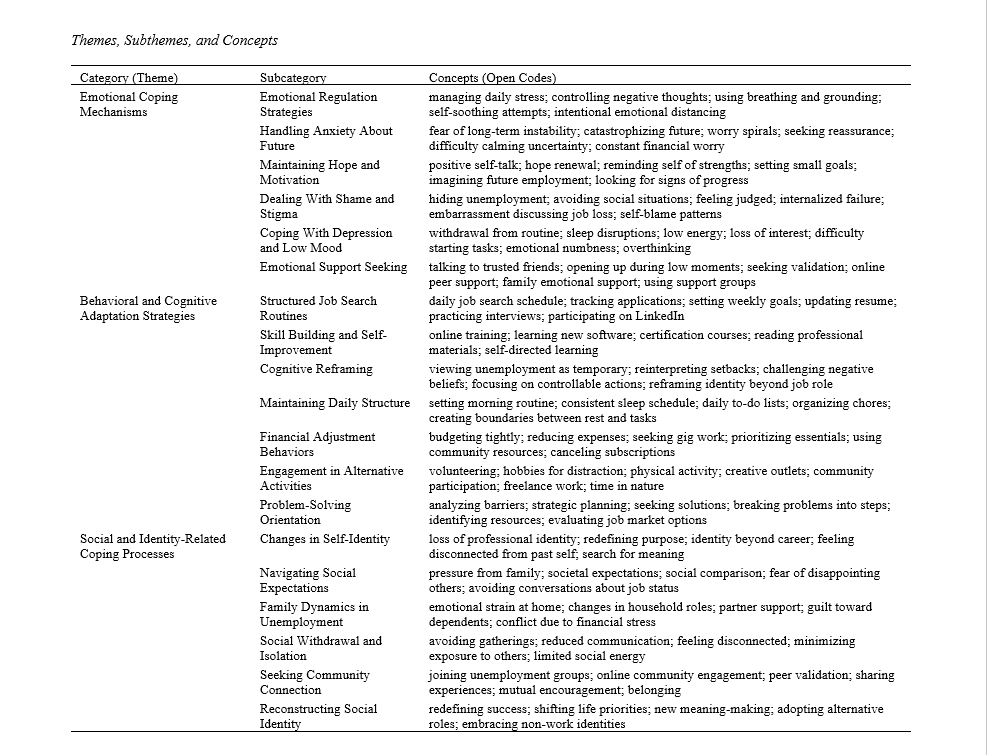
This study aimed to identify and explore the emotional, behavioral, cognitive, and social dimensions of coping among individuals experiencing long-term unemployment. This qualitative study employed a semi-structured interview design to capture the lived experiences of individuals facing extended unemployment. A total of 17 participants from various regions across the United States were recruited through purposive sampling. Interviews were conducted online, recorded with consent, and transcribed verbatim. Data collection continued until theoretical saturation was achieved. NVivo software supported the organization and analysis of data using open, axial, and selective coding procedures. Thematic analysis guided the identification of major themes and subthemes describing coping dimensions. Analysis revealed three overarching thematic dimensions of coping. First, emotional coping mechanisms included strategies for managing anxiety, shame, stigma, and depressive symptoms, as well as seeking emotional support. Second, behavioral and cognitive adaptation strategies encompassed structured job-search routines, skill-building efforts, daily routine maintenance, financial adjustments, and cognitive reframing. Third, social and identity-related coping processes involved reconceptualizing personal identity, navigating social expectations, adjusting family dynamics, managing social withdrawal, and reconnecting through community networks. Collectively, these findings suggest that coping with long-term unemployment is multifaceted and characterized by continuous psychological adaptation across emotional, behavioral, cognitive, and social domains. Long-term unemployment generates substantial psychological and social challenges, requiring individuals to draw upon diverse emotional, behavioral, and relational resources. The findings underscore the need for supportive interventions that address the complex interplay between emotional resilience, routine-building, skill development, identity reconstruction, and social belonging. Programs aimed at strengthening coping capacities may enhance well-being and help individuals navigate prolonged joblessness more effectively.
Downloads
References
Aldossari, F., & Alanizan, S. (2025). The Impact of Transformational Leadership on Employee Performance: The Mediating Role of Job Satisfaction and Organizational Commitment. Edelweiss Applied Science and Technology, 9(6), 609-625. https://doi.org/10.55214/25768484.v9i6.7860
Almaqableha, A., & Omar, K. (2024). Nexus of Leadership Style, Organizational Climate, Motivation and OCB in Jordanian Telecommunications. Revista De Gestão Social E Ambiental, 18(5), e05594. https://doi.org/10.24857/rgsa.v18n5-071
Aman, S. (2025). The Leadership Styles and the Employees' Performance: An Investigation of Public Sector Organization by Considering Employee's Motivation, Behavior &Amp; Role of Training. Qlantic Journal of Social Sciences and Humanities, 6(2), 166-172. https://doi.org/10.55737/qjssh.vi-ii.25371
Anggita, F. R. (2025). The Role of Transformational Leadership in Enhancing Employee Engagement in the Hybrid Work Era. International Journal Management and Economic, 4(2), 84-88. https://doi.org/10.56127/ijme.v4i2.2161
Ankitha, C., Ramesha, H. H., & B, N. (2025). Transformational and Transactional Leadership: Effects on Workplace Culture and Productivity in IT Organizations. Interantional Journal of Scientific Research in Engineering and Management, 09(08), 1-9. https://doi.org/10.55041/ijsrem51875
Appah, W. W. (2025). The Effects of Leadership Style on Employee Motivation and Satisfaction (Evidence From Selected Healthcare Institutions in Rivers State). dbebj.com/, 5(2). https://doi.org/10.60089/dbebj.2025.5.2.04
Bakri, M. K. B. (2024). Applying Organizational Psychology Principles for Positive Workplace Outcomes. Ahrmr, 2(1), 36-49. https://doi.org/10.60079/ahrmr.v2i1.258
Citta, A. B., Putro, G. S., Arfiany, A., & Syam, A. (2025). The Effect of Servant Leadership and Compensation on Employee Engagement Makassar City Tourism Office. Marginal Journal of Management Accounting General Finance and International Economic Issues, 4(2), 252-262. https://doi.org/10.55047/marginal.v4i2.1582
Deepalakshmi, N. (2025). The Role of Inclusive Leadership in Enhancing Employee Engagement. Journal of Information Systems Engineering & Management, 10(35s), 1062-1074. https://doi.org/10.52783/jisem.v10i35s.6190
Guzman, R., Ayban, J. A. R., & Tan, K. E. (2025). Leadership Styles and Its Influence on Employee Motivation and Organizational Commitment in Academic Institutions. International Journal of Research and Innovation in Social Science, IX(V), 5701-5732. https://doi.org/10.47772/ijriss.2025.905000440
Handaya, L. K. (2025). Peran Gaya Kepemimpinan Terhadap Intention to Leave: Literature Review. Value Jurnal Manajemen Dan Akuntansi, 20(2), 406-414. https://doi.org/10.32534/jv.v20i2.7251
Hartono, H., Salju, S., & Qamaruddin, M. Y. (2024). Implementation of Transformational Leadership in Increasing the Organizational Commitment of Civil Servants. Jppi (Jurnal Penelitian Pendidikan Indonesia), 10(3), 84. https://doi.org/10.29210/020243250
K., P. P., & Lalwani, N. (2025). The Impact of Leadership Styles on Employee Engagement in Modern Organizations. International Journal for Multidisciplinary Research, 7(4). https://doi.org/10.36948/ijfmr.2025.v07i04.51300
Kawimbe, S., & M., P. (2024). An Evaluation of the Impact of Leadership Styles on the Performance of SMEs in Zambia: A Conceptual Perspective. International Journal for Multidisciplinary Research, 6(3). https://doi.org/10.36948/ijfmr.2024.v06i03.19005
Maindola, S., Giri, S., & Kumar, S. (2025). The Role of Leadership Styles in Enhancing Employee Engagement: An Empirical Study in the Information Technology Industry. International Journal for Multidisciplinary Research, 7(5). https://doi.org/10.36948/ijfmr.2025.v07i05.56891
Manoharan, S., Mohanty, A. K., Sengupta, P. D., Yn, R., Tr, K. L., Homavazir, Z., Traisa, R., & Ghumman, S. (2025). The Impact of Leadership Effectiveness on Employee Commitment and Engagement Within Corporate Workplaces. Management (Montevideo), 3, 175. https://doi.org/10.62486/agma2025175
Mukhaini, S. A. A., Uraimi, S. M. A., & Farsi, T. S. A. (2025). The Effect of Leadership Style on Organizational Performance in Oman. International Journal of Research and Innovation in Social Science, IX(I), 911-930. https://doi.org/10.47772/ijriss.2025.9010075
Purwanti, G. A., & Sarı, M. (2024). The Effect of Transformational Leadership on Team Performance in the Work Environment. M.Journal, 1(3), 1-6. https://doi.org/10.70076/simj.v1i3.41
Qureshi, E., Shehri, F. A., Malik, A., & Saif, O. B. (2024). Unravelling the Interplay of Servant Leadership, Cognitive Trust, and Employee Wellbeing: A Cae of an Emerging Economy. Abgmce, 4(1), 154-162. https://doi.org/10.62019/abgmce.v4i1.70
Ramlan, M., Akob, M., & Jumady, E. (2025). The Role of Leadership in Fostering Employee Engagement: A Literature Analysis. Golden Ratio of Human Resource Management, 5(2), 360-373. https://doi.org/10.52970/grhrm.v5i2.864
Rao, S. (2025). Servant Leadership: A Pathway to Ethical and Effective Organizational Leadership. Innovapath, 1(3), 5. https://doi.org/10.63501/v0gjhe26
Rusilowati, U., Bangun, C. S., & Bennet, D. (2025). Impact of Leadership Styles on Employee Engagement and Organizational Growth. Aptisi Transactions on Management (Atm), 9(2), 197-209. https://doi.org/10.33050/atm.v9i2.2441
Sahoo, A., Sood, S., Sohal, J., Goyal, N., Bawa, R. K., & Rajitha, R. (2025). Exploring the Influence of Organizational Culture on Employee Performance and Organizational Success. Multidisciplinary Science Journal, 7, 2025ss0211. https://doi.org/10.31893/multiscience.2025ss0211
Sam, T. H., Isa, K., Siqi, P., Palpanadan, S. T., Hong, H. C., & Luan, N. M. (2024). Leadership Styles and Their Effects on Employee Satisfaction in Empowering Happiness at Workplace. Journal of Ecohumanism, 3(8). https://doi.org/10.62754/joe.v3i8.5091
Santiago, J. (2024). Rethinking Transformational Leadership and Workforce Dynamics for the Human -Centric Tech Era: Insights Into Employee Engagement, Satisfaction and Job Performance. Journal of Intercultural Management, 16(4), 42-94. https://doi.org/10.2478/joim-2024-0014
Shafiq, S., Kiren, A., Aslam, S., & Awan, A. E. (2025). Impact of Servant Leadership on Job Performance and Work Engagement of University Employees: The Mediating Role of Organizational Identification. Aijss, 4(3), 5885-5896. https://doi.org/10.63056/acad.004.03.0852
Sharma, A., & Patel, P. (2025). Role of Leadership in Shaping Positive Work Culture Psychology. International Journal of Information Technology and Management, 20(2), 33-42. https://doi.org/10.29070/xm8bg421
Sharma, D. B. (2025). A Leadership Approach and Its Efficacy on Employees. International Scientific Journal of Engineering and Management, 04(05), 1-9. https://doi.org/10.55041/isjem03697
Sharma, R. (2024). Leadership Styles and Employee Motivation: A Comparative Study in the Modern Workplace. J. Adv. Mgmt. Stu., 1(2), 1-6. https://doi.org/10.36676/jams.v1.i2.7
Usman, A., Hanif, M. Z., & Majeed, P. (2024). Servant Leadership as a Driver of Work Engagement: Unveiling the Mediating Role of Basic Psychological Needs Satisfaction. Jssa, 2(2), 509-528. https://doi.org/10.59075/jssa.v2i2.80
Zhu, Y. (2025). Leading With Purpose: The Transformative Impact of Servant, Authentic, and Spiritual Leadership on Workplace Well-Being and Ethics. Icmrss, 2(1), 15-24. https://doi.org/10.33422/icmrss.v2i1.827
Downloads
Additional Files
Publication Timeline
- Submitted
- Revised
- Accepted