Identifying Emotional and Behavioral Factors Affecting School Dropout Intentions
Keywords:
School dropout intention, emotional factors, behavioral disengagement, motivation, qualitative research, adolescentsAbstract
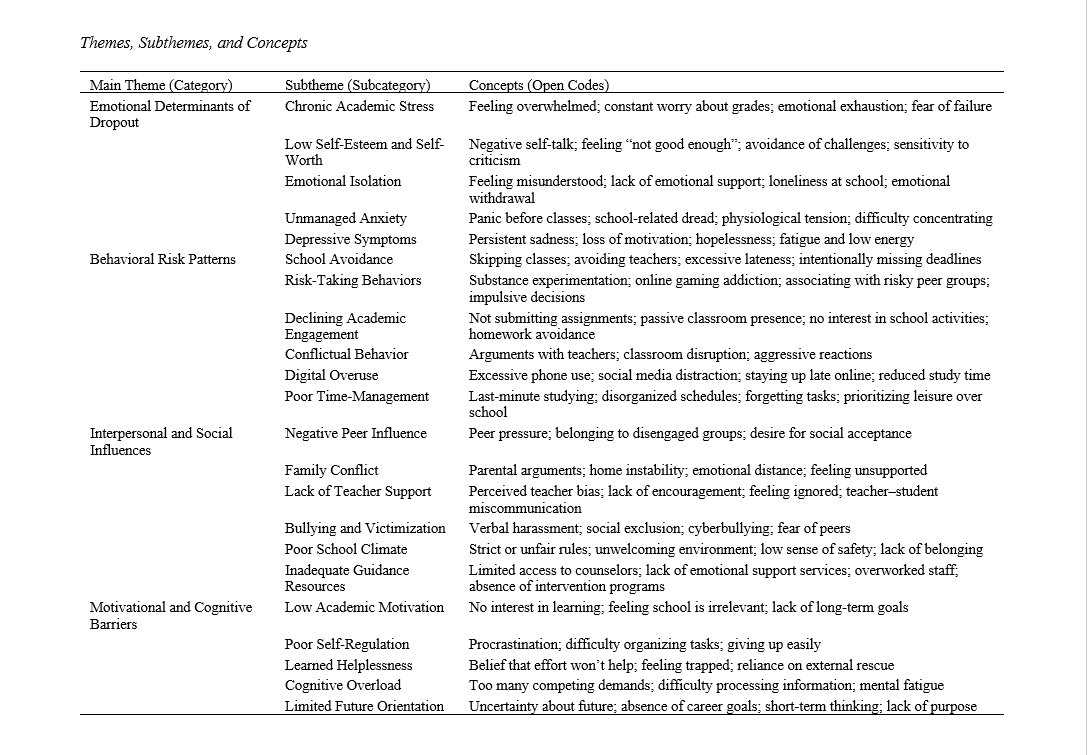
This study aimed to explore the emotional and behavioral factors shaping school dropout intentions among secondary-school students. This qualitative study employed a semi-structured interview design to capture students’ lived experiences and internal processes related to dropout intention. A total of 26 participants from various regions across Canada were selected through purposive sampling to ensure representation of students who had expressed dropout intention or were considered at risk. Interviews were conducted in person or through secure online platforms, recorded with consent, and transcribed verbatim. Data collection continued until theoretical saturation was reached. NVivo software was used to support systematic coding and theme development through inductive thematic analysis. Trustworthiness was enhanced through peer debriefing, reflexive memoing, and maintaining an audit trail throughout the analytic process. Analysis revealed four overarching categories influencing dropout intention: emotional determinants, behavioral risk patterns, interpersonal and social influences, and motivational–cognitive barriers. Emotional determinants such as stress, anxiety, and low self-esteem significantly contributed to dropout inclination, while behavioral patterns—including absenteeism, academic disengagement, and digital overuse—amplified existing vulnerabilities. Interpersonal and social influences, particularly peer dynamics, teacher support, family conflict, and school climate, demonstrated strong associations with disengagement trajectories. Motivational and cognitive factors, including low academic motivation, poor self-regulation, and limited future orientation, further intensified withdrawal considerations. Collectively, the themes highlighted dropout intention as a multidimensional process shaped by interacting emotional, behavioral, relational, and motivational conditions. Findings demonstrate that dropout intention emerges from the interplay of psychological strain, disengagement behaviors, social contexts, and motivational deficits, emphasizing the need for early identification and holistic support systems. Interventions addressing emotional well-being, relational support, behavioral regulation, and academic motivation may reduce dropout intention among school-aged youth.
Downloads
References
Breetzke, J., & Bohndick, C. (2024). Expectancy-Value Interactions and Dropout Intentions in Higher Education: Can Study Values Compensate for Low Expectancies? Motivation and Emotion, 48(5), 700-713. https://doi.org/10.1007/s11031-024-10088-9
Buizza, C., Cela, H., Sbravati, G., Bornatici, S., Rainieri, G., & Ghilardi, A. (2024). The Role of Self-Efficacy, Motivation, and Connectedness in Dropout Intention in a Sample of Italian College Students. Education Sciences, 14(1), 67. https://doi.org/10.3390/educsci14010067
Cazan, A. M., Stoica, R. E., Truţă, C., Stan, M. M., & Maican, C. (2024). Motivations for Attending University and Dropout Intention in First-Year University Students. Series Vii - Social Sciences and Law, 9-18. https://doi.org/10.31926/but.ssl.2024.17.66.1.6
Guo, Q., & Huh, J. (2023). The Effect of Academic Stress on School Dropout of Chinese Physical Education Major University Students: The Mediating Effect of Social Support. The World Society of Taekwondo Culture, 14(1), 77-92. https://doi.org/10.18789/jwstc.2023.38.77
Hancco-Monrroy, D. E., Caballero, L., Abarca-Fernández, D. S., Castagnetto, J. M., Condori-Cardoza, F. A., De-Lama-Morán, R., Aguilar, J. R. C., Gutierrez, S., Gonzales, M., Berduzco-Torres, N., Bolton, R. C. D., San-Martín, M., & Vivanco, L. (2024). Medical Professionalism and Its Association With Dropout Intention in Peruvian Medical Students During the COVID-19 Pandemic. Behavioral Sciences, 14(8), 641. https://doi.org/10.3390/bs14080641
Heusel, L., Glaesser, J., Kilian, P., Merk, S., & Kelava, A. (2023). Comparing Dropout Intentions of Math Students on Trainee Teacher Courses Versus Bachelor of Science Courses Using Intensive Longitudinal Data. Frontiers in Education, 8. https://doi.org/10.3389/feduc.2023.1205949
Höhne, E., Lotz, C., Deiglmayr, A., & Zander, L. (2024). How Do Perceived Instructors’ Mindset Beliefs Influence STEM Students’ Belonging Uncertainty and Dropout Intentions? Zeitschrift Für Entwicklungspsychologie Und Pädagogische Psychologie, 56(1-2), 55-72. https://doi.org/10.1026/0049-8637/a000290
Kim, H., & Mo, H. (2024). Analysis of University Student’s Dropout Intention: Effects of Tinto’s Student Integration, Student Characteristics, and University Characteristics. Korean Association for Learner-Centered Curriculum and Instruction, 24(3), 773-792. https://doi.org/10.22251/jlcci.2024.24.3.773
Kim, H. Y., & Lee, E. (2024). Analysis of Structural Relationships Among Compassion Competence, School Pride, and Depression and Drop Out Intention of Female College Students. Reg Entrep Edu Res Cent, 6(3), 377-397. https://doi.org/10.23108/decrc.2024.6.3.377
Kwak, J.-Y., & Lee, H. (2023). Analysis of Factors for Prevention of School Dropout in High School Students. Korean Soc Cult Converg, 45(6), 541-552. https://doi.org/10.33645/cnc.2023.06.45.06.541
Lee, J., Park, E.-A., & Cho, H. (2025). The Effect of College Students' Career Identity on Dropout Intention Through the Mediating of Depression : Moderated Mediating Effect of Social Support. K Assoc Edu Res, 10(2), 619-640. https://doi.org/10.48033/jss.10.2.30
Lee, M. (2023). The Effect of Academic Stress on Self-Efficacy, Dropout Intention of College Students Majoring in Airline Services in the Post Corona Era. Korean Soc Cult Converg, 45(11), 697-709. https://doi.org/10.33645/cnc.2023.11.45.11.697
López-Angulo, Y., Cobo‐Rendón, R., Sáez-Delgado, F., Mella-Norambuena, J., Pérez-Villalobos, M. V., & Mújica, A. D. (2024). Cognitive Motivational Variables and Dropout Intention as Precursors of University Dropout. Frontiers in Education, 9. https://doi.org/10.3389/feduc.2024.1416183
Pedditzi, M. L. (2024). School Satisfaction and Self-Efficacy in Adolescents and Intention to Drop Out of School. International journal of environmental research and public health, 21(1), 111. https://doi.org/10.3390/ijerph21010111
Shin, S., & Kwon, S. (2025). A Study on the Relationship Between University Education Satisfaction Factors, Student Satisfaction, Leave of Absence and Dropout Intention. Korea Univ Inst Educ Res, 95, 109-131. https://doi.org/10.24299/kier.2025.382.109
Stellmacher, A., Franz, S., & Paetsch, J. (2025). Career Choice Motivation, Academic and Social Integration, and Their Relationship With Intention to Drop Out of Vocational Teacher Training. Empirical Research in Vocational Education and Training, 17(1). https://doi.org/10.1186/s40461-025-00182-8
Van, T. (2024). The Relationship Between Academic Stress and Dropout Intention of University Students: The Mediating Role of Teacher and Family Support. Revista Romaneasca pentru Educatie Multidimensionala, 16(2), 642-665. https://doi.org/10.18662/rrem/16.2/877
Velíz, J., & Ortega, A. M. (2023). Dropout Intentions in Higher Education: Systematic Literature Review. Journal on Efficiency and Responsibility in Education and Science, 16(2), 149-158. https://doi.org/10.7160/eriesj.2023.160206
Vijayakumaran, N., Yusof, H. M., Oulaganathan, S., & Rajan, D. K. S. (2023). The Impact of Parental Involvement and Student Engagement on School Dropout Intention: A Systematic Literature Review. International Journal of Education Psychology and Counseling, 8(50), 36-46. https://doi.org/10.35631/ijepc.850003
Wang, A. T., Reyes, A., Ürkmez, B., McGuire, A. P., Lee, B., & Umucu, E. (2024). The Association Between PTSD, Gratitude, Academic Adjustment, and Dropout Decisions in Veteran Students With Disabilities: Brief Report. Journal of Veterans Studies, 10(1), 40-47. https://doi.org/10.21061/jvs.v10i1.499
Downloads
Additional Files
Publication Timeline
- Submitted
- Revised
- Accepted