Comparison of the Effectiveness of Acceptance and Commitment Therapy (ACT) and Emotion-Focused Therapy (EFT) on Cognitive Distortions and Emotion Regulation in Women with Social Anxiety Disorder
DOI:
https://doi.org/10.61838/kman.hp.psynexus.4892Keywords:
Social anxiety disorder, Acceptance and Commitment Therapy, Emotion-Focused Therapy, Cognitive distortion, Emotion regulationAbstract
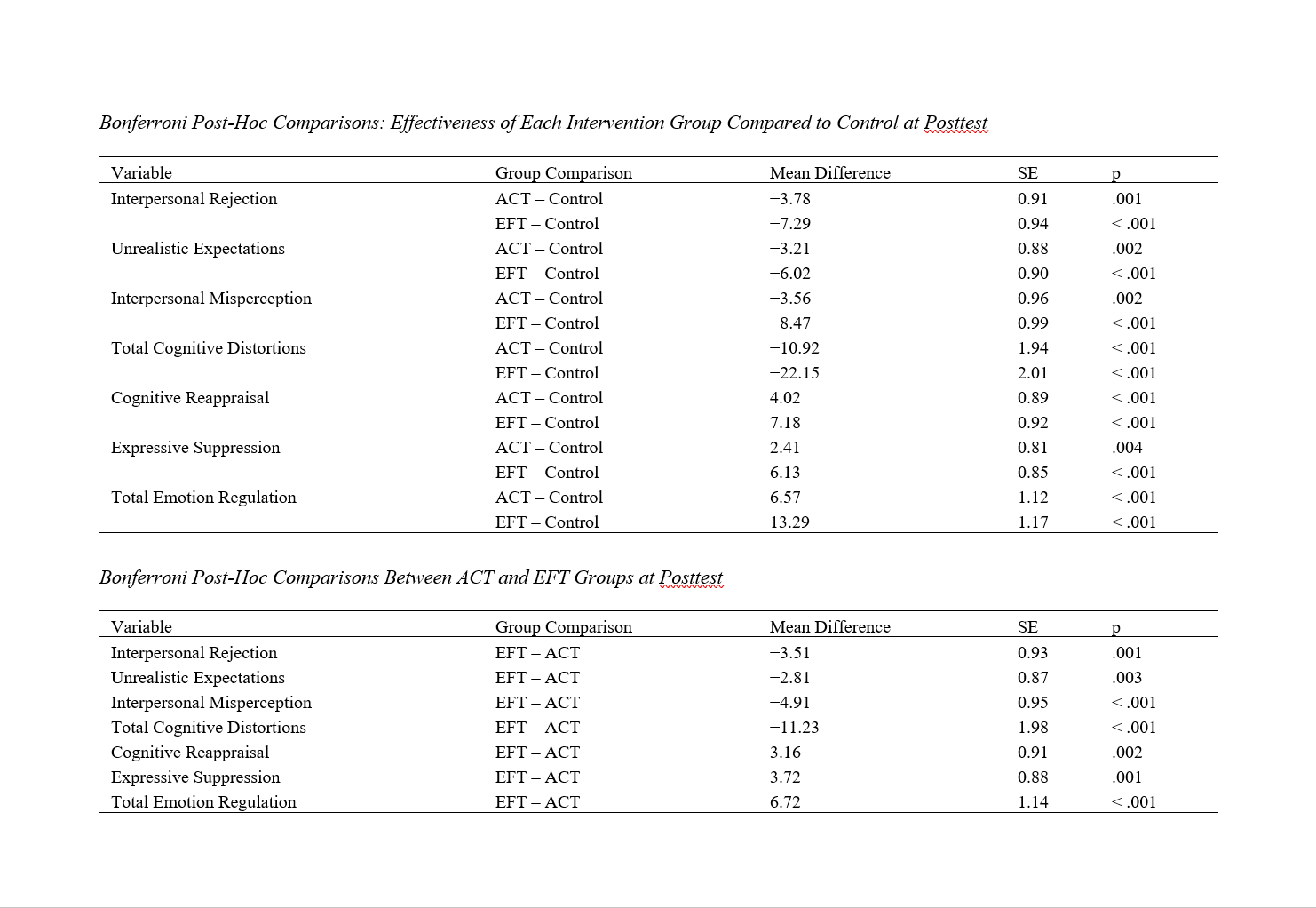
The objective of this study was to compare the effectiveness of Acceptance and Commitment Therapy (ACT) and Emotion-Focused Therapy (EFT) on cognitive distortions and emotion regulation in women diagnosed with social anxiety disorder. This study employed a quasi-experimental design with a non-equivalent control group, including pretest, posttest, and follow-up phases. The statistical population consisted of women aged 20–30 years with a clinical diagnosis of social anxiety disorder in District 22 of Tehran. Sixty participants were selected through purposive sampling and randomly assigned to three groups: ACT (n = 20), EFT (n = 20), and a control group (n = 20). The ACT and EFT interventions were delivered in eight 90-minute group sessions based on standardized protocols. Data were collected using the Social Anxiety Questionnaire, the Cognitive Distortions Questionnaire, and the Emotion Regulation Scale. Multivariate analysis of covariance (MANCOVA) and Bonferroni post-hoc tests were used to analyze the data while controlling for pretest scores. The results of MANCOVA indicated a significant main effect of group on all components of cognitive distortions and emotion regulation (p < .001), with large effect sizes. Post-hoc analyses revealed that both ACT and EFT were significantly more effective than the control group in reducing cognitive distortions and improving emotion regulation. Comparative analyses showed that ACT was significantly more effective in reducing overall cognitive distortions, whereas EFT demonstrated significantly greater improvements in overall emotion regulation. These effects remained stable at the follow-up assessment. Both ACT and EFT are effective interventions for women with social anxiety disorder; however, they demonstrate differential strengths, with ACT showing greater efficacy in reducing cognitive distortions and EFT exhibiting superior effects on emotion regulation, highlighting the importance of mechanism-based treatment selection.
Downloads
References
Akbari Dehghi, A., & Molaei, M. (2025). The effectiveness of acceptance and commitment therapy in enhancing emotional regulation and academic motivation in adolescents. Achievements in Clinical Psychology, 11(2), 33-48. https://doi.org/10.22055/jacp.2025.48800.1443
Conradi, H. J., Dingemanse, P., Noordhof, A., Finkenauer, C., & Kamphuis, J. H. (2018). Effectiveness of the 'Hold me Tight' relationship enhancement program in a self‐referred and a clinician‐referred sample: An Emotionally Focused Couples Therapy‐based approach. Family Process, 57(3), 613-628. https://doi.org/10.1111/famp.12305
Doshmanfana, S., Mosafer, A., Mostafaei, N., Samadifard, N., & Yekta, M. R. (2025). The effectiveness of emotion-focused therapy on emotion dysregulation and resilience in patients with chronic pain and depressive symptoms. Health Nexus, 3(1), 123-130. https://doi.org/10.61838/kman.hn.3.1.13
Ebrahimi, A. (2020). The effectiveness of emotion-focused therapy on fear of negative evaluation and anxiety sensitivity in individuals with social anxiety Department of Psychology, Bahar Higher Education Institute]. https://www.researchgate.net/publication/378836693_The_effectiveness_of_emotion-focused_therapy_on_anxiety_sensitivity_distress_tolerance_and_coping_strategies_in_betrayed_women
Hosseini Ardakani, A. (2020). The effectiveness of emotion-focused therapy on social anxiety and interpersonal dependency in women visiting health houses. New Ideas in Psychology, 4(8), 1-11. https://jnip.ir/browse.php?a_id=265&sid=1&slc_lang=fa
Jahedi, R., & Badri-Gorgari, R. (2023). A meta-analysis of the effectiveness of acceptance and commitment therapy interventions on social anxiety. Social Psychology Research, 13(50), 76-57. https://www.socialpsychology.ir/article_178110_714fc25c83ce25ce3385a97343f4460d.pdf
Kebritchi, A., Abolghasemi, S., & Shahriari Ahmadi, M. (2024). Investigating the effectiveness of emotion-focused therapy on cognitive flexibility and distress tolerance in married women with social anxiety disorder. Journal of Psychological Science, 23(143), 97-113. https://psychologicalscience.ir/browse.php?a_id=2527&sid=1&slc_lang=en
Laurito, L. D., Loureiro, C. P., Dias, R. V., Vigne, P., de Menezes, G. B., Freire, R. C., & Fontenelle, L. F. (2018). Predictors of benzodiazepine use in a transdiagnostic sample of panic disorder, social anxiety disorder, and obsessive-compulsive disorder patients. Psychiatry research, 262, 237-245. https://doi.org/10.1016/j.psychres.2018.02.013
Mennin, D. S., Holaway, R. M., Fresco, D. M., Moore, M. T., & Heimberg, R. G. (2017). Delineating components of emotion and its dysregulation in anxiety and mood psychopathology. Behavior therapy, 38(3), 284-302. https://doi.org/10.1016/j.beth.2006.09.001
Mohammadi, Z., Pasha, R., Bakhtiarpour, S., & Askari, P. (2022). The effectiveness of acceptance and commitment therapy on difficulties in emotion regulation and rumination in women with social anxiety disorder. Knowledge and research in applied psychology, 23(2), 62-52. https://www.sid.ir/paper/1032929/fa
Niles, A. N., Burklund, L. J., Arch, J. J., Lieberman, M. D., Saxbe, D., & Craske, M. G. (2014). Cognitive mediators of treatment for social anxiety disorder: Comparing acceptance and commitment therapy and cognitive-behavioral therapy. Behavior therapy, 45(5), 664-677. https://doi.org/10.1016/j.beth.2014.04.006
Razaqi, S., Mansoubi Far, M., Havasie Sumar, N., & Tahmorsi, N. (2023). The effectiveness of Emotion-Focused Therapy on emotional regulation and quality of life in music students exhibiting social anxiety disorder traits. Journal of Psychological Sciences, 22(27), 1335-1352. http://psychologicalscience.ir
Rozen, N., & Aderka, I. M. (2023). Emotions in social anxiety disorder: A review. Journal of anxiety disorders, 95, 102696. https://doi.org/10.1016/j.janxdis.2023.102696
Salehi, S., Vaziri, S., & Nasri, M. (2025). Comparing the Effectiveness of Acceptance and Commitment Therapy and Paradoxical Timetable Therapy on Worry in Individuals with Social Anxiety Disorder. Sadra Medical Journal, 13(1), 138-154. https://doi.org/10.30476/smsj.2025.101698.1495
Shadfar, Z., Emami, F., Kojouri, A., Koohestani, F., & Khandehroy Lafmegani, S. (2025). Comparison of Emotion-Focused Therapy Approach and Meta-Diagnostic Protocol on Emotion Regulation in Adolescents with Borderline Personality Disorder. International Journal of Body, Mind & Culture, 12(2). https://search.ebscohost.com
Shahar, B. (2014). Emotion‐focused therapy for the treatment of social anxiety: An overview of the model and a case description. Clinical Psychology & Psychotherapy, 21(6), 536-547. https://doi.org/10.1002/cpp.1853
Vaqe, F. (2022). The effectiveness of acceptance and commitment therapy on emotional regulation, self-efficacy, and severity of symptoms in students with social anxiety disorder in Tehran Department of General Psychology, Payame Noor University]. https://cjhr.gums.ac.ir/article-1-423-en.pdf
Vatankhah, S., Bakhshipour Roodsari, A., Hashemi Nosratabad, T., & Shalchi, B. (2025). The Effectiveness of Emotion-Focused Therapy (EFT) on Body Image Dissatisfaction, Cognitive Emotion Regulation and Impulsivity in Women with Bulimia Nervosa: A Single Case Study. Journal of Clinical Psychology, 17(65). https://jcp.semnan.ac.ir
Yadolahi, S., Mirzaei, S. H., & Soleimianian, A. A. (2025). Comparing the efficacy of counseling based on acceptance commitment approach and the compassion approach in a group way on emotion regulation and the quality of marital relationship in infertile women. Journal of Psychological Science, 24(149), 287-305. https://psychologicalscience.ir/article-1-2488-en.html
Yousefpouri, M., Zomorodi, S., & Bazzāziān, S. (2024). Effectiveness of Acceptance and Commitment-Based Couples Therapy on Attitudes Towards Marital Infidelity and Emotional Regulation in Married Women. Aftj, 5(2), 103-111. https://doi.org/10.61838/kman.aftj.5.2.12
Yuan, J., Li, H., Zhang, Y., & Zhou, X. (2024). Effect of acceptance and commitment therapy on emotion regulation in adolescent patients with nonsuicidal self-injury. Frontiers in psychology, 15, 1189. https://doi.org/10.5152/alphapsychiatry.2024.231324
Downloads
Additional Files
Publication Timeline
- Submitted
- Revised
- Accepted