The Relationship Between Anger Management and Integrative Self-Knowledge with the Mediating Role of Self-Compassion in Nurses
DOI:
https://doi.org/10.61838/kman.hp.psynexus.4850Keywords:
anger management, integrative self-knowledge, self-compassion, nursesAbstract
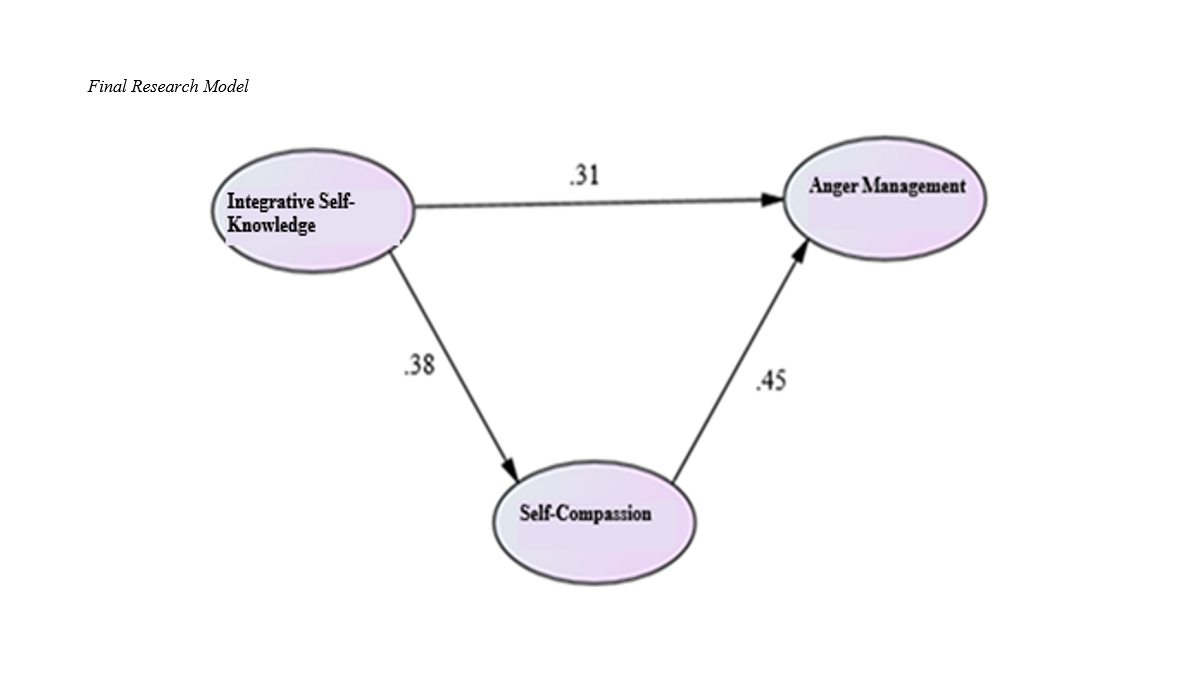
The aim of the present study was to propose a causal model of anger management based on integrative self-knowledge with the mediating role of self-compassion in nurses. The present research employed a descriptive (correlational) design using structural equation modeling. The statistical population consisted of all nurses working in the city of Qom, totaling at least 3,000 individuals. The sample included 200 nurses who were selected through purposive sampling based on specific inclusion and exclusion criteria. The research sample responded to the Spielberger Anger Questionnaire (Spielberger, 2003), the Integrative Self-Knowledge Scale developed by Ghorbani et al. (2008), and the Self-Compassion Scale by Neff (2003). Pearson correlation analysis, regression analysis, and structural equation modeling were used. The results indicated that integrative self-knowledge had a positive and significant effect on anger management among nurses, accounting for 31 percent of the variance in anger management through a direct and significant path (P ≤ .05). Self-compassion demonstrated a positive and significant effect on the relationship between anger management and integrative self-knowledge and played a significant mediating role between anger management and mindfulness (P ≤ .05). Based on the results, it can be concluded that anger management in nurses—given their direct involvement with patients’ lives—is a critical and vital issue. By emphasizing factors such as self-compassion and integrative self-knowledge, it is possible to improve anger management in nurses.
Downloads
References
Allen, A. B., Goldwasser, E. R., & Leary, M. R. (2012). Self-compassion and well-being among older adults. Self and identity, 11(4), 428-453. https://doi.org/10.1080/15298868.2011.595082
Asadi, F., Khodabakhsh Pirkalani, R., & Mehrinezhad, S. A. (2022). The role of emotional self-regulation strategies, defense mechanisms and integrative self-knowledge in predicting quality of interpersonal relationships. Journal of Modern Psychological Research, 17(67), 1-1. https://psychologyj.tabrizu.ac.ir/article_15314_en.html?lang=en
Audulv, Å., Sampaio, F., & Sousa, C. (2025). Nursing approaches to self-care, self-management, and adaptation to illness. BMC Nursing, 24(1), 81. https://doi.org/10.1186/s12912-025-02737-2
Beaudin, J., Chouinard, M. C., Girard, A., Houle, J., Ellefsen, É., & Hudon, C. (2022). Integrated self-management support provided by primary care nurses to persons with chronic diseases and common mental disorders: A scoping review. BMC Nursing, 21(1), 212. https://doi.org/10.1186/s12912-022-01000-2
Bian, J., Chen, F., Fang, S., & Wang, Y. (2025). Self-compassion intervention programs for nurses: A scoping review. Healthcare (Basel), 13(2), 177. https://doi.org/10.3390/healthcare13020177
Croston, M., & Rutter, S. (2023). Becoming an inner ally: The compassionate minds approach to self-compassion− an online programme. British Journal of Nursing, 32(1), S20-S23. https://doi.org/10.12968/bjon.2023.32.1.S20
del-Castillo-Feito, C., Blanco-González, A., & Hernández-Perlines, F. (2022). The impacts of socially responsible human resources management on organizational legitimacy. Technological Forecasting and Social Change, 174, 121274. https://doi.org/10.1016/j.techfore.2021.121274
Dev, V., Fernando, A. T., & Consedine, N. S. (2020). Self-compassion as a stress moderator: A cross-sectional study of 1700 doctors, nurses, and medical students. Mindfulness, 11, 1170-1181. https://doi.org/10.1007/s12671-020-01325-6
Dil, S., & Çam, M. (2024). The mediator role of mindfulness in the relationship between the listening skills and anger management skills of emergency health care professionals. International Emergency Nursing, 75, 101475. https://doi.org/10.1016/j.ienj.2024.101475
Elder, E., Johnston, A. N., Wallis, M., Greenslade, J. H., & Crilly, J. (2019). Emergency clinician perceptions of occupational stressors and coping strategies: A multi-site study. International Emergency Nursing, 45, 17-24. https://doi.org/10.1016/j.ienj.2019.03.006
Fresnics, A., & Borders, A. (2016). Angry rumination mediates the unique associations between self-compassion and anger and aggression. [Journal Name Missing]. https://doi.org/10.1007/s12671-016-0629-2
Ghorbani, N., Cunningham, C. J. L., & Watson, P. J. (2010). Comparative analysis of integrative self-knowledge, mindfulness, and private self-consciousness in predicting responses to stress in Iran. [Journal Name Missing]. https://doi.org/10.1080/00207590903473768
Ghorbani, N., Watson, P. J., Fayyaz, F., & Chen, Z. (2015). Integrative self-knowledge and marital satisfaction. Journal of Psychology, 149(1), 1-8. https://doi.org/10.1080/00223980.2013.827614
Guan, F., Liu, G., Pedersen, W. S., Chen, O., Zhao, S., Sui, J., & Peng, K. (2024). Self-compassion and dorsolateral prefrontal cortex activity during sad self-face recognition in depressed adolescents. [Journal Name Missing]. https://www.cambridge.org/core/journals/psychological-medicine/article/selfcompassion-and-dorsolateral-prefrontal-cortex-activity-during-sad-selfface-recognition-in-depressed-adolescents/342FD48B44524686B14CB084E603D828
Hajifathali, F., Ghorbani, N., & Rostami, R. (2021). The relationship between integrative self-knowledge, mindfulness, self-control, and mental health parameters. [Journal Name Missing]. https://doi.org/10.20511/pyr2021.v9nSPE3.1277
Heffernan, M., Quinn Griffin, M. T., McNulty, S. R., & Fitzpatrick, J. J. (2010). Self‐compassion and emotional intelligence in nurses. İnternational journal of nursing practice, 16(4), 366-373. https://doi.org/10.1111/j.1440-172X.2010.01853.x
Inwood, E., & Ferrari, M. (2018). Mechanisms of change in the relationship between self-compassion, emotion regulation, and mental health: A systematic review. [Journal Name Missing]. https://doi.org/10.1111/aphw.12127
Jagosh, J., Boudreau, J. D., Steinert, Y., MacDonald, M. E., & Ingram, L. (2011). The importance of physician listening from the patients' perspective: Enhancing diagnosis, healing, and the doctor-patient relationship. Patient Education and Counseling, 85(3), 369-374. https://doi.org/10.1016/j.pec.2011.01.028
Jarzynkowski, P., Piotrkowska, R., Mędrzycka-Dąbrowska, W., & Książek, J. (2021). Areas of work life as predictors of occupational burnout of nurses and doctors in operating theaters in Poland-Multicenter studies. Healthcare (Basel), 10(1), 26. https://doi.org/10.3390/healthcare10010026
Koppers, D., Van H, P. J., & Dekker, J. J. (2021). Psychological symptoms, early maladaptive schemas and schema modes: Predictors of the outcome of group schema therapy in patients with personality disorders. Psychotherapy Research, 31(7), 831-842. https://doi.org/10.1080/10503307.2020.1852482
Long, Z., Ma, F., Sun, B., Tan, M., & Li, S. (2023). Diversified branch fusion for self-knowledge distillation. Information Fusion, 90, 12-22. https://doi.org/10.1016/j.inffus.2022.09.007
Majolo, M., Gomes, W. B., & DeCastro, T. G. (2023). Self-consciousness and self-awareness: Associations between stable and transitory levels of evidence. Behavioral Sciences, 13(2), 117. https://doi.org/10.3390/bs13020117
Mosayebi, Z., & Amooei, M. (2024). Promoting teachers' health and emotional balance: An intervention study on positive emotions and anger management. Health Education and Health Promotion, 12(1), 165-171. https://hehp.modares.ac.ir/article_2505_8c1b6fa97c4288a4514365198566c6fa.pdf
Neff, K. D. (2016). The self-compassion scale is a valid and theoretically coherent measure of self-compassion. Mindfulness, 7, 264-274. https://doi.org/10.1007/s12671-015-0479-3
Okumura, M., Ishigaki, T., Mori, K., & Fujiwara, Y. (2022). Personality traits affect critical care nursing competence: A multicentre cross-sectional study. Intensive and Critical Care Nursing, 68, 103128. https://doi.org/10.1016/j.iccn.2021.103128
Othman, S. Y., Hassan, N. I., & Mohamed, A. M. (2023). Effectiveness of mindfulness-based interventions on burnout and self-compassion among critical care nurses caring for patients with COVID-19: A quasi-experimental study. BMC Nursing, 22(1), 305. https://doi.org/10.1186/s12912-023-01466-8
Pachi, A., Panagiotou, A., Soultanis, N., Ivanidou, M., Manta, M., Sikaras, C., & et al. (2024). Resilience, anger, and insomnia in nurses after the end of the pandemic crisis. Epidemiologia, 5(4), 643-657. https://doi.org/10.3390/epidemiologia5040045
Pank, C., von Boros, L., Lieb, K., Dalkner, N., Egger-Lampl, S., Lehr, D., & et al. (2025). The role of self-care and self-compassion in networks of resilience and stress among healthcare professionals. Scientific reports, 15(1), 18545. https://doi.org/10.1038/s41598-025-01111-1
Pien, L. C., Cheng, W. J., Chou, K. R., & Lin, L. C. (2021). Effect of work-family conflict, psychological job demand, and job control on the health status of nurses. International journal of environmental research and public health, 18(7), 3540. https://doi.org/10.3390/ijerph18073540
Quirin, M., Jais, M., Di Domenico, S. I., Kuhl, J., & Ryan, R. M. (2021). Effortless willpower? The integrative self and self-determined goal pursuit. [Journal Name Missing]. https://doi.org/10.3389/fpsyg.2021.684433
Sadeghi, I., Salahyan, A., & Salehy, M. (2022). The role of self-knowledge, love and emotional intelligence in predicting marital conflicts. Counseling Culture and Psychotherapy, 13(50), 69-97. https://qccpc.atu.ac.ir/article_13453_264e445a07bbe21838c2ce4fb14bc46f.pdf
Seligman, M. E., & Csikszentmihalyi, M. (2000). Positive psychology: An introduction. American Psychological Association. https://link.springer.com/chapter/10.1007/978-94-017-9088-8_18
Sheikhi, M., Abooei, A., & Azizi, M. (2023). The effectiveness of Jung's self-knowledge on the adaptability and marital satisfaction of mothers with hearing-impaired children. Auditory and Vestibular Research, 32(3), 233-239. https://doi.org/10.18502/avr.v32i3.12940
Shekarchi, R., Akbari, P. D., Ahmadian, P. D., & Yarahmadi, P. D. (2021). The mediating role of integrative self-knowledge in the relationship between family emotional atmosphere and self-control among high school students in Naqadeh. Quarterly Journal of Family Research, 17(4), 27-42. https://qjfr.ir/browse.php?a_code=A-10-2-212&sid=1&slc_lang=en
Sofia, R. M. C., & Cruz, J. F. A. (2017). Comprehending how individuals regulate anger: An integrative review of coping, emotion regulation and self-control processes. [Journal Name Missing]. https://psycnet.apa.org/record/2018-06617-002
Speedie, L. (2021). Impact of chronic illness, disability, or end-of-life care for the child and family Wong's Nursing Care of Infants and Children: Australia and New Zealand Edition. https://researchoutput.csu.edu.au/en/publications/impact-of-chronic-illness-disability-or-end-of-life-care-for-the-/
Tripathi, S. K., & Mulkey, D. C. (2023). Implementing brief mindfulness-based interventions to reduce compassion fatigue. Critical Care Nurse, 43(5), 32-40. https://doi.org/10.4037/ccn2023745
Verhulst, S., Bustamante, C. M., Carvajal-Velez, L., Cece, F., Requejo, J. H., Shaw, A., & et al. (2023). Toward a demand-driven, collaborative data agenda for adolescent mental health. Journal of Adolescent Health, 72(1), S20-S26. https://doi.org/10.1016/j.jadohealth.2022.05.027
Weigl, M., & Schneider, A. (2017). Associations of work characteristics, employee strain and self-perceived quality of care in Emergency Departments: A cross-sectional study. International Emergency Nursing, 30, 20-24. https://doi.org/10.1016/j.ienj.2016.07.002
Williamson, J. (2020). Effects of a self-compassion break induction on self-reported stress, self-compassion, and depressed mood. Psychological Reports, 123(5), 1537-1556. https://doi.org/10.1177/0033294119877817
Wu, Q., Chi, P., Zeng, X., Lin, X., & Du, H. (2018). Roles of anger and rumination in the relationship between self-compassion and forgiveness. [Journal Name Missing]. https://doi.org/10.1007/s12671-018-0971-7
Yun, K., & Yoo, Y. S. (2021). Effects of the anger management program for nurses. Asian Nursing Research, 15(4), 247-254. https://doi.org/10.1016/j.anr.2021.07.004
Zhang, M., Murphy, B., Cabanilla, A., & Yidi, C. (2021). Physical relaxation for occupational stress in healthcare workers: A systematic review and network meta-analysis of randomized controlled trials. Journal of Occupational Health, 63(1), e12243. https://doi.org/10.1002/1348-9585.12243
Zhou, L., Cai, E., Thitinan, C., Khunanan, S., Wu, Y., & Liu, G. (2024). Explaining the relation between perceived social support and psychological well-being among Chinese nursing students: A serial multiple mediator model involving integrative self-knowledge and self-integrity. Psychological Reports, 127(2), 594-619. https://doi.org/10.1177/00332941221127625
Downloads
Additional Files
Publication Timeline
- Submitted
- Revised
- Accepted