Exploring the Components of Subjective Well-Being Among Individuals Living in Urban Stressful Environments
DOI:
https://doi.org/10.61838/kman.ooc.psynexus.3.13Keywords:
Subjective well-being, urban stress, coping strategies, social support, resilience, qualitative research, United KingdomAbstract
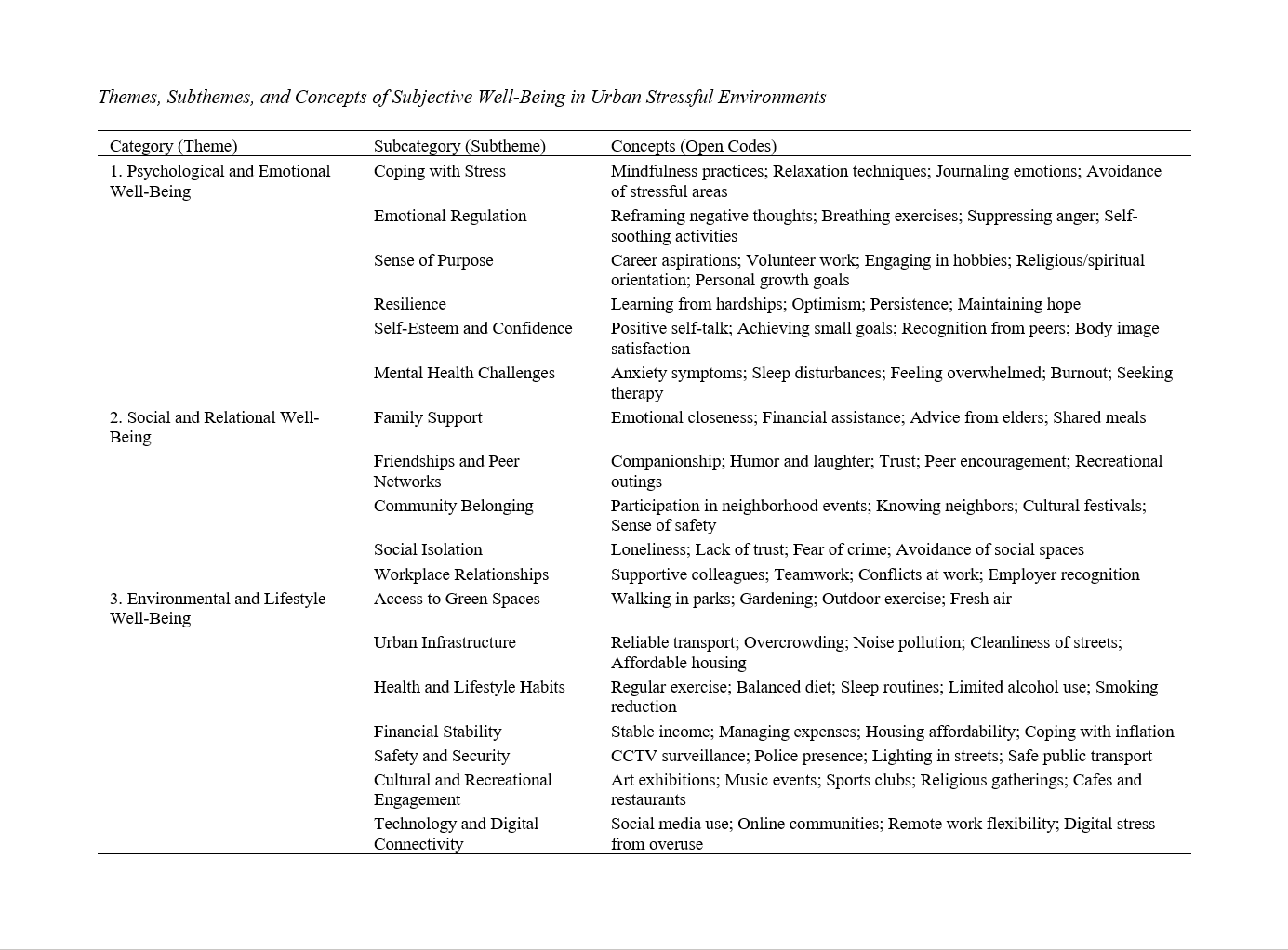
The aim of this study was to explore the psychological, social, and environmental components of subjective well-being among individuals residing in stressful urban environments in the United Kingdom. This qualitative study employed an exploratory design to capture participants’ lived experiences of well-being in the context of urban stress. A purposive sampling strategy was used to recruit 28 adults living in metropolitan and mid-sized urban areas across the United Kingdom. Semi-structured interviews were conducted until theoretical saturation was reached, focusing on coping strategies, sources of support, and perceptions of well-being. Each interview lasted between 45 and 70 minutes, was audio-recorded with consent, and subsequently transcribed verbatim. Data were analyzed using thematic analysis supported by NVivo 14 software. Reflexive memoing and iterative coding were employed to ensure rigor, and Braun and Clarke’s six-phase approach guided the analytical process. Analysis revealed three overarching themes shaping subjective well-being: (1) psychological and emotional well-being, which included coping with stress, resilience, emotional regulation, and challenges such as anxiety and burnout; (2) social and relational well-being, encompassing family support, friendships, workplace relations, and community belonging, alongside the negative impact of social isolation; and (3) environmental and lifestyle well-being, which included access to green spaces, urban infrastructure, financial stability, safety, cultural participation, and technology use. Participants emphasized the protective role of resilience, social support, and access to restorative environments, while highlighting financial insecurity, social isolation, and digital overuse as key threats to well-being. Subjective well-being in urban stressful environments is a multidimensional construct shaped by individual coping strategies, social support systems, and environmental conditions. Strengthening resilience, enhancing community connectedness, and addressing structural urban challenges are essential for promoting healthier, more sustainable urban living.
Downloads
References
Aleksejūnienė, J., Hysi, D., Nikolovovska, J., Stangvaltaite‐Mouhat, L., Chałas, R., Oancea, R., Richardas, K., Lipski, M., Sarna‐Boś, K., & Пуриене, А. (2022). European Student Wellness, Stress, Coping, Support and Perceptions About Remote Dental Training During COVID‐19. European Journal of Dental Education, 26(4), 820-829. https://doi.org/10.1111/eje.12765
Balcan, A.-D. (2023). The Relationship Between Organizational Stress and Psychological Well-Being- A Longitudinal Mediation Model. Ra Journal of Applied Research, 09(05). https://doi.org/10.47191/rajar/v9i5.03
Balcan, A. D. (2023). The Mediating Role of Social Support in the Relationship Between Operational Stress and Well-Being in Military Personnel. Brain Broad Research in Artificial Intelligence and Neuroscience, 14(1), 105-116. https://doi.org/10.18662/brain/14.1/409
Davis, R. F., & Kiang, L. (2020). Parental Stress and Religious Coping by Mothers of Children With Autism. Psychology of Religion and Spirituality, 12(2), 137-148. https://doi.org/10.1037/rel0000183
Demirtepe-Saygılı, D. (2022). Stress, Coping, and Social Media Use. 1036-1055. https://doi.org/10.4018/978-1-6684-5594-4.ch053
Gerymski, R. (2019). Support and Coping as Moderators of the Relationship Between Perceived Stress and the Quality of Life of Transgender People. Czasopismo Psychologiczne Psychological Journal, 24(3). https://doi.org/10.14691/cppj.24.3.607
Grünenwald, I., Kaluza, A. J., Schultze, M., & Dick, R. v. (2022). Stress Mindset and Social Identification in Chronic Pain Patients and Their Relationship to Coping, Well-Being &Amp; Depression. Journal of Clinical Psychology in Medical Settings, 30(1), 153-168. https://doi.org/10.1007/s10880-022-09883-8
Jeon, S.-H., & Park, K. O. (2015). Sociopsychological Factors Associated With Depressive Symptoms Among Some Urban Middle-Aged Men and Women: Focused on Social Support and Stress Coping Strategy. Korean Journal of Health Education and Promotion, 32(3), 43-55. https://doi.org/10.14367/kjhep.2015.32.3.43
Kaveh, M. H., Mehrazin, F., Cousins, R., & Mokarami, H. (2023). Effectiveness of a Transactional Model-Based Education Programme for Enhancing Stress-Coping Skills in Industrial Workers: A Randomized Controlled Trial. Scientific reports, 13(1). https://doi.org/10.1038/s41598-023-32230-2
Kumar, R., & Bansal, E. (2024). Health and Well-Being: Academic Stress and Psychological Well-Being. Journal Global Values, XV(1), 64-75. https://doi.org/10.31995/jgv.2024.v15i01.009
Kwon, E. H., Ju, H. O., Jeung, E. O., Han, C. H., Im, J. J., Lee, Y. R., Jung, M. S., & Park, S. Y. (2018). Stress Due to End-of-Life Care, Coping Strategies, and Psychological Well-Being Among Nurses in Neonatal Intensive Care Units. Child Health Nursing Research, 24(4), 475-483. https://doi.org/10.4094/chnr.2018.24.4.475
Mendoza, N., Fruhauf, C. A., & MacPhee, D. (2019). Grandparent Caregivers’ Resilience: Stress, Support, and Coping Predict Life Satisfaction. The International Journal of Aging and Human Development, 91(1), 3-20. https://doi.org/10.1177/0091415019843459
Putri, R. T., Lahmuddin, L., & Darmayanti, N. (2020). Hubungan Coping Stres Dan Dukungan Sosial Dengan Subjective Well Being Siswa Kelas XI Di Sekolah SMA Singosari Deli Tua. Tabularasa Jurnal Ilmiah Magister Psikologi, 2(2), 119-126. https://doi.org/10.31289/tabularasa.v2i2.305
Rosdianto, N. O. (2024). Factors Affecting the Incidence of Postpartum Blues in Postpartum Women in the Karang Tengah Urban Village Area, Sukabumi City. Jurnal Keperawatan Komprehensif, 10(1). https://doi.org/10.33755/jkk.v10i1.657
Sabir, A. B., Sikandar, A., & Ajaz, N. (2025). Comparative Analysis of Stress Level and Mental Well-Being in Rural and Urban Residents. TRT, 4(1), 194-203. https://doi.org/10.63062/trt/wr25.070
Uye, E. E., Adejuwon, L., & Ehondor, E. (2024). Workplace Stress, Social Support and Coping Strategy as Predictors of Mental Well-Being Among Nurses in Ibadan. Ijasse, 2(2), 169-180. https://doi.org/10.59890/ijasse.v2i2.1753
Vetrivel, S. C., Saravanan, T. P., Maheswari, R., & Arun, V. P. (2024). Coping Mechanisms for Stress Among Students at Universities. 157-186. https://doi.org/10.4018/979-8-3693-4417-0.ch007
Wang, H., Liu, S., Xu, J., Hu, X., & Han, Z. R. (2023). Daily Experiences and Well-Being of Chinese Parents of Children With Autism. Autism, 27(6), 1560-1574. https://doi.org/10.1177/13623613221144191
Wasantha, U. G. A. (2024). Mental Stress for Creating Healthy Environment for Housewives in Maharagama MOH’s. International Journal of Research and Innovation in Applied Science, IX(XI), 280-361. https://doi.org/10.51584/ijrias.2024.911025
Widyasrini, J. U. S., & Lestari, S. (2020). Dual Role Conflict, Coping Stress, and Social Support as Nurses’ Well-Being Predictor. Jurnal Psikologi, 19(2), 174-187. https://doi.org/10.14710/jp.19.2.174-187
Zhao, Y., Cui, Y., Liu, S., Wen, Y., Ding, Y., & Xu, Q. (2021). Staff's Psychological Well-Being and Coping Mechanisms During COVID-19 Lockdown in Care Homes for Older Adults: A Structural Equation Modeling Analysis. Research in Gerontological Nursing, 14(4), 180-190. https://doi.org/10.3928/19404921-20210325-01
Zourrig, H., & Hedhli, K. E. (2022). Consumption Coping Strategies and Well‐being Among Refugee Consumers. Journal of Consumer Affairs, 57(1), 140-170. https://doi.org/10.1111/joca.12494
Downloads
Additional Files
Publication Timeline
- Submitted
- Revised
- Accepted