Effectiveness of Acceptance and Commitment Therapy (ACT)–Based Intervention on Job Burnout and Quality of Care among Psychiatric Ward Nurses
Keywords:
Acceptance and Commitment Therapy, job burnout, psychiatric nursing, quality of care, psychological flexibilityAbstract
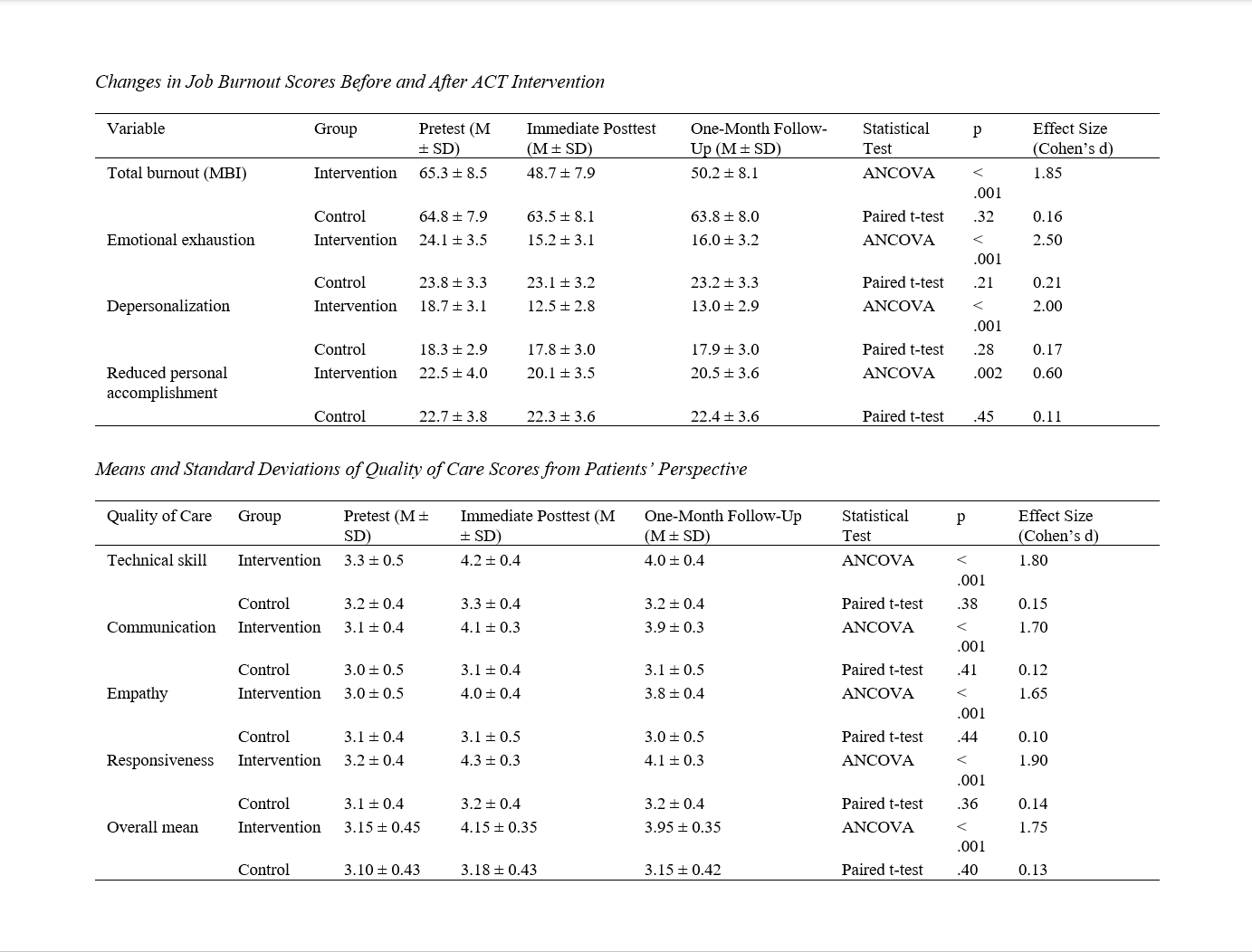
This study aimed to evaluate the effectiveness of a group-based Acceptance and Commitment Therapy (ACT) intervention in reducing job burnout among psychiatric ward nurses and improving the quality of nursing care as perceived by patients. A quasi-experimental pretest–posttest design with a control group was applied among 40 nurses working in the psychiatric ward of Farabi Hospital, Isfahan, Iran. After screening with the Maslach Burnout Inventory (MBI), nurses with burnout scores above average were purposively selected and randomly assigned to the intervention (n = 20) and control (n = 20) groups. The intervention group participated in eight 90-minute ACT sessions based on the standardized protocol (Hayes et al., 2012). Patient-perceived quality of care was measured using the Caring Behaviors Inventory (CBI), with five patients evaluating each nurse at baseline, immediate posttest, and one-month follow-up (total n = 200). Data were analyzed using analysis of covariance (ANCOVA), paired t-tests, and effect size (Cohen’s d). ACT significantly reduced total burnout scores in the intervention group compared to controls (pretest M = 65.3 ± 8.5 to immediate posttest M = 48.7 ± 7.9; p < .001; Cohen’s d = 1.85). Emotional exhaustion showed the largest reduction (d = 2.50), followed by depersonalization (d = 2.00) and reduced personal accomplishment (p = .002; d = 0.60). In the control group, no meaningful changes occurred (p > .05). Patient-reported care quality improved significantly in all dimensions in the intervention group, including technical skill, communication, empathy, and responsiveness (p < .001; d ranging from 1.65 to 1.90), with improvements sustained at one-month follow-up. Group-based ACT effectively alleviates burnout and enhances patient-perceived care quality among psychiatric nurses. This approach is practical, sustainable, and beneficial for improving both staff well-being and service delivery in mental health settings.
Downloads
References
Aiken, L. H., Lasater, K. B., Sloane, D. M., Pogue, C. A., Rosenbaum, K. E. F., Muir, K. J., & Consortium, U. S. C. W. S. (2023). Physician and Nurse Well-Being and Preferred Interventions to Address Burnout in Hospital Practice: Factors Associated with Turnover, Outcomes, and Patient Safety. Jama Health Forum, 4(7), e231809. https://doi.org/10.1001/jamahealthforum.2023.1809
Alzailai, N., Barriball, L., & Xyrichis, A. (2021). Burnout and Job Satisfaction Among Critical Care Nurses in Saudi Arabia and Their Contributing Factors: A Scoping Review. Nursing Open, 8(5), 2331-2344. https://doi.org/10.1002/nop2.843
Ashoori, N., Rafiepoor, A., & Sabet, M. (2024). Comparison of the Effectiveness of Cognitive-Behavioral Therapy and Acceptance and Commitment Therapy on Job Burnout and Psychological Well-being of Nurses. Psychology of Woman Journal, 5(3), 106-115. https://doi.org/10.61838/kman.pwj.5.3.13
Devira, G. A. (2024). Analysis of the Relationship Between Nurse Burnout Levels and the Quality of Nursing Services. International Journal on ObGyn and Health Sciences, 2(3), 159-165. https://doi.org/10.35335/obgyn.v2i3.187
Enayati Shabkolai, M., Enayati Shabkalai, M., & Bagheri Dadokolai, M. (2023). The Effectiveness of Treatment based on Acceptance and Commitment on Social Adaptation, Academic Self-Regulation and Cognitive Flexibility of Students with Specific Learning Disorders. International Journal of Education and Cognitive Sciences, 4(1), 33-41. https://doi.org/10.61838/kman.ijecs.4.1.5
Han, J., Zhang, L., Liu, Y., Zhang, C., Zhang, Y., Tang, R., & Bi, L. (2022). Effect of a group-based acceptance and commitment therapy programme on the mental health of clinical nurses during the COVID-19 sporadic outbreak period. Journal of nursing management, 30(7), 3005-3012. https://doi.org/10.1111/jonm.13696
Hayes, S. C., Pistorello, J., & Levin, M. E. (2012). Acceptance and Commitment Therapy as a Unified Model of Behavior Change. The counseling psychologist, 40(7), 976-1002. https://doi.org/10.1177/0011000012460836
Karimi, S., Mahmofakhe, H., & Shiri, H. (2022). The effect of acceptance and commitment therapy on burnout, quality of life, and mental health of nurses. Occupational Psychology Quarterly, 1(3), 44-35. https://jpsy.journals.pnu.ac.ir/article_9657.html?lang=en
Mohammadi, M. (2022). The effectiveness of acceptance and commitment therapy on mental health and job satisfaction among nurses working in intensive care units of Farshian Hospital in Hamadan. New Ideas in Psychology Quarterly, 12(16), 14-11. https://jnip.ir/article-1-680-fa.html
Motie, M., Fallahi-khoshknab, M., Mohammadi Shahbolaghi, F., Khanjani, M. S., Stueck, M., & Khankeh, H. (2025). Secondary Traumatic Stress in Emergency Department Nurses: A Multi-Methods Study Protocol. Journal of Research Development in Nursing and Midwifery, 22(2), 17-22. https://nmj.goums.ac.ir/browse.php?a_id=1990&sid=1&slc_lang=en&ftxt=0
Prudenzi, A., Graham, C. D., Flaxman, P. E., Wilding, S., Day, F., & O'Connor, D. B. (2022). A Workplace Acceptance and Commitment Therapy (ACT) Intervention for Improving Healthcare Staff Psychological Distress: A Randomised Controlled Trial. PLoS One, 17(4), e0266357. https://doi.org/10.1371/journal.pone.0266357
Ruiz, F. J. (2010). A Review of Acceptance and Commitment Therapy (ACT) Empirical Evidence: Correlational, Experimental Psychopathology, Component and Outcome Studies. International journal of psychology and psychological therapy, 10(1), 125-162. https://psycnet.apa.org/record/2010-05335-008
Salehi, S. (2020). Comparison of the effectiveness of group schema therapy and Acceptance and Commitment Therapy (ACT) on job burnout, marital resilience, and family resilience in married nurses https://jwfs.alzahra.ac.ir/article_2970_en.html
Shah, M. K., Gandrakota, N., Cimiotti, J. P., Ghose, N., Moore, M., & Ali, M. K. (2021). Prevalence of and Factors Associated with Nurse Burnout in the US. JAMA Network Open, 4(2), e2036469. https://doi.org/10.1001/jamanetworkopen.2020.36469
Shahbaz, K., Shibli, N., Amjad, S., & Sharon, J. (2022). Impacts of Perceived Care Quality on Psychological Wellbeing of Cancer Patients. International Transactions on Engineering, 13(1), 1-10. https://tuengr.com/A13/13A1/13A1F.html
Taghilo, L., Azizi Ziabari, L. S., Khajevand Khoshli, A., & Damghani Mirmahaleh, M. (2023). Comparing the effectiveness of acceptance and commitment therapy(ACT) and paradoxical time table therapy (PTC) on the psychological well-being of nurses. EBNESINA, 25(3), 14. https://doi.org/10.22034/25.3.14
Taghilu, L., Azizi Ziyabari, L. S., Khvajavand-Khoshli, A., & Damghani-Mirmohalleh, M. (2023). Comparing the effectiveness of Acceptance and Commitment Therapy (ACT) and repetitive transcranial magnetic stimulation on ego strength among nurses. Nurse and Physician in Razm, 11(38), 1-12. https://ppls.ui.ac.ir/article_27118.html
Tavella, G., Hadzi-Pavlovic, D., & Parker, G. (2021). Burnout: Redefining Its Key Symptoms. Psychiatry research, 302, 114023. https://doi.org/10.1016/j.psychres.2021.114023
Van Bogaert, P., Peremans, L., Van Heusden, D., Verspuy, M., Kureckova, V., Van de Cruys, Z., & Franck, E. (2017). Predictors of Burnout, Work Engagement and Nurse Reported Job Outcomes and Quality of Care: A Mixed Method Study. BMC Nursing, 16(1), 5. https://doi.org/10.1186/s12912-016-0200-4
Downloads
Additional Files
Publication Timeline
- Submitted
- Revised
- Accepted
Issue
Section
Categories
License
Copyright (c) 2024 Fariba Khakzar (Corresponding Author); Maryam Faghih (Author)

This work is licensed under a Creative Commons Attribution-NonCommercial 4.0 International License.