Examining the Effectiveness of Metacognitive Therapy on Self-Disclosure and Self-Restraint in Single Women Unwilling to Marry
DOI:
https://doi.org/10.61838/kman.fct.psynexus.3.18Keywords:
unwillingness to marry, metacognitive therapy, self-disclosure, self-restraint, womenAbstract
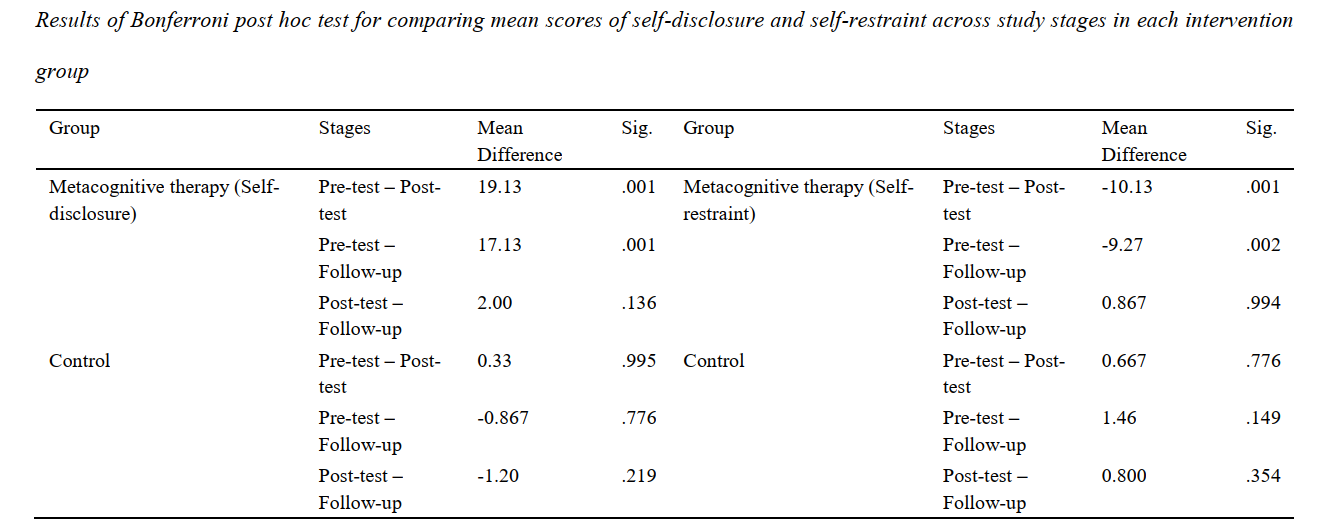
The present study aimed to examine the effectiveness of metacognitive therapy on self-disclosure and self-restraint in single women unwilling to marry. The research method was quasi-experimental, employing a pre-test–post-test and follow-up design with a control group. The statistical population consisted of all female students at Islamic Azad Universities in Isfahan during the 2022–2023 academic year. Participants were selected based on inclusion and exclusion criteria. A total of 30 individuals were selected through purposive sampling and were randomly assigned to the experimental and control groups (15 participants in each group). Both groups completed the pre-test, after which the experimental group received metacognitive therapy over the course of eight intervention sessions, whereas the control group received no intervention. Data were collected using the 24-item Emotional Self-Disclosure Questionnaire by Snell et al. (1988), the 30-item Self-Restraint Questionnaire by Weinberger and Schwartz (1990), and the Marriage Inclination Scale by Heydari et al. (2004). Data analysis was conducted using repeated measures analysis of variance in SPSS version 23. The findings indicated that metacognitive therapy led to increased self-disclosure and self-restraint in single women unwilling to marry, and the therapeutic effects persisted at the follow-up stage (F = 9.95, p < .01). Based on the present findings, metacognitive therapy can be utilized to enhance self-disclosure and self-restraint in single women unwilling to marry.
Downloads
References
Abdi Zarrin, S., Najafalizadeh, A., & Monirpour, N. (2022). Predicting attitudes toward marriage based on the basic needs of choice theory and family functioning in single students of Farhangian University. Culture in Islamic University, 12(2), 255-272. https://pmc.ncbi.nlm.nih.gov
Ahangari, A., Jahangir, P., & Dokaneifard, F. (2024). Comparison of the effectiveness of schema therapy and metacognitive therapy on the emotional expression of conflicted women. Rooyesh, 13(5), 101-112. https://frooyesh.ir/browse.php?a_id=5225&sid=1&slc_lang=en
Ahn, J., & Kim, I. (2022). The Effect of Autonomy and Self-Control on Changes in Healthy Lifestyles of Inactive College Students through Regular Exercise. Int J Environ Res Public Health, 19(17), 10727. https://doi.org/10.3390/ijerph191710727
Bagheri, S., Khajevand Khoshli, A., & Asadi, J. (2023). The Effectiveness of Emotion-Focused Couple Therapy Approach on Improving Marital Burnout and Emotional Self-Disclosure of Couples Applying for Divorce. MEJDS, 20(2), 243. https://www.sid.ir/paper/1127107/en
Basharpour, S., & Estiri, S. (2024). Predicting marriage readiness based on identity status, intimacy, desire for marriage, and optimism model. J Fam Res, 19(4), 553-566. https://doi.org/10.48308/JFR.19.4.553
Capobianco, L., & Nordahl, H. (2023). A brief history of metacognitive therapy: From cognitive science to clinical practice. Cogn Behav Pract, 30(1), 45-54. https://doi.org/10.1016/j.cbpra.2021.11.002
Carter, J. D., Jordan, J., McIntosh, V. W., Frampton, C. M. A., Lacey, C., Porter, R. J., & Mulder, R. T. (2022). Long-term efficacy of metacognitive therapy and cognitive behaviour therapy for depression. Aust N Z J Psychiatry, 56(2), 137-143. https://doi.org/10.1177/00048674211025686
Cindy, H., & Hu. (2022). Self-disclosure for early relationship development through situated prompts in opportunistic collective experiences. CHI,
Dadjoo, M., & Gharibzadeh, S. (2022). Prediction of self-control based on cognitive intelligence and socio-emotional behavior assessments in early childhood. Front Biomed Technol, 9(1), 21-28. https://doi.org/10.18502/fbt.v9i1.8141
Dehghan Hesar, M., Hajhosseini, M., Gholamali Lavasani, M., & Hejazi Moughari, E. (2023). Solo-living among single women: A phenomenological study of challenges and strategies. Rooyesh, 11(12), 2. http://frooyesh.ir/article-1-4102-en.html
Faramarzi Rad, B., Rabat Mili, S., Abolmaali Hosseini, K., & Zare Bahramabadi, M. (2023). Structural model for predicting emotional non-disclosure based on early maladaptive schemas with the mediation of emotional self-disclosure. Journal of Psychological Sciences, 22(123), 539-555. https://www.sciencedirect.com
Fennis, B. M. (2022). Self-control, self-regulation, and consumer wellbeing: A life history perspective. Curr Opin Psychol, 46, 101344. https://doi.org/10.1016/j.copsyc.2022.101344
Fouladi, A., Khademi, A., & Shaker Dioulagh, A. (2023). The effectiveness of compassion therapy and meta-cognitive therapy on the level of nurses' meta-emotion. J Res Psychopathol, 4(11), 23-32. https://doi.org/10.22098/jrp.2022.11300.1131
Hauschildt, M., Arlt, S., Moritz, S., Yassari, A. H., & Jelinek, L. (2022). Efficacy of metacognitive training for depression as add-on intervention for patients with depression in acute intensive psychiatric inpatient care: A randomized controlled trial. Clin Psychol Psychother, 1-14. https://doi.org/10.1002/cpp.2733
Jafarnejad, A., & Khakpour, R. (2024). Comparison of emotional maturity and psychological disorders (anxiety and depression) in women and men with cohabitation and formal marriage. J Fam Health, 14(1), 40. https://journals.sagepub.com
Moghtadai, M., Yousefi, Z., & Davari Dolatabadi, M. (2023). The internal consistency and validity of marriage values scales among young women. J Assess Res Appl Couns, 5(1), 56-70. https://doi.org/10.52547/jarac.5.1.56
Niknejadi, M., Sajjadian, A., & Manshaei, G. (2023). The effectiveness of emotional efficiency-based therapy on self-control and intimacy in women traumatized by marital betrayal. Applied Family Therapy, 4(2), 29-45. https://doi.org/10.61838/kman.aftj.4.2.2
Noroozi Azam, M., Monirpour, N., & Mirzahosseini, H. (2022). Marital stability based on the quality of the parent-child relationship and attachment: The mediating role of narcissistic personality, alienation, and the experience of "we-ness". Rooyesh Psychology, 11(5), 74. https://search.proquest.com
Panahpouri, N., & Johari, S. (2024). The mediating role of marital self-disclosure in the relationship between intimacy and sexual performance and divorce tendency among couples on the brink of divorce: A descriptive study. JRUMS, 23(4), 337-351. https://doi.org/10.61186/jrums.23.4.237
Patel, A., Daros, A. R., Irwin, S. H., Lau, P., Hope, I. M., Perkovic, S. J. M., Laposa, J. M., Husain, M. I., Levitan, R. D., Kloiber, S., & Quilty, L. C. (2023). Associations between rumination, depression, and distress tolerance during CBT treatment for depression in a tertiary care setting. Journal of affective disorders, 339, 74-81. https://doi.org/10.1016/j.jad.2023.06.063
Rahmanipour, R. (2024). Examining society in terms of marital status and celibacy and mate selection patterns in Iran. Monthly Journal of the Islamic Consultative Assembly Research Center, 32(5), 19982. https://doi.org/10.22034/report.2024.17060.1864
Roshan Chesli, R., Farahani, H., & Morvaridi, M. (2023). Structural model of the relationship between attachment styles and emotional schemas with regard to the mediating variables of emotional regulation and cognitive flexibility with the desire to marry. Clinical Psychology and Personality, 21(1), 57-72. https://doi.org/10.22070/cpap.2023.16191.1227
Sadeghi, M., Sarani, H., Senobar, A., & Asgari, M. (2021). The effectiveness of cognitive behavioral group therapy on self-control, self-restraint, and dysfunctional attitudes in individuals with substance abuse. Rooyesh-e-Ravanshenasi, 9(10), 67-78. https://search.proquest.com
Shaker Khoshroudi, Z., & Houshyari. (2021). The relationship between the tendency and desire to marry with differentiation and responsibility in students. Islamic Psychological Research, 7(4), 85-99. http://ri.journals.miu.ac.ir/article_8922_en.html
Sharif, A., Soroya, H. S., Ahmad, S., & Mahmood, K. (2021). Antecedents of self-disclosure on social networking sites (SNSs): A study of Facebook users. Sustainability, 13, 1220. https://doi.org/10.3390/su13031220
Sharma, V., Sagar, R., Kaloiya, G., & Mehta, M. (2022). The scope of metacognitive therapy in the treatment of psychiatric disorders. Cureus, 14(3), e23424. https://doi.org/10.7759/cureus.23424
Smith, J., & Johnson, L. (2022). Changing Attitudes Toward Marriage in the 21st Century: A Global Perspective. Journal of Social Studies, 45(2), 150-170. https://onlinelibrary.wiley.com/doi/abs/10.1002/9781118320990.ch1
Wells, A., Reeves, D., Heal, C., Davies, L. M., Shields, G. E., Heagerty, A., Fisher, P., Doherty, P., & Capobianco, L. (2022). Evaluating metacognitive therapy to improve treatment of anxiety and depression in cardiovascular disease: The NIHR funded PATHWAY research programme. Front Psychiatry, 13, 886407. https://doi.org/10.3389/fpsyt.2022.886407
Yari, L., Zeini Hasanvand, N., & Yousefvand, M. (2023). Comparing the effectiveness of dialectical behavior therapy and metacognitive therapy on cognitive emotional regulation strategies in adolescents. Family and Health, 13(A), 45-59. https://
Downloads
Additional Files
Publication Timeline
- Submitted
- Revised
- Accepted
Issue
Section
Categories
License
Copyright (c) 2025 Fahimeh Sistani (Author); Felor Khayatan (Corresponding Author); Zahra Yousefi (Author)

This work is licensed under a Creative Commons Attribution-NonCommercial 4.0 International License.