Predicting Addiction Tendency in Adolescents Based on Dark Personality Traits, Social Isolation, and Psychological Hardiness
DOI:
https://doi.org/10.61838/kman.ec.psynexus.3.12Keywords:
Addiction tendency, dark personality traits, social isolation, psychological hardinessAbstract
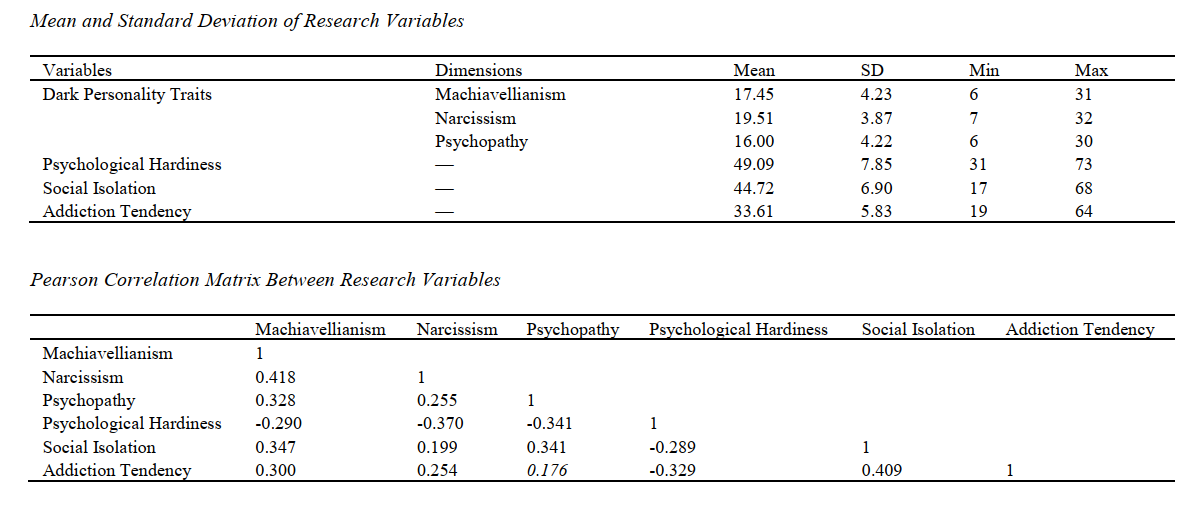
The present study aimed to predict the tendency toward addiction in adolescents based on dark personality traits, social isolation, and psychological hardiness. This study is applied in its objective, quantitative in nature, and employs a descriptive-correlational statistical approach. The study population included all adolescents enrolled in upper secondary schools in Shiraz during the year 2025. The sample consisted of 200 adolescents selected through cluster sampling from secondary schools in District 2 of Shiraz. In the field phase, quantitative data on the variables were collected using the following instruments: the Addiction Tendency Questionnaire by Mousavi et al. (2008), the Dark Triad Personality Questionnaire by Johnson and Webster (2010), the Social Isolation Questionnaire by Chalabi and Amirkafi (2004), and the Psychological Hardiness Questionnaire by Kobasa (1982). The data collected from the questionnaires were analyzed using SPSS version 28. To examine the research hypotheses, Pearson correlation tests and multiple regression analysis were used. The results showed that the dimensions of dark personality traits, psychological hardiness, and social isolation collectively accounted for 36% of the variance in addiction tendency scores. Furthermore, the Machiavellianism component positively and significantly predicted addiction tendency (β = 0.298, p = .001). The antisocial component also positively and significantly predicted addiction tendency (β = -0.328, p = .001). The cognitive component of psychological hardiness negatively and significantly predicted addiction tendency (β = -0.267, p = .005). Additionally, social isolation positively and significantly predicted addiction tendency (β = 0.429, p = .001). Therefore, addiction tendency can be predicted by dark personality traits, social isolation and psychological hardiness.
Downloads
References
Aghajani, S., Parzor, P., & Ahmadi, S. (2022). The role of risk perception and social isolation in predicting COVID-19 anxiety through the mediation of health anxiety in students. Journal of Health and Care, 23(1), 7-19. https://doi.org/10.52547/jhc.23.1.7
Aghdaki, F., & Seddighi Arfaei, F. (2023). The role of perceived social support and anger in predicting addiction tendencies in adolescents. Quarterly Journal of Addiction Studies, 17(67), 229-244. https://doi.org/10.52547/etiadpajohi.17.67.229
Alotaibi, M. S., Fox, M., Coman, R., Ratan, Z. A., & Hosseinzadeh, H. (2022). Smartphone addiction prevalence and its association on academic performance, physical health, and mental well-being among university students in Umm Al-Qura University (UQU), Saudi Arabia. International journal of environmental research and public health, 19(6), 37-47. https://doi.org/10.3390/ijerph19063710
Asadi, A., Zarei, S., Daglioglu, N., Guzel, E. Y., & Ravankhah, N. (2025). Illicit drug use derived from wastewater-based epidemiology in Iran, their removal during wastewater treatment, and occurrence in receiving waters. Heliyon, 11(3DO - 10.1016/j.heliyon.2025.e42516). https://www.cell.com/heliyon/fulltext/S2405-8440(25)00896-5
Bartone, P. T., McDonald, K., & Hansma, B. J. (2022). Hardiness and burnout in adult US workers. Journal of Occupational and Environmental Medicine, 64(5), 397-402. https://doi.org/10.1097/JOM.0000000000002448
Carlucci, S., & McCuaig Edge, H. (2022). An exploratory analysis of hardiness and health behaviours in Canadian Armed Forces recruits. Journal of Military, Veteran and Family Health, 8(2), 94-103. https://doi.org/10.3138/jmvfh-2021-0068
Dabbagh, R., Alsulimani, A., Alshamrani, S., Abuhaimed, A., Alzaid, W., Aldofyan, M., Rawson, R., Darijani, S. R., Seyedmirzaei, H., Nakhostin-Ansari, A., Menbari-Oskouie, I., Ghaseminejad-Raeini, A., Nasoori, H., & Akhondzadeh, S. (2023). Prescription opioid misuse in relation to addiction susceptibility among women at a Saudi universityJO - Saudi Pharmaceutical Journal Burden of Substance Use Disorders in the Middle East and North Africa from 1990 to 2019. Balkan Medical Journal, 31(10), 101764. https://doi.org/10.1016/j.jsps.2023.101764 10.4274/balkanmedj.galenos.2025.2024-11-61
Dermani, H., & Perdikaris, P. (2022). Internet addiction and psychological impact on adolescents: A scoping review. International Journal of Biological and Pharmaceutical Sciences Archive, 4(2), 73-87. https://doi.org/10.53771/ijbpsa.2022.4.2.0096
Ebrahimzade, S., & Sohrabi, F. (2021). Predicting addiction tendency based on the variables of psychological hardiness and intolerance of ambiguity in university students. etiadpajohi, 15(61), 283-302. https://doi.org/10.52547/etiadpajohi.15.61.283
Garcia, M., Rouchy, E., Colins, O., Andershed, H., & Michel, G. (2022). Validation of the French Youth Psychopathic Traits Inventory-Short Version in a general population sample of emerging adults in France. Psychologie Française. https://www.sciencedirect.com/science/article/pii/S0033298422000309
Gohari, F., Qamari, H., & Sheykholeslami, A. (2025). The effectiveness of computer-based cognitive rehabilitation on the social isolation of the elderly with death anxiety living in elderly centers. Social Psychology Research, 14(56), 15-32. https://www.socialpsychology.ir/article_215642_en.html
Heidari Mofard, M., Safai, A., & Iman, M. (2023). The relationship between the dark triad of personality and harmful online gaming among adolescents at the national level: The mediating role of motivation and game type. Sports Psychology Studies, 11(42), 159-178. https://spsyj.ssrc.ac.ir/article_3120_en.html?lang=en
Karami, N., Amini, N., Behrouzi, M., & Jafarinia, G. (2022). The mediating role of social isolation in the relationship between brain-behavioral systems and HEXACO personality traits with distress tolerance in drug-dependent individuals. Journal of Counseling and Psychotherapy, 12(47), 221-258. https://maherpub.com/jndd/article/view/449
Khadse, V. J., Dhillon, H. S., & Sasidharan, S. (2024). Psychological hardiness, personality factors and coping styles in male patients of alcohol dependence syndrome. Medical Journal Armed Forces India, 80(2), 172-177. https://doi.org/10.1016/j.mjafi.2022.07.007
Lee, J., An, J., & Suh, K. (2021). The Double Mediating Effect of Social Isolation and Emotional Support on Feelings of Entrapment and Motivation for Recovery among Korean Alcoholic Inpatients. International journal of environmental research and public health, 18. https://doi.org/10.3390/ijerph18094710
Liu, H., Chen, J., Peng, Q., Zhang, H., & He, Y. (2024). Hardiness personality and mental health of financially-struggling medical students in private universities in China: the intervening roles of coping styles and gender. Frontiers in Public Health, 12, 1458049. https://doi.org/10.3389/fpubh.2024.1458049
Liu, N., Bao, G., & Wu, S. (2023). Social implications of Covid-19: Its impact on general trust, political trust, and trust in physicians in China. Social Science & Medicine, 317, 115629. https://doi.org/10.1016/j.socscimed.2022.115629
Lu, L., Xu, J., Wei, J., Shults, F. L., & Feng, X. L. (2024). The role of emotion and social connection during the COVID-19 pandemic phase transitions: a cross-cultural comparison of China and the United States. Humanities and Social Sciences Communications, 11IS - 1, 1-16. https://doi.org/10.1057/s41599-024-02744-9
Mahmodfakhe, H. (2022). Prediction of moral disengagement based on dark triad of personality and belief in a just world among the Marketers of Urmia city during Corona. Social Psychology Research, 12(47), 98-114. https://www.socialpsychology.ir
Naderi Lordegani, M., & Chorami, M. (2021). The effectiveness of meta-cognitive training on quality of life and psychological hardiness of red crescent relief rescuer workers. Positive Psychology Research, 6(4), 81-92. https://ppls.ui.ac.ir/article_25505.html?lang=en
Naderifar, N., Akbari, B., & Sadeghi, A. (2023). Structural Modeling of the Relationship between Spiritual Health with Addiction Tendency in Adolescents: The Mediating Role of Emotional well-being. Journal Of Shahid Sadoughi University Of Medical Sciences. https://doi.org/10.18502/ssu.v31i9.14187
Nooripour, R., Hosseinian, S., Farmani, F., Abtahi Foroshani, N., Ghanbari, N., Farkhojasteh, V. S., & Ilanloo, H. (2022). Relationship between hardiness and stress of COVID-19 through the mediating role of mindfulness in Iranian students. Practice in Clinical Psychology, 10(3), 193-202. https://doi.org/10.32598/jpcp.10.3.288.7
Reyes, M. Q., Bautista, F. J., Soria-Miranda, N., Oleas, D., Mascialino, G., & Rodas, J. A. (2024). Family and Personal Factors Predisposing Adolescents to Addiction in High-Risk Urban Areas. https://doi.org/10.31219/osf.io/euhk4
Rezaei, S., & Vakilian, M. (2021). The mediating role of illness perception in the relationship between psychological hardiness and the health status of covid-19 (coronavirus disease) survived patients. Health Psychology Research, 9(1), 24839. https://doi.org/10.52965/001c.24839ER -
Schreiber, A., & Marcus, B. (2020). The place of the "Dark Triad" in general models of personality: Some meta-analytic clarification. Psychological BulletinVL - 146(11), 1021. https://doi.org/10.1037/bul0000299
Szabó, Z. P., Diller, S. J., Czibor, A., Restás, P., Jonas, E., & Frey, D. (2023). "One of these things is not like the others": The associations between dark triad personality traits, work attitudes, and work-related motivation. Personality and individual differences, 205, 112098. https://doi.org/10.1016/j.paid.2023.112098
Tahir, S. I., & Jan, T. (2023). Pandemic perspectives: How students navigate social relationships. Education Mind, 2(2), 85-100. https://doi.org/10.58583/Pedapub.EM2308
Temane, A. A., Rikhotso, T., Poggenpoel, M., & Myburgh, C. (2023). Adolescents' lived experiences of substance abuse in the Greater Giyani Municipality. Curationis, 46(1), e1-e9. https://doi.org/10.4102/curationis.v46i1.2379
Downloads
Additional Files
Publication Timeline
- Submitted
- Revised
- Accepted
Issue
Section
Categories
License
Copyright (c) 2025 Mohammad Shafiei, Mohammad Sadegh Pishbin, Sara Akbari (Author); Fatemeh Sharifi (Corresponding Author)

This work is licensed under a Creative Commons Attribution-NonCommercial 4.0 International License.