The Moderating Role of Academic Self-Efficacy in the Relationship Between Mobile-Based Cyberloafing and Academic Commitment Among Secondary Students in Babylon, Iraq
DOI:
https://doi.org/10.61838/kman.psynexus.2.2.30Keywords:
mobile-based cyberloafing, academic self-efficacy, academic commitment, students.Abstract
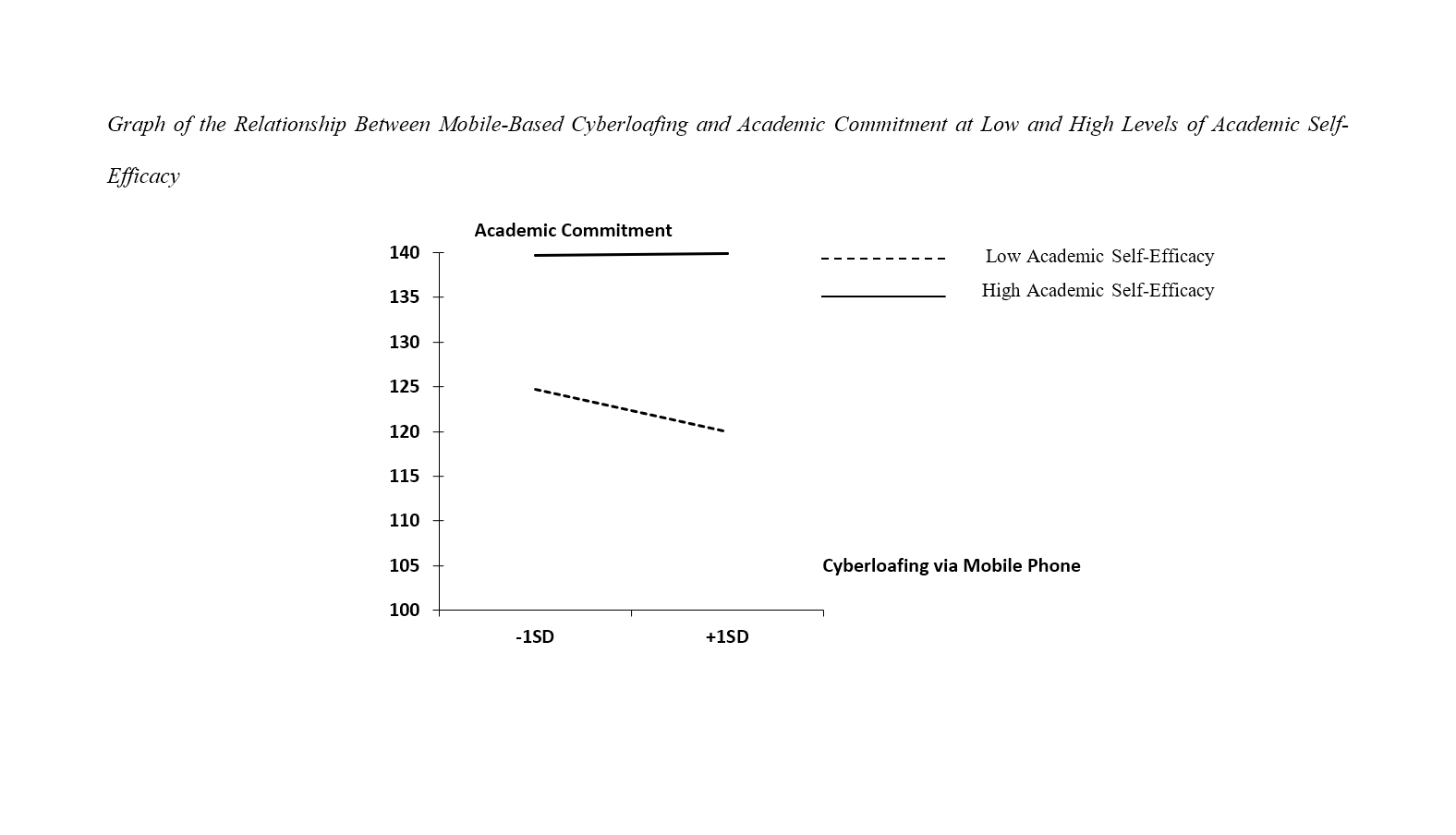
Enhancing students’ capacity and ability to make optimal use of available opportunities and resources is of critical importance. This study aimed to investigate the moderating role of academic self-efficacy in the relationship between mobile-based cyberloafing and academic commitment among lower secondary school students in the city of Babylon, Iraq. The research employed a correlational method, and the statistical population consisted of lower secondary school students in Babylon, Iraq, during spring 2024. A total of 368 students were selected through convenience sampling and responded to the Academic Commitment Questionnaire (Huynh, Vogel, & Rabi, 2015), the Mobile-Based Cyberloafing Questionnaire (Askew, 2012), and the Academic Self-Efficacy Questionnaire (McIlroy & Bunting, 2002). Data were analyzed using Pearson correlation coefficients and hierarchical regression analysis via SPSS version 26. The results indicated that mobile-based cyberloafing had a significant relationship with both academic commitment and academic self-efficacy (p < .05). Hierarchical regression analysis further revealed that academic self-efficacy served as a moderating variable in the relationship between mobile-based cyberloafing and academic commitment. Specifically, when academic self-efficacy was high, there was no significant relationship between mobile-based cyberloafing and academic commitment. Based on the findings of this study, it is essential to consider the role of academic self-efficacy in mitigating the negative effects of mobile-based cyberloafing on academic commitment, with the aim of strengthening student capabilities.
Downloads
References
Ahmad Aboud, A. (2023). The multiple relationship of bullying behaviors with academic vitality, academic self-efficacy, and academic procrastination among middle school students in Kirkuk Master's thesis in Psychology, Faculty of Educational Sciences and Psychology, Islamic Azad University, Isfahan (Khorasgan) Branch].
Ahmad Ali, M. (2024). The relationship between hyperactivity and academic self-efficacy with regard to the mediating role of academic commitment among students in Diyala Province Master's thesis in Psychology, Faculty of Educational Sciences and Psychology, Islamic Azad University, Isfahan (Khorasgan) Branch].
Aljuboori, A. F., Fashakh, A., & Bayat, O. (2020). The impacts of social media on University students in Iraq. Egyptian Informatics Journal, 21, 139-144. https://doi.org/10.1016/j.eij.2019.12.003
Askew, K. L. (2012). The relationship between cyberloafing and task performance and an examination of the theory of planned behavior as a model of cyberloafing Unpublished Doctoral Dissertation, Department of Psychology College of Arts and Sciences, University of South Florida]. https://search.proquest.com/openview/1ead49d57204ce8fc8a426bb0798bdfe/1?pq-origsite=gscholar&cbl=18750
Aziz, A., Azizah, F. N., & Rifa'i, A. (2024). The Influence of Academic Self-Efficacy, Social Support, and Supervisor Interpersonal Communication on Student Thesis Completing Motivation. Indonesian Interdisciplinary Journal of Sharia Economics (Iijse), 7(1), 929-944. https://www.e-journal.uac.ac.id/index.php/iijse/article/view/3769
Busch, P. A., & McCarthy, S. (2021). Antecedents and consequences of problematic smartphone use: A systematic literature review of an emerging research area. Computers in human Behavior, 114, 106414. https://doi.org/10.1016/j.chb.2020.106414
Chen, Y., Chen, H., Andrasik, F., & Gu, C. (2021). Perceived stress and cyberloafing among college students: The mediating roles of fatigue and negative coping styles. Sustainability, 13, 4468. https://doi.org/10.3390/su13084468
Heydari Gardagoni, G. (2022). The relationship between work anxiety and job stress with physical complaints, cyberloafing via mobile phone, and incivility, considering the moderating role of self-compassion towards oneself, colleagues, and supervisors Master's thesis in Industrial and Organizational Psychology, Faculty of Educational Sciences and Psychology, Islamic Azad University, Isfahan (Khorasgan) Branch].
Human-Vogel, S., & Rabe, P. (2015). Measuring self-differentiation and academic commitment in University students: A case study of education and engineering students. South African Journal of Psychology, 45(1), 60-70. https://doi.org/10.1177/0081246314548808
Li, L., Gao, H., & Xu, Y. (2020). The mediating and buffering effect of academic self-efficacy on the relationship between smartphone addiction and academic procrastination. Computers & Education, 159, 104001. https://doi.org/10.1016/j.compedu.2020.104001
Mahdizadeh, I., Rajai Pour, S., Hovida, R., & Salm Abadi, M. (2018). The role of academic self-efficacy and self-handicapping in academic procrastination among students. Strategies for Education in Medical Sciences, 11(3). https://www.google.com/url?sa=t&source=web&rct=j&opi=89978449&url=https://edcbmj.ir/article-1-1285-fa.html&ved=2ahUKEwiQ8qiFpZmOAxWSXvEDHYg2IfcQFnoECB0QAQ&usg=AOvVaw0bqJxa4uWTh10dO1jB8JHo
McIlroy, D., & Bunting, B. (2002). Personality, behavior, and academic achievement: Principles for educators to inculcate and students to model. Contemporary Educational Psychology, 27(2), 326-337. https://doi.org/10.1006/ceps.2001.1086
Nigussie Worku, B., & Urgessa Gita, D. (2024). Students' academic culture: the mediating role of academic commitment in the relationship between academic resilience and academic performance of university students. Cogent Education, 11(1), 1-14. https://doi.org/10.1080/2331186X.2024.2377004
Nweke, G. E., Jarrar, Y., & Horoub, I. (2024). Academic stress and cyberloafing among university students: the mediating role of fatigue and self-control. Humanities and Social Sciences Communications, 11, 419. https://doi.org/10.1057/s41599-024-02930-9
Parmaksız, İ. (2023). The effect of phubbing, a behavioral problem, on academic procrastination: The mediating and moderating role of academic self-efficacy. Psychology in the Schools, 60, 105-121. https://doi.org/10.1002/pits.22765
Peng, J. H. (2022). The impact of college students' academic self-efficacy on cyberloafing: The role of moral disengagement and individual self-control. Open Access Library Journal, 9, 1-10. https://doi.org/10.4236/oalib.1108788
Putra, P. D., Agusti, I. S., & Hastuti, P. (2022). Commitment, motivation, and involvement of students in improving academic performance. Advances in Economics, Business and Management Research, 204, 1-8. https://doi.org/10.2991/aebmr.k.220104.029
Rezaei-Gazki, P., Delavar, A., & Samavi, A. (2019). Standardization of the Persian version of the academic commitment scale. Strides in Development of Medical Education, 16(1), e90940. https://doi.org/10.5812/sdme.90940
Sadri, L., Shahriari Ahmadi, M., & Tajali, P. (2021). Examining the mediating role of social media addiction on mobile platforms in the relationship between self-concept and risky behaviors in female high school students with social anxiety. Disability Studies, 11(1), 1-8. https://www.google.com/url?sa=t&source=web&rct=j&opi=89978449&url=https://jdisabilstud.org/article-1-2203-fa.html&ved=2ahUKEwjwh8SVpZmOAxVqSvEDHfbFBLMQFnoECBkQAQ&usg=AOvVaw17drXQQr4Z4q4GdJxjMAze
Shavardi, T., Heydari, H., & Chit Saz Qomi, M. J. (2020). The impact of social media on the academic performance of female secondary school students in Tehran. Educational Technology, 14(4), 801-812. https://www.google.com/url?sa=t&source=web&rct=j&opi=89978449&url=https://sid.ir/paper/407219/fa&ved=2ahUKEwi_kLWhpZmOAxVvSfEDHRu6FIoQFnoECCQQAQ&usg=AOvVaw1wdvOsdvUJD7Wujz7cVpOZ
Simatupang, K. M., & Margaretha, M. (2023). The impact of academic stress on cyberloafing with fatigue as a mediating variable: A study of students in Bandung city-Indonesia during a pandemic. European Journal of Educational Research, 12(1), 525-535. https://doi.org/10.12973/eu-jer.12.1.525
Talan, T., & Kalinkara, Y. (2022). An investigation of the cyberloafing and nomophobia levels of university students. International Journal of Research in Education and Science (IJRES), 8(2), 430-450. https://doi.org/10.46328/ijres.2708
Xia, T., Liao, J., Deng, Y., & Li, L. (2023). Cyberbullying victimization and social anxiety: Mediating effects with moderation. Sustainability, 15, 9978. https://doi.org/10.3390/su15139978
Zhong, J., Chen, Y., Yan, J., & Luo, J. (2022). The mixed blessing of cyberloafing on innovation performance during the COVID-19 pandemic. Computers in human Behavior, 126, 106982. https://doi.org/10.1016/j.chb.2021.106982
Downloads
Additional Files
Publication Timeline
- Submitted
- Revised
- Accepted
License
Copyright (c) 2024 Safa Nsaif Jasem Almahmodi (Author); Mohsen Golparvar (Corresponding Author); Safaa Abdel Rasoul Abdel-Amir Jassim Al-Ibrahimi, Ali Mehdad (Author)

This work is licensed under a Creative Commons Attribution-NonCommercial 4.0 International License.