Monopolized Minds: The Mental Health Effects of Social Media Power Concentration on Consumers
DOI:
https://doi.org/10.61838/kman.hp.psynexus.3.21Abstract
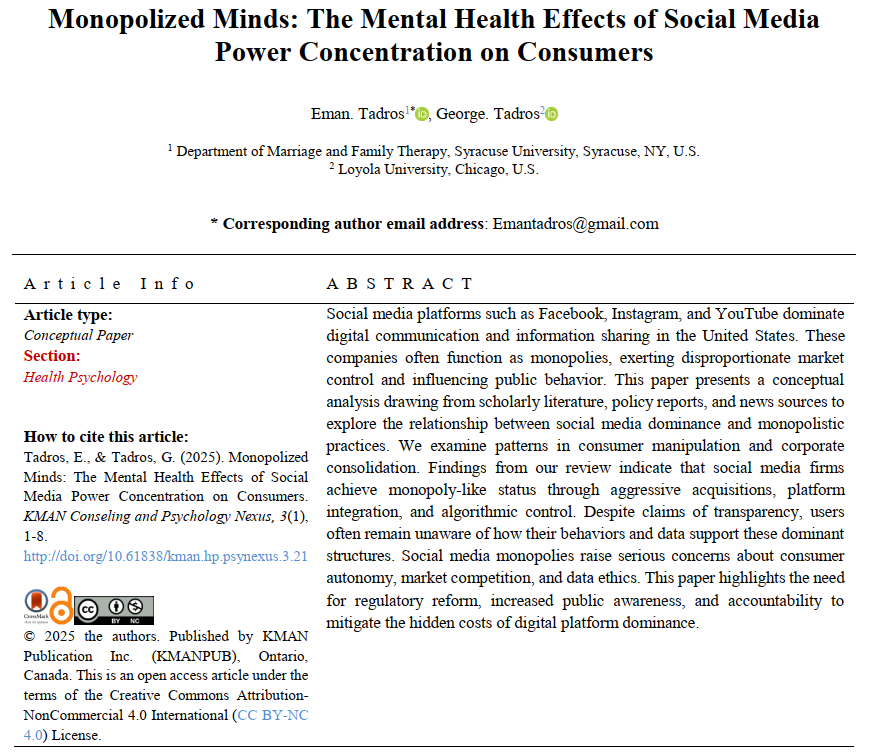
Social media platforms such as Facebook, Instagram, and YouTube dominate digital communication and information sharing in the United States. These companies often function as monopolies, exerting disproportionate market control and influencing public behavior. This paper presents a conceptual analysis drawing from scholarly literature, policy reports, and news sources to explore the relationship between social media dominance and monopolistic practices. We examine patterns in consumer manipulation and corporate consolidation. Findings from our review indicate that social media firms achieve monopoly-like status through aggressive acquisitions, platform integration, and algorithmic control. Despite claims of transparency, users often remain unaware of how their behaviors and data support these dominant structures. Social media monopolies raise serious concerns about consumer autonomy, market competition, and data ethics. This paper highlights the need for regulatory reform, increased public awareness, and accountability to mitigate the hidden costs of digital platform dominance.
Downloads
References
Ahmed, W., Bath, P. A., Sbaffi, L., & Demartini, G. (2019). Novel insights into views towards H1N1 during the 2009 Pandemic: A thematic analysis of Twitter data. Health Information & Libraries Journal, 36(1), 60-72. https://doi.org/10.1111/hir.12247
Allyn, B., Bond, S., & Lucas, R. (2020, October 20). Google abuses its monopoly power over search, Justice Department says in lawsuit. https://www.npr.org/2020/10/20/925736276/google-abuses-its-monopoly-power-over-search-justice-department-says-in-lawsuit
Birnbaum, M. L., Garrett, C., Baumel, A., Germano, N. T., Lee, C., Sosa, D., Ngo, H., Fox, K. H., Dixon, L., & Kane, J. M. (2022). Digital strategies to accelerate help-seeking in youth with psychiatric concerns in New York State. Frontiers in Psychiatry, 13. https://doi.org/10.3389/fpsyt.2022.889602
Bond, S. (2021, August 19). Federal Trade Commission refiles suit accusing Facebook of illegal monopoly. https://www.npr.org/2021/08/19/1029310979/federal-trade-commission-refiles-suit-accusing-facebook-of-illegal-monopoly
Burclaff, N. (2020, January 14). This month in business history: Standard Oil established. https://guides.loc.gov/this-month-in-business-history/january/standard-oil-established
Cohen, S. E. (2013, March 7). Sandy marked a shift for social media use in disasters. https://www.govtech.com/em/disaster/sandy-social-media-use-in-disasters.html#:~:text=Throughout%20Hurricane%20Sandy%2C%20the%20public,and%20direct%20resources%20where%20needed.
Constine, J. (2012, August 22). How big is Facebook's data? 2.5 billion pieces Of content And 500+ terabytes ingested every day. https://techcrunch.com/2012/08/22/how-big-is-facebooks-data-2-5-billion-pieces-of-content-and-500-terabytes-ingested-every-day/
Cyphers, B. (2020, March 19). Google says it doesn't 'sell' your data. Here's how the company shares, monetizes, and exploits it. https://www.eff.org/deeplinks/2020/03/google-says-it-doesnt-sell-your-data-heres-how-company-shares-monetizes-and
Day, G. (2021). Antitrust, attention, and the mental health crisis. Minnesota Law Review, 106, 1901-1957. https://doi.org/10.2139/ssrn.3816978
Farber, D. (2012, June 6). Twitter hits 400 million tweets per day, mostly mobile. https://www.cnet.com/tech/services-and-software/twitter-hits-400-million-tweets-per-day-mostly-mobile/
Federal Trade, C. (2021). Monopolization defined. https://www.ftc.gov/advice-guidance/competition-guidance/guide-antitrust-laws/single-firm-conduct/monopolization-defined
Fischer, B. M. (2021). The rise of the data-opoly: Consumer harm in the digital economy. Washington University Law Review, 99(2), 729-750. https://wustllawreview.org/2022/01/22/the-rise-of-the-data-opoly-consumer-harm-in-the-digital-economy/
Greenwood, S., Perrin, A., & Duggan, M. (2016). Social media update 2016. https://www.pewresearch.org/internet/2016/11/11/social-media-update-2016/
Karim, F., Oyewande, A. A., Abdalla, L. F., Chaudhry Ehsanullah, R., & Khan, S. (2020). Social media use and its connection to mental health: A systematic review. Cureus: Journal of Medical Science, 12(6). https://doi.org/10.7759/cureus.8627
Kayrouz, R., Dear, B. F., Karin, E., & Titov, N. (2016). Facebook as an effective recruitment strategy for mental health research of hard to reach populations. Internet Interventions, 4, 1-10. https://doi.org/10.1016/j.invent.2016.01.001
Levy, D., Chaloupka, F., Lindblom, E. N., Sweanor, D. T., O'Connor, R. J., Shang, C., & Borland, R. (2019). The US cigarette industry: An economic and marketing perspective. Tobacco Regulatory Science, 5(2), 156-168. https://doi.org/10.18001/TRS.5.2.7
Naslund, J. A., Bondre, A., Torous, J., & Aschbrenner, K. A. (2020). Social media and mental health: Benefits, risks, and opportunities for research and practice. Journal of Technology in Behavioral Science, 5, 245-257. https://doi.org/10.1007/s41347-020-00134-x
National Institute of Mental, H. (2024). Mental illness. https://www.nimh.nih.gov/health/statistics/mental-illness
Pereira, D. (2024, December 2). Facebook business model. https://businessmodelanalyst.com/facebook-business-model/
Perrin, A. (2015, October 8). Social media usage: 2005-2015. https://www.pewresearch.org/internet/2015/10/08/social-networking-usage-2005-2015/
Porter, P. G. (1969). Origins of the American Tobacco Company. Business History Review, 43(1), 59-76. https://doi.org/10.2307/3111987
Salop, S. C. (2021). Dominant digital platforms: Is antitrust up to the task? The Yale Law Journal Forum, 130. https://www.yalelawjournal.org/forum/dominant-digital-platforms
Sarcevic, A., Palen, L., White, J., Starbird, K., Bagdouri, M., & Anderson, K. (2012). Beacons of hope in decentralized coordination: Learning from on-the-ground medical twitterers during the 2010 Haiti earthquake.
Shklovski, I., Palen, L., & Sutton, J. (2008). Finding community through information and communication technology in disaster response.
Simon, T., Goldberg, A., & Adini, B. (2015). Socializing in emergencies - A review of the use of social media in emergency situations. International Journal of Information Management, 35(5), 609-619. https://doi.org/10.1016/j.ijinfomgt.2015.07.001
Smith, A., & Anderson, M. (2018, March 1). Social media use in 2018. https://www.pewresearch.org/internet/2018/03/01/social-media-use-in-2018/
Tadros, E., Morgan, A. A., & Durante, K. (2024). Criticism, compassion, and conspiracy theories: A thematic analysis of what people on Twitter are saying about COVID in correctional settings. International Journal of Offender Therapy & Comparative Criminology, 68(4), 370-388. https://doi.org/10.1177/0306624X221102847
Tadros, E., Mullin, T., & Presley, S. (2025). The #stigma of conviction: A Twitter thematic analysis. Current Psychology. https://doi.org/10.1007/s12144-025-08042-0
Teo, A. R., Liebow, S. B. L., Chan, B., Dobscha, S. T., & Graham, A. L. (2018). Reaching those at risk for psychiatric disorders and suicidal ideation: Facebook advertisements to recruit military veterans. Journal of Medical Internet Research, 5(3). https://doi.org/10.2196/10078
Ulvi, O., Karamehic-Muratovic, A., Baghbanzadeh, M., Bashir, A., Smith, J., & Haque, U. (2022). Social media use and mental health: A global analysis. Epidemiologia (Basel, Switzerland), 3(1), 11-25. https://doi.org/10.3390/epidemiologia3010002
Villanti, A. C., Johnson, A. L., Ilakkuvan, V., Jacobs, M. A., Graham, A. L., & Rath, J. M. (2017). Social media use and access to digital technology in US young adults in 2016. Journal of Medical Internet Research, 19(6), e196. https://doi.org/10.2196/jmir.7303
Walton, G. M., & Rockoff, H. (2018). Industrial expansion and concentration. Cengage Learning.
Yang, Q., Liu, J., & Rui, J. (2022). Association between social network sites use and mental illness: A meta-analysis. Cyberpsychology: Journal of Psychosocial Research on Cyberspace, 16(1). https://doi.org/10.5817/CP2022-1-1
Downloads
Additional Files
Publication Timeline
- Submitted
- Revised
- Accepted
Issue
Section
Categories
License
Copyright (c) 2025 Eman Tadros, George Tadros (Author)

This work is licensed under a Creative Commons Attribution-NonCommercial 4.0 International License.