Predicting Obsessive-Compulsive Personality Disorder Symptoms Based on Defense Mechanisms and Cognitive Distortions Mediated by Mentalization in University Students
DOI:
https://doi.org/10.61838/kman.hp.psynexus.3.20Keywords:
Obsessive-Compulsive Personality Disorder Symptoms, Defense Mechanisms, Cognitive Distortions, MentalizationAbstract
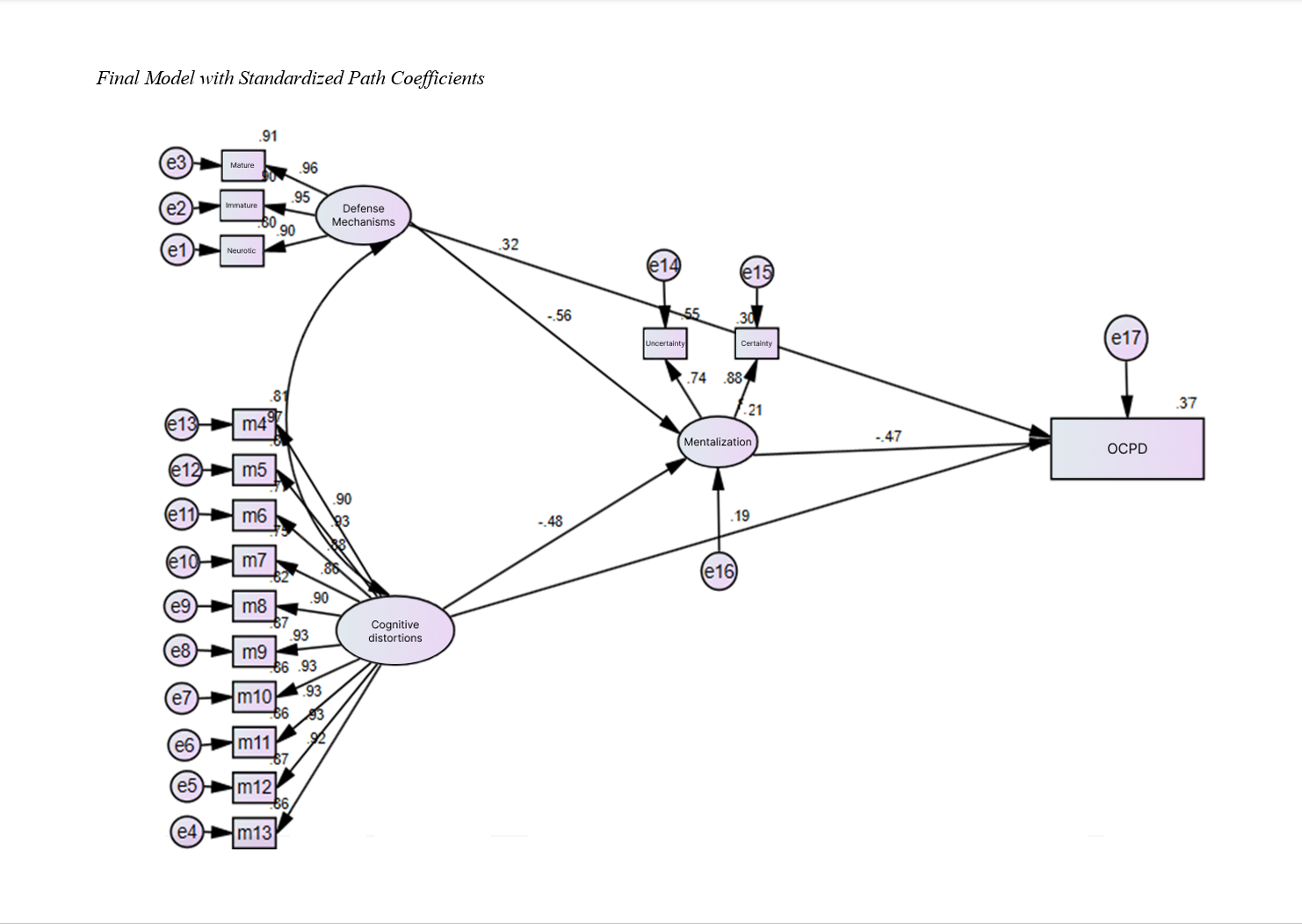
The aim of this study was to predict the symptoms of obsessive-compulsive personality disorder (OCPD) based on defense mechanisms and cognitive distortions, with the mediating role of mentalization, among students of selected universities in Isfahan Province. This research employed a descriptive-correlational design and was conducted cross-sectionally. The statistical population included all students of selected universities in Isfahan Province in the year 2024. From this population, 300 students were selected through convenience sampling. Data were collected using four instruments: the Defense Style Questionnaire (DSQ-40), Abdollahzadeh’s Cognitive Distortions Questionnaire (2009), the Mentalization Questionnaire by Fonagy (2016), and the Millon Clinical Multiaxial Inventory-III (MCMI-III). Structural equation modeling (SEM) and path analysis were used for data analysis. The results indicated that both defense mechanisms and cognitive distortions significantly predicted OCPD symptoms, both directly and indirectly through mentalization. Moreover, SEM analyses revealed that mentalization played a significant mediating role in the relationship between defense mechanisms and cognitive distortions with OCPD symptoms. These findings highlight the importance of addressing cognitive and defensive processes and considering the mediating function of mentalization in the diagnosis and treatment of obsessive-compulsive personality symptoms. This study introduces a new model to enhance the understanding of contributing factors to OCPD and emphasizes the necessity of incorporating cognitive and defensive components into therapeutic planning.
Downloads
References
Baer, L., Rauch, S. L., & Lydiard, R. B. (2023). Obsessive-compulsive disorder: Advances in the last 20 years. Springer. https://link.springer.com/rwe/10.1007/978-3-030-42825-9_23-1
Bateman, A., & Fonagy, P. (2018). Mentalization-based treatment for borderline personality disorder: A practical guide. Oxford University Press. https://pmc.ncbi.nlm.nih.gov/articles/PMC2816926/
Beck, A. T. (1976). Cognitive therapy and the emotional disorders. International Universities Press. https://psycnet.apa.org/record/1976-28303-000
Beck, A. T., & Haigh, E. A. P. (2021). Cognitive therapy for obsessive-compulsive disorder. Guilford Press. https://pmc.ncbi.nlm.nih.gov/articles/PMC11170287/
Bouchard, S., Lavoie, M. E., & Brien, M. E. (2020). Cognitive and emotional processes in obsessive-compulsive personality disorder. Journal of personality disorders, 34(3), 285-301.
Cramer, P. (2006). Protecting the self: Defense mechanisms in action. Guilford Press. https://psycnet.apa.org/record/2006-08215-000
Cramer, P. (2017). Defense mechanisms in psychology today: Further processes for adaptation. Springer Publishing Company. https://pubmed.ncbi.nlm.nih.gov/10892206/
Cramer, P. (2019). Defense mechanisms and their role in personality disorders: A comprehensive review. Journal of personality, 87(4), 394-406. https://doi.org/10.1037/per0000035
Fertuck, E. A., Jekal, A., & Smith, S. M. (2019). Mentalization and attachment in individuals with personality disorders. Personality and Mental Health, 13(2), 79-92. https://doi.org/10.1002/pmh.1375
Fonagy, P., Bateman, A., & Luyten, P. (2021). Mentalizing in the development and treatment of attachment trauma. Journal of Trauma & Dissociation, 22(4), 487-506. https://doi.org/10.1080/15299732.2021.1913484
Fonagy, P., Gergely, G., Jurist, E. L., & Target, M. (2002a). Affect regulation, mentalization, and the development of the self. Other Press. https://psycnet.apa.org/record/2002-17653-000
Fonagy, P., Gergely, G., Jurist, E. L., & Target, M. (2002b). The mentalization guidebook. Oxford University Press. https://pocketbook.de/de_de/downloadable/download/sample/sample_id/5794898/?srsltid=AfmBOop5H1ZuEtCbqzujdPdb6TiPFMjKo_iFyMXkTlhrNrOqnqUWZ9Oh
Fonagy, P., Luyten, P., & Allison, E. (2017). Mentalizing, epistemic trust and the phenomenology of psychotherapy. Psychopathology, 50(5), 271-286. https://doi.org/10.1159/000484018
Heydari Nasab, L., & Shairi, M. R. (2011). Factor structure of the Defense Styles Questionnaire (DSQ-40) in Iranian non-clinical samples. Quarterly Journal of Modern Psychological Research, 6(21), 77-97. https://psychologyj.tabrizu.ac.ir/article_4170_685.html
Kotov, R., Ruggero, C. J., & Mullen, J. (2020). Personality and psychopathology: Personality disorders and their role in mental health. Cambridge University Press.
Luyten, P., Campbell, C., & Fonagy, P. (2020). The role of mentalization in obsessive-compulsive personality disorder. Journal of personality disorders, 34(6), 759-776. https://doi.org/10.1521/pedi_2020_34_9
Sperry, L. (2022). Psychodynamic psychotherapy: A clinical manual. Routledge. https://www.amazon.de/-/en/Psychodynamic-Psychotherapy-Clinical-Deborah-Cabaniss/dp/1119141982
Topalalioğlu, S. (2025). Role of Interpersonal Sensitivity and Cognitive Distortions in the Development of Psychopathologies. Psikiyatride Güncel Yaklaşımlar, 17(2), 261-271. https://doi.org/10.18863/pgy.1484640
Wells, A., & Matthews, G. (2017). Cognitive models of anxiety and depression: A review. Journal of Clinical Psychology, 73(1), 3-12. https://doi.org/10.1002/jclp.22326
Downloads
Additional Files
Publication Timeline
- Submitted
- Revised
- Accepted
License
Copyright (c) 2025 Seyed Hamid Atashpour (Corresponding Author); Ehsan Ghazavi, Seyed Salar Atashpour (Author)

This work is licensed under a Creative Commons Attribution-NonCommercial 4.0 International License.