Exploring the Implementation of Effective Virtual Counseling: A Systematic Review
DOI:
https://doi.org/10.61838/kman.ooc.psynexus.3.12Keywords:
Virtual counseling, counselor training, privacy and confidentiality, client resistance, documentary method, PRISMAAbstract
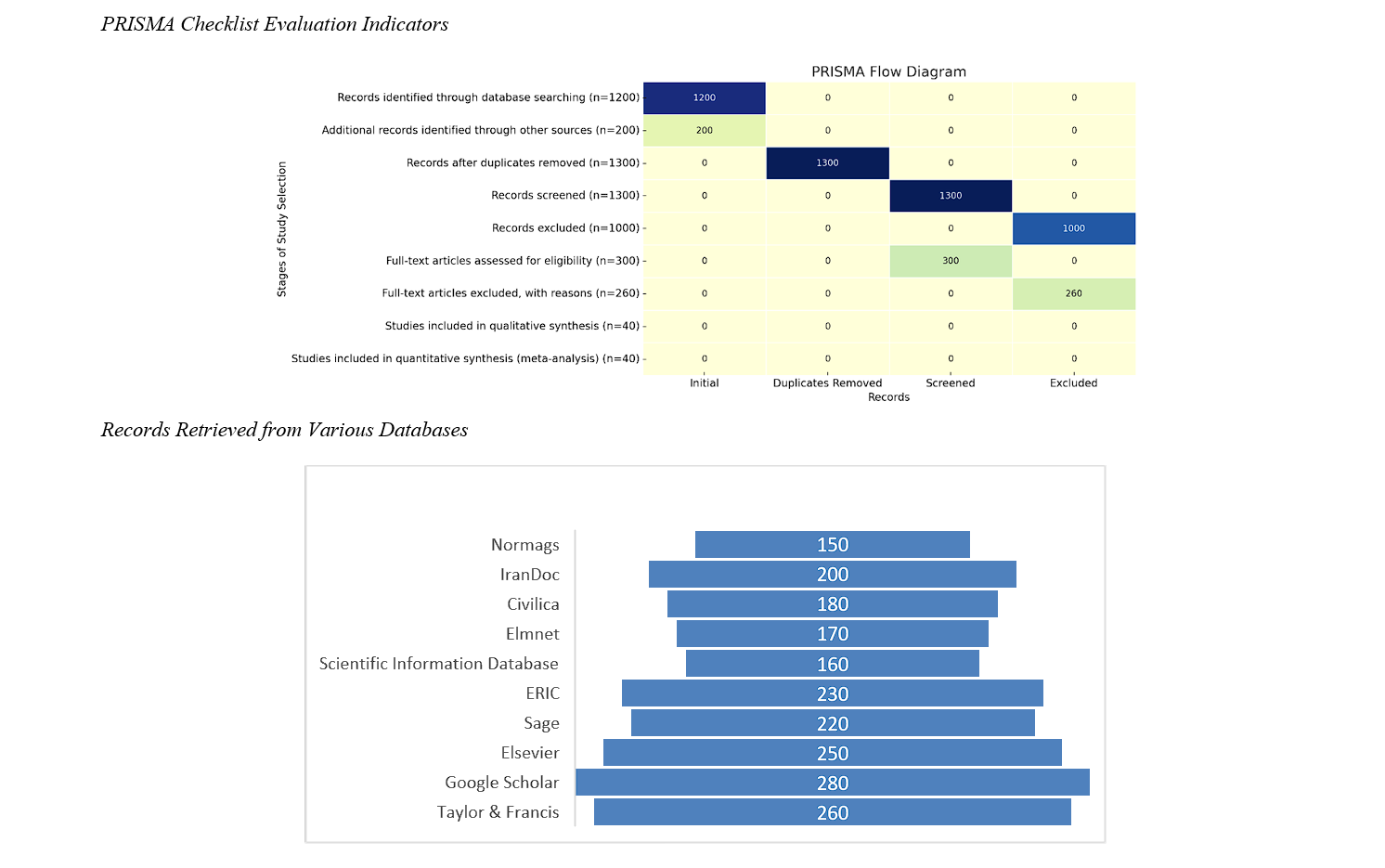
Virtual counseling, as a new approach in the field of counseling services, is gradually replacing face-to-face counseling due to its accessibility and the possibility of communication at any time. However, the client experience in this modality may differ from that of traditional in-person counseling. In this documentary study using a systematic review, key facilitators and barriers influencing the implementation of virtual counseling processes were examined. A total of 860 documents were retrieved from domestic databases such as Noormags, IranDoc, Civilica, ElmNet, and Human Sciences Portal within the time span of 2019 to 2023. Based on the PRISMA (Preferred Reporting Items for Systematic Reviews and Meta-Analyses) checklist indicators, 12 documents were selected for review. Additionally, 540 documents were retrieved from international databases including ERIC, Sage, Elsevier, Scopus, and Taylor & Francis from 2000 to 2024, from which 28 documents were selected for analysis using the PRISMA checklist. Data analysis was conducted using the Altheide method. The findings revealed four facilitating factors, including technological infrastructure, counselor training and competence, client engagement strategies, and organizational support, as well as four inhibiting factors, namely technological barriers, concerns about privacy and confidentiality, client resistance, and lack of standardization.
Downloads
References
Agoncillo, A. P. B. (2023). Embracing virtual support: a phenomenological study on the lived experiences of Filipino guidance counselees during the COVID-19 pandemic. Indones J Soc Sci. https://doi.org/10.20473/ijss.v15i2.44990
Chen, S., Coker, K., Wathen, C. C., & Sheperis, D. S. (2021). Effects of clinical skills training: technology and pedagogy for the quality virtual classroom. J Technol Couns Educ Superv. https://doi.org/10.22371/tces/0009
Chiu, P. L. (2022). Support and companionship in virtual communities: establishing a COVID-19 counseling network for Taiwanese soldiers and the collective healing phenomenon. Int J Ment Health Promot. https://doi.org/10.32604/ijmhp.2022.019167
Cohen, K. A., Graham, A. K., & Lattie, E. (2020). Aligning students and counseling centers on student mental health needs and treatment resources. J Am Coll Health, 70, 724-732. https://doi.org/10.1080/07448481.2020.1762611
Hanley, T., Sefi, A., Grauberg, J., Prescott, J., & Etchebarne, A. (2021). A theory of change for web-based therapy and support services for children and young people: collaborative qualitative exploration. JMIR Pediatr Parent, 4. https://doi.org/10.2196/23193
Hara, K. M., Westra, H., Coyne, A., Di Bartolomeo, A. A., Constantino, M. J., & Antony, M. M. (2021). Therapist affiliation and hostility in cognitive-behavioral therapy with and without motivational interviewing for severe generalized anxiety disorder. Psychotherapy Res, 32(5), 598-610. https://doi.org/10.1080/10503307.2021.2001069
Heydari Nia, M. (2023). Ethical and legal implications of using technology in online counseling. International Conference on Psychology, Social Sciences, Educational Sciences, and Philosophy,
Hidjayanti, D. (2023). Keterbukaan Diri Melalui Cyber Counseling (Studi Kasus Layanan Konseling Individual Pada Siswa MTS Zia Salsabila)JO - Student Scientific Creativity Journal. 1(3). https://doi.org/10.55606/sscj-amik.v1i3.1359
Jaber, F., & Al-Hroub, A. (2023). School counselors' perceptions of virtual counseling in Lebanon: a qualitative study. Front Psychol, 13, 1083644. https://doi.org/10.3389/fpsyg.2022.1083644
Javadi Azad, Z. (2023). The importance of implementing online counseling in schools to address educational challenges. 6th National Conference on Modern Technologies in Education, Psychology, and Counseling in Iran,
Johnson, M., & Lee, R. (2023). Enhancing counseling experience with advanced technologies. Virtual Ther Innov, 10(2), 123-135.
Kargari, L. (2020). Virtual counseling and its advantages and disadvantages. Growth Sch Couns Educ J(56), 25-27. https://www.noormags.ir/view/fa/articlepage/1701753
Kawakita, T., Sasaki, T., & Ishihara, S. (2021). Remote virtual counseling and effects of embodied cues: toward casual online counseling under COVID-19 situation. Springer Nature Switzerland AG,
Liu, L., Chui, W. H., Deng, Y., & Li, H. (2020). Dealing with resistance: Working with involuntary clients in community-based drug treatment programs in China. Aust Soc Work, 73(3), 309-320. https://doi.org/10.1080/0312407X.2019.1688367
Olafsson, S., Pedrelli, P., Wallace, B. C., & Bickmore, T. (2023). Accommodating user expressivity while maintaining safety for a virtual alcohol misuse counselor. Proc 23rd ACM Int Conf Intell Virtual Agents,
Reger, G. M., Norr, A. M., Gramlich, M. A., & Buchman, J. M. (2021). Virtual standardized patients for mental health education. Curr Psychiatry Rep, 23(8), 51. https://doi.org/10.1007/s11920-021-01273-5
Sajn, T. M., Andresen, P. A., & Mitchell, J. W. (2020). 5-4-3-2-1 Go! Standardizing nutrition and physical activity-related counseling. J Nurse Pract, 16(10), 754-758. https://doi.org/10.1016/J.NURPRA.2020.06.026
Schwartz, R. A., Chambless, D., Milrod, B., & Barber, J. (2021). Patient, therapist, and relational antecedents of hostile resistance in cognitive-behavioral therapy for panic disorder: A qualitative investigation. Psychotherapy, 58(1), 123-130. https://doi.org/10.1080/10503307.2021.1953819
Shorey, S., Ang, E., Ng, E. D., Yap, J., Lau, L. S. T., & Chui, C. (2023). Evaluation of a theory-based virtual counseling application in nursing education. Comput Inform Nurs, 41(8), 385-393. https://doi.org/10.1186/s12912-024-01819-x
Shorey, S., Ang, E., Yap, J., Ng, E. D., Lau, S. T., & Chui, C. K. (2023). A virtual counseling application using artificial intelligence for communication skills training in nursing education: Development study. J Med Internet Res, 21(10), e14658. https://doi.org/10.2196/14658
Tian, W., Lu, Y., Yu, J., Fan, J., Tang, P., & Zhang, L. (2022). A privacy-preserving framework for mental health chatbots based on confidential computing. 2022 IEEE SmartWorld, Ubiquitous Intelligence & Computing, Scalable Computing & Communications, Digital Twin, Privacy Computing, Metaverse, Autonomous & Trusted Vehicles (SmartWorld/UIC/ScalCom/DigitalTwin/PriComp/Meta),
Yu, D., & Ji, Q. (2022). Application of psychological counseling system based on virtual reality technology in college students' psychological counseling. 10th Int Conf Orange Technol (ICOT),
Downloads
Additional Files
Publication Timeline
- Submitted
- Revised
- Accepted