Iranian EFL Teachers’ Perceptions of a Digital Literacy-Based Teacher Education
DOI:
https://doi.org/10.61838/kman.rc.psynexus.3.9Keywords:
digitalization, digital, competence, digital literacy, teacher perceptionsAbstract
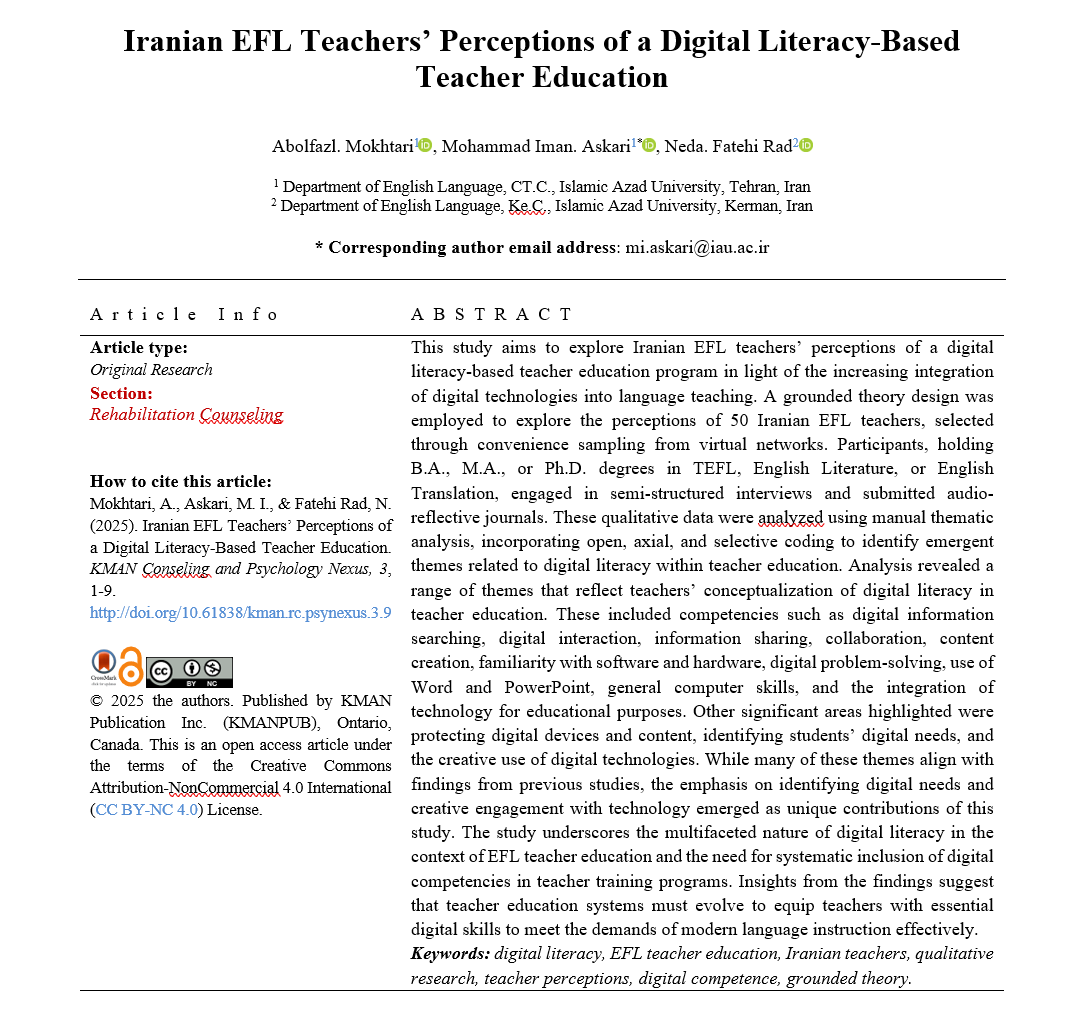
Digital literacy has become increasingly important in today's world due to the widespread use of technology and the internet in various aspects of life. Digital literacy enables teachers to access, evaluate, and use information effectively from various online sources. The mission of the present study was exploring how Iranian EFL teachers perceive a digital literacy-based teacher education. To this end, a grounded theory design was used. The participants taking part in this research included 50 males and females Iranian EFL teachers, holding B.A., M.A. and Ph.D. in TEFL, English Language and Literature, and English Translation fields, with varying years of teaching experience in schools and institutes of Iran. They were picked up through available sampling from virtual groups in social networks. To collect the data, semi-structured interview and audio-reflective journal were used. Data analysis was conducted through the qualitative manual thematic analysis. The following themes were outcomes of data analysis: Digital Information Searching, Digital Interaction, Digital Information Sharing, Digital Collaboration, Digital Content Creation, Familiarity with Soft Wares and Hard Wares, Digital Problem-Solving, Using Word and PowerPoint Skills, General Computer Skills, Using Technology for Educational Purposes, Protecting Digital Devices, Protecting Digital Content, Identifying Digital Needs, and Creative Use of Digital Technologies. EFL teacher educators, administers, authorities and teachers can take useful insights from the results.
Downloads
References
Abedi, Z. A. U. T.-Y. M. (2023). Does digital literacy provide evidence for Iranian EFL learners' cooperative learning in online classrooms? Journal of Contemporary Language Research, 2(3), 158-166. https://doi.org/10.58803/jclr.v2i3.74
Abella, J. L., & Rosa, E. D. (2023). Digital literacy and digital competence of selected Filipino teachers: Basis for a post-pandemic pedagogy. International Journal of Recent Educational Research, 4(5), 548-569. https://doi.org/10.46245/ijorer.v4i5.378
Al-shaboul, I. A., Kalsoom, T., Alshraah, S. M., & Khasawneh, M. A. S. (2023). Students' perceptions on the effects of blogging sites in enhancing their motivation for foreign languages writing and reading proficiency. Migration Letters, 20(S12), 157-168. https://doi.org/10.59670/ml.v20is12.5869
Ary, D., Jacobs, L. C., & Sorensen, C. (2010). Introduction to research in Education (Vol. 8). Wadsworth Group. https://ebookppsunp.files.wordpress.com/2016/06/donald_ary_lucy_cheser_jacobs_asghar_razavieh_bookfi-org.pdf
Bodaghi, Z., & Ghapanchi, Z. (2023). On the relationship between Iranian intermediate EFL learners' digital literacy and their self-directed learning process. Journal of Research in Techno-based Language Education, 3(3), 20-34. https://doi.org/10.22034/JRTLE.2023.403645.1046
Chew, S. Y., & Ng, L. L. (2021). Interpersonal interactions and language learning: Face-to-face vs. computer-mediated communication. Springer. https://doi.org/10.1007/978-3-030-67425-0
Dashtestani, R., & Hojatpanah, S. (2020). Digital literacy of EFL students in a junior high school in Iran: voices of teachers, students and ministry directors. Computer Assisted Language Learning, 35(4), 635-665. https://doi.org/10.1080/09588221.2020.1744664
Fishman, B., Dede, C., & Means, B. (2016). Teaching and technology: New tools for new times. In D. Gitomer & C. Bell (Eds.), (pp. 1269-1334). American Educational Research Association. https://doi.org/10.3102/978-0-935302-48-6_21
Gilakjani, A. P. (2017). A review of the literature on the integration of technology into the learning and teaching of English language skills. International Journal of English Linguistics, 7(5), 95-106. https://doi.org/10.5539/ijel.v7n5p95
Godwin-Jones, R. (2021). Emerging technologies for language learning. In C. A. Chapelle (Ed.), (pp. 120-145). https://doi.org/10.1002/9781405198431.wbeal0365
Heidari, N., & Tabatabaee-Yazdi, M. (2021). Digital literacy skills among Iranian EFL teachers and students. Journal of Research in Techno-based Language Education, 1(1), 22-34. https://doi.org/10.22034/JRTLE.2021.133013
Herrera-Pavo, M. Á. (2021). Collaborative learning for virtual higher education. Learning, Culture and Social Interaction, 28, Article 100437. https://doi.org/10.1016/j.lcsi.2020.100437
Karale, A. (2021). The challenges of IoT addressing security, ethics, privacy, and laws. Internet of Things, 15, Article 100420. https://doi.org/10.1016/j.iot.2021.100420
Kumar, A., Krishnamurthi, R., Bhatia, S., Kaushik, K., Ahuja, N. J., Nayyar, A., & Masud, M. (2021). Blended learning tools and practices: A comprehensive analysis. IEEE Access, 9, 85151-85197. https://doi.org/10.1109/access.2021.3085844
Martin, A., & Madigan, D. (2006). Digital literacies for learning. Facet Publishing. https://www.facetpublishing.co.uk/page/detail/digital-literacies-for-learning/?k=9781856045636
Mehran, P., Alizadeh, M. A. U. K. I., & Takemura, H. (2017). Are Japanese digital natives ready for learning English online? A preliminary case study at Osaka University. International Journal of Educational Technology in Higher Education, 14, Article 8. https://doi.org/10.1186/s41239-017-0047-0
Mokhtari, F. (2023). Fostering digital literacy in higher education: Benefits, challenges and implications. International Journal of Linguistics, Literature and Translation, 6(10), 160-167. https://doi.org/10.32996/ijllt
Mudra, H. (2020). Digital literacy among young learners: How do EFL teachers and learners view its benefits and barriers? Teaching English with Technology, 20(3), 3-24. https://eric.ed.gov/?id=EJ1264169
Namdari, E., & Sahragard, R. (2021). Professional development needs of Iranian EFL teachers ProQuest Dissertations and Theses Global]. Shiraz University. https://elmnet.ir/vslgg?id=11706712-12775
Nguyen, L. A. T., & Habók, A. (2021). Digital literacy of EFL students: An empirical study in Vietnamese universities. Libri, 72(1), 53-66. https://doi.org/10.1515/libri-2020-0165
Nurhidayat, E., Mujiyanto, J., Yuliasri, I., & Hartono, R. (2023). Technology integration and teachers' competency in the development of 21st-century learning in EFL classroom. Journal of Namibian Studies, 18(2), 342-349. https://doi.org/10.11591/edulearn.v18i2.21069
Panagiotidis, P. (2021). Virtual reality applications and language learning. International Journal for Cross-Disciplinary Subjects in Education, 12(1), 4447-4454. https://doi.org/10.20533/ijcdse.2042.6364.2021.0543
Pehlevan, İ., & Ünal, B. (2024). Investigating the relationship between digital literacy and TPACK levels of pre-service English teachers. Journal of Language Education and Research, 10(1), 87-111. https://doi.org/10.31464/jlere.1432879
Rahmah, A. L. D., Eryansyah, E., & Silvhiany, S. (2021). EFL students' digital literacy: Barriers to development and effective web application programs. Edukasi: Jurnal Pendidikan dan Pengajaran, 8(2), 106-120. https://doi.org/10.19109/ejpp.v8i2.9733
Reinders, H., & White, C. (2016). 20 Years of autonomy and technology: How far have we come and where to next? Language Learning & Technology, 20(2), 143-154. http://hdl.handle.net/10652/3552
Santos, A. I., & Serpa, S. (2020). Flipped classroom for an active learning. Journal of Education and E-Learning Research, 7(2), 167-173. https://doi.org/10.20448/journal.509.2020.72.167.173
Selfa-Sastre, M., Pifarre, M., Cujba, A., Cutillas, L., & Falguera, E. (2022). The role of digital technologies to promote collaborative creativity in language education. Frontiers in psychology, 13, Article 828981DO - 828910.823389/fpsyg.822022.828981. https://www.frontiersin.org/journals/psychology/articles/10.3389/fpsyg.2022.828981/full
Stockwell, G. (2013). Technology and motivation in English-language teaching and learning. In E. Ushioda (Ed.). Springer. https://doi.org/10.1057/9781137000873_9
Tewathia, N., Kamath, A., & Ilavarasan, P. V. (2020). Social inequalities, fundamental inequities, and recurring of the digital divide: Insights from India. Technology in Society, 61, Article 101251. https://doi.org/10.1016/j.techsoc.2020.101251
Wheeler, S. (2015). Learning with e's: Educational theory and practice in the digital age. Crown House Publishing. https://www.abebooks.co.uk/9781845909390/Learning-educational-theory-practice-digital-1845909399/plp
Wulantari, N. P., Rachman, A., Sari, M. N., Uktolseja, L. J., & Rofi'i, A. (2023). The role of gamification in English language teaching: A literature review. Journal on Education, 6(1), 2847-2856. https://doi.org/10.31004/joe.v6i1.3328
Downloads
Additional Files
Publication Timeline
- Submitted
- Revised
- Accepted
Issue
Section
Categories
License
Copyright (c) 2025 Abolfazl Mokhtari (Author); Mohammad Iman Askari (Corresponding Author); Neda Fatehi Rad (Author)

This work is licensed under a Creative Commons Attribution-NonCommercial 4.0 International License.