Modeling the Relationship Between Controlling Behavior and Differentiation With Spousal Violence Through the Mediation of Spiritual Well-being in Couples
DOI:
https://doi.org/10.61838/kman.rc.psynexus.3.7Keywords:
Controlling behavior, differentiation, spousal violence, spiritual well-beingAbstract
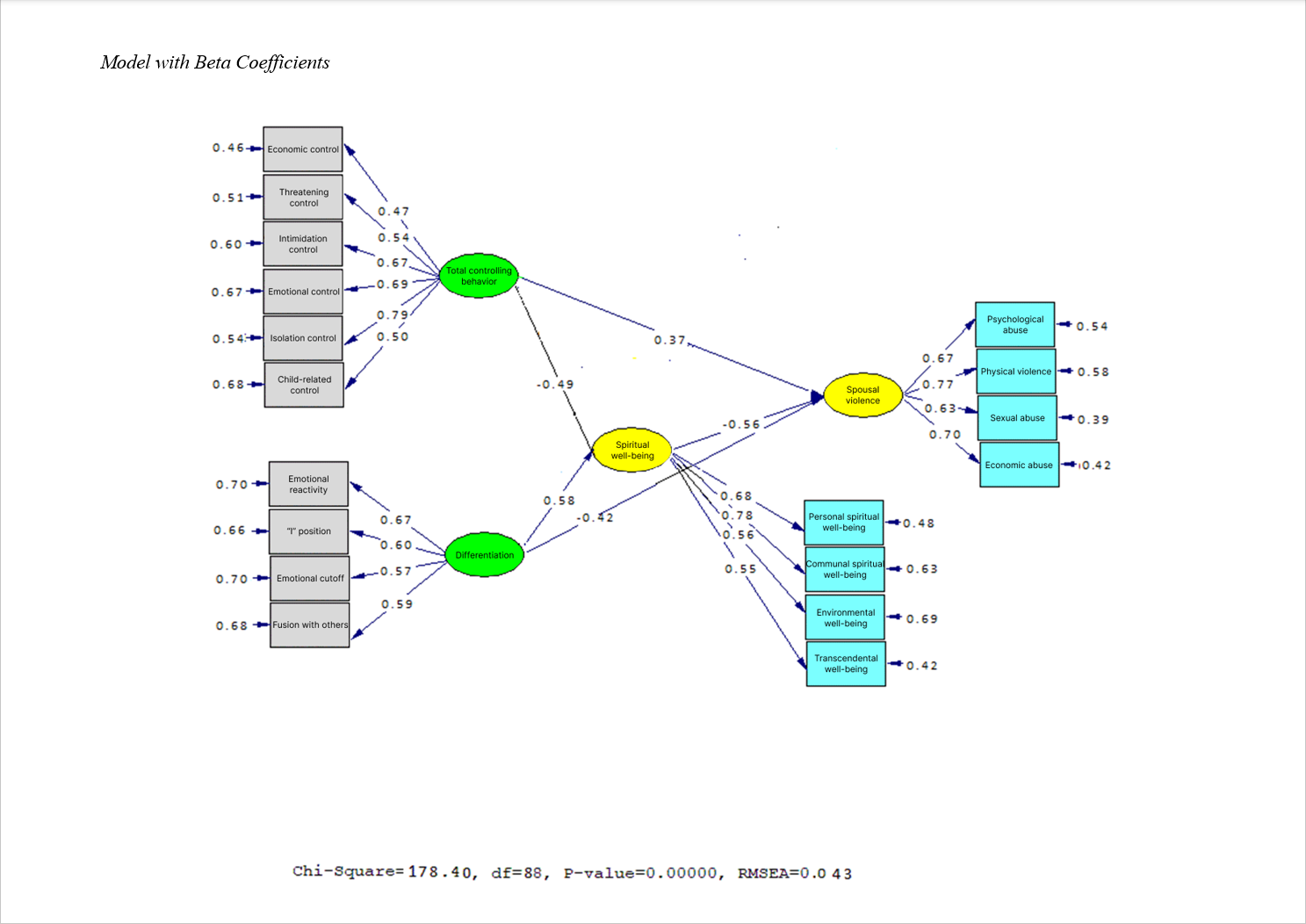
The present study aimed to determine the goodness-of-fit of a model assessing the relationship between controlling behavior and differentiation with spousal violence, mediated by spiritual well-being in couples seeking counseling in Tabriz. The research method was descriptive-correlational in nature. The statistical population consisted of all spouses who referred to the social emergency centers of Tabriz during the first half of 2023, totaling 305 individuals. Using simple random and purposive sampling based on inclusion and exclusion criteria, 240 participants were selected (n = 240). Data collection tools included the Haj-Yahya Violence Against Women Questionnaire (1999), the Revised Controlling Behaviors Scale by Graham-Kevan and Archer (2005), the Differentiation of Self Inventory by Skowron and Friedlander (1998), and the Spiritual Well-Being Questionnaire by Gomez and Fisher (2003). Data analysis was conducted using SPSS and LISREL software. Pearson correlation analysis indicated that controlling behavior has a direct and statistically significant positive effect on spousal violence (p < .05, β = .374); differentiation has a direct and statistically significant negative effect on spousal violence (p < .05, β = –.421). Findings from structural equation modeling revealed that controlling behavior indirectly and negatively influences spousal violence through the mediation of spiritual well-being (p < .05, β = –.508); similarly, differentiation indirectly and negatively influences spousal violence via spiritual well-being (p < .05, β = –.578). Therefore, the model of the relationship between controlling behavior and differentiation with spousal violence, mediated by spiritual well-being, fits well with the empirical data collected from couples seeking counseling services in Tabriz. These results may assist clinical professionals in promoting compassion and empathetic understanding while reducing spousal violence, enabling them to develop effective treatment plans by considering predictive factors in this population.
Keywords: Controlling behavior, differentiation, spousal violence, spiritual well-being.
Downloads
References
Abedi, G., Ataeifar, R., & Ghamari, M. (2024). The Effectiveness of Group Marital Conflict Resolution Training Based on Choice Theory on Emotional Divorce and Hope for Life in Married Women. International Journal of Education and Cognitive Sciences, 5(3), 136-146. https://doi.org/10.61838/kman.ijecs.5.3.10
Amiri Shamili, M. (2014). Examining the Relationship Between Emotional Intelligence of Female Teachers and Violence Against Them in Bandar Abbas. https://civilica.com/doc/518676/
Baucom, D. H., Fischer, M. S., Corrie, S., Worrell, M., & Boeding, S. E. (2019). Treating relationship distress and psychopathology in couples: A cognitive-behavioural approach. Routledge. https://doi.org/10.4324/9781315626413
Bedir Akpınarlı, B., & Eryücel, S. (2024). Marital Adjustment, Spiritual Well-Being, and Locus of Control in Married Couples. Religions, 15(11), 1376. https://doi.org/10.3390/rel15111376
Buser, T. J., Pertuit, T. L., & Muller, D. L. (2019). Nonsuicidal self‐injury, stress, and self‐differentiation. Adultspan Journal, 18(1), 4-16. https://doi.org/10.1002/adsp.12065
Chapman, B. P., & Goldberg, L. R. (2011). Replicability and 40-year predictive power of childhood ARC types. Journal of personality and social psychology, 101(3), 593. https://doi.org/10.1037/a0024289
Dastyar, N., Rafati, F., & Mehralizadeh, A. (2022). Examining Spiritual Health in Pregnant Women Under Domestic Violence. Hayat, 28(2), 161-172. https://hayat.tums.ac.ir/article-1-4516-fa.pdf
Davoodifar, F., & Esmaeilian, Z. (2024). The Effectiveness of Positive Psychotherapy on Marital Conflicts and Spiritual Wellbeing of Women With Marital Conflicts. PWJ, 5(2), 51-58. https://doi.org/10.61838/kman.pwj.5.2.8
Deheshiri, G., Najafi, M., Sohrabi, F., & Tarakijah, S. (2013). Construction and Validation of a Spiritual Well-Being Questionnaire Among Students. Psychological studies, 9(4), 73-98. https://psychstudies.alzahra.ac.ir/article_1759.html?lang=en
Derakhshan Pour, F., Mahboubi, H., & Keshavarzi, S. (2014). The Prevalence of Domestic Violence Against Women in Bandar Abbas. Journal of Golestan University of Medical Sciences, 16(49), 126-131. https://www.sid.ir/paper/79129/fa
Golparvar, M. (2018). An Analysis of the Role of Proactive Personality in the Relationship Between Spiritual Capital and Spiritual Well-Being. Positive Psychology Research Journal, 4(1), 19-34. https://ppls.ui.ac.ir/article_22871.html
Gomez, R., & Fisher, J. W. (2003). Domains of spiritual well-being and development and validation of the Spiritual Well-Being Questionnaire. Personality and individual differences, 35(8), 1975-1991. https://doi.org/10.1016/S0191-8869(03)00045-X
Gou, L. H., Duerksen, K. N., & Woodin, E. M. (2019). Coercive control during the transition to parenthood: An overlooked factor in intimate partner violence and family wellbeing? Aggressive Behavior, 45(2), 139-150. https://doi.org/10.1002/ab.21803
Graham-Kevan, N., & Archer, J. (2005). Investigating three explanations of women's relationship aggression. Psychology of Women Quarterly, 29, 270-277. https://doi.org/10.1111/j.1471-6402.2005.00221.x
Haj-Yahia, M. M. (1999). Wife abuse and its psychological consequences as revealed by the first Palestinian National Survey on Violence Against Women. Journal of Family Psychology, 13(4), 642. https://doi.org/10.1037/0893-3200.13.4.642
Haji, B., Rahimzadeh, S., Mohammadi, M., & Haji, M. (2018). Examining the Effect of Differentiation and Attachment Styles on Violence Against Women. First National Conference on Sustainable Development in Educational Sciences and Psychology,
Hakimi Dezfouli, Z. S., & Ebrahimpour, G. (2024). The role of psychological flexibility, emotional empathy and spiritual experiences in predicting marital satisfaction of married women. Studies in Islam and Psychology. https://islamicpsy.rihu.ac.ir/article_2162.html?lang=en
Hamberger, L. K., Larsen, S. E., & Lehrner, A. (2017). Coercive control in intimate partner violence. Aggression and Violent Behavior, 37, 1-11. https://doi.org/10.1016/j.avb.2017.08.003
Hammett, J. F., Lavner, J. A., Karney, B. R., & Bradbury, T. N. (2021). Intimate partner aggression and marital satisfaction: a cross-lagged panel analysis. Journal of interpersonal violence, 36(3-4), NP1463-NP1481. https://doi.org/10.1177/0886260517747607
Haryanto, S., & Muslih, M. (2025). The Contribution of Transpersonal Psychology to the Emotional, Mental, and Spiritual Well-Being of Individuals. Islamic Guidance and Counseling Journal, 8(1). https://doi.org/10.25217/0020258549000
Hossain, M., Cariola, L. A., & Gillanders, D. (2025). Exploring the Role of Psychological Flexibility in Relationship Functioning Among Couples Coping With Prostate Cancer: A Cross-Sectional Study. Supportive Care in Cancer, 33(3). https://doi.org/10.1007/s00520-025-09229-8
Jafarzadeh, T., Soleimanian, A., & Mohammadi Pour, M. (2020). Predicting Domestic Violence Based on Family Functioning and Levels of Self-Differentiation. Educational Research Journal, 16(65), 167-186. https://journals.iau.ir/article_678719.html
Jankowski, P. J., & Vaughn, M. (2009). Differentiation of self and spirituality: Empirical explorations. Counseling and Values, 53(2), 82-96. https://doi.org/10.1002/j.2161-007X.2009.tb00116.x
Kia Darband Sari, Z., Mirza Hosseini, H., & Zargam Hajabi, M. (2022). The Effectiveness of Training Couples' Relationship Enrichment with an Emotion-Focused Approach on Controlling Behaviors. Applied Family Therapy, 3(2), 230-245. https://doi.org/10.61838/kman.aftj.3.2.11
Koçyiğit, M., & Uzun, M. (2025). Emotion Regulation and Couple Burnout in Marriage: A Moderated Moderation Model of Authenticity, Sex of Parents and Having Children. Current Psychology. https://doi.org/10.1007/s12144-024-07253-1
Lynch, T. R. (2018). Radically open dialectical behavior therapy: Theory and practice for treating disorders of overcontrol. New Harbinger Publications. https://psycnet.apa.org/record/2018-11651-000
Lynch, T. R., Hempel, R. J., & Clark, L. A. (2015). Flexibility and radical openness: Facilitating self-inquiry in overcontrolled personality disorders. Integrated Treatment of Personality Disorder, 1-13. https://ouci.dntb.gov.ua/en/works/4bkk3m1l/
Meteyard, J. D., Andersen, K. L., & Marx, E. (2012). Exploring the relationship between differentiation of self and religious questing in students from two faith-based colleges. Pastoral Psychology, 61, 333-342. https://doi.org/10.1007/s11089-011-0401-4
Moblian, A., Diyarian, M., & Vosefi, Z. (2022). Predicting Marital Relationship Quality Based on Personality Traits, Glasser Needs, and Self-Acceptance. Journal of Applied Psychology, 15(4), 207-232. https://doi.org/10.52547/apsy.2021.216020.0
Moslehi, J., & Ahmadi, M. (2013). The Role of Religious Life in Marital Satisfaction Among Couples. Psychology and Religion, 6(22), 75-90. https://ensani.ir/fa/article/322749s
Peleg, O., Halaby, E., & Whaby, E. N. (2006). The relationship of maternal separation anxiety and differentiation of self to children's separation anxiety and adjustment to kindergarten: A study in Druze families. Journal of anxiety disorders, 20(8), 973-995. https://doi.org/10.1016/j.janxdis.2006.01.008
Rafezi, Z., & Sabouri, R. (2022). The Role of Self-Differentiation Components in Predicting Marital Intimacy in Couples. Culture of Counseling and Psychotherapy, 13(51), 182-206. https://qccpc.atu.ac.ir/article_14237.html
Rahmani, M. (2018). The Role of the Quality of Verbal and Non-Verbal Relationships in Predicting Marital Frustration Master's Thesis, Ferdowsi University of Mashhad]. https://profdoc.um.ac.ir/paper-abstract-1072960.html
Rodríguez-González, M., Lampis, J., Murdock, N. L., Schweer-Collins, M. L., & Lyons, E. R. (2020). Couple adjustment and differentiation of self in the United States, Italy, and Spain: A cross-cultural study. Family Process, 59(4), 1552-1568. https://doi.org/10.1111/famp.12522
Sandage, S. J., & Jankowski, P. J. (2010). Forgiveness, spiritual instability, mental health symptoms, and well-being: Mediator effects of differentiation of self. Psychology of Religion and Spirituality, 2(3), 168. https://doi.org/10.1037/a0019124
Seifi, Y., & Taghavi, M. (2019). The Relationship Between Spiritual Well-Being and Marital Satisfaction: The Mediating Role of Psychological Resilience. Contemporary psychology, 14(1), 31-41. https://doi.org/10.29252/bjcp.14.1.31
Shari'at, E., Ghodnfari, A., Yarmohammadian, A., Solati, K., & Charami, M. (2021). Comparing the Effectiveness of Meaning Therapy and Positive Psychotherapy on Differentiation. Journal of Health and Aging, 6(1), 74-86. https://cjhaa.mubabol.ac.ir/browse.php?a_id=154&sid=1&slc_lang=fa&ftxt=0
Skowron, E. A., & Friedlander, M. L. (1998). The Differentiation of Self Inventory: Development and initial validation. Journal of counseling psychology, 45(3), 235. https://doi.org/10.1037/0022-0167.45.3.235
Sleath, E., Walker, K., & Tramontano, C. (2018). Factor structure and validation of the controlling behaviors scale-revised and revised conflict tactics scale. Journal of Family Issues, 39(7), 1880-1903. https://doi.org/10.1177/0192513X17729721
Taghipour, Z., & Panah Ali, A. (2023). The effectiveness of spiritual therapy based on conscientiousness on increasing marital satisfaction and intimacy of couples in Tabriz city. Spiritual research in health sciences, 1(2), 120-130. https://doi.org/10.34172/srhs.2023.011
Yuan, Q., Fan, Z., & Leng, J. (2022). The effect of emotional reactivity on marital quality in Chinese couples: the mediating role of perceived partner responsiveness. Frontiers in psychology, 12, 787899. https://doi.org/10.3389/fpsyg.2021.787899
Zahedi Rad, Z., & Hosseini, M. (2016). Examining the Relationship Between Family Religiosity and the Level of Violence Against Women. Global Conference on Management, Economics, and Humanities,
Ziaei, M. (2015). Explaining the Psychometric Characteristics of the Controlling Behaviors Scale for Couples Master's Thesis, Islamic Azad University, Marvdasht]. https://elmnet.ir/article/109165
Downloads
Additional Files
Publication Timeline
- Submitted
- Revised
- Accepted
Issue
Section
Categories
License
Copyright (c) 2025 Fahimeh Torabi Soufiani (Author); Masoumeh Azmoodeh (Corresponding Author); Reza Abdi, Amir Panahali, Javad Mesrabadi (Author)

This work is licensed under a Creative Commons Attribution-NonCommercial 4.0 International License.