Effectiveness of Paradoxical Time-Scheduling Therapy on Physical Fatigue Symptoms, Habitual Action, and Helplessness Toward Change in Women with Post-Traumatic Stress Disorder (PTSD)
DOI:
https://doi.org/10.61838/kman.cp.psynexus.3.13Keywords:
Paradoxical time-scheduling therapy, physical fatigue symptoms, habitual action, helplessnessAbstract
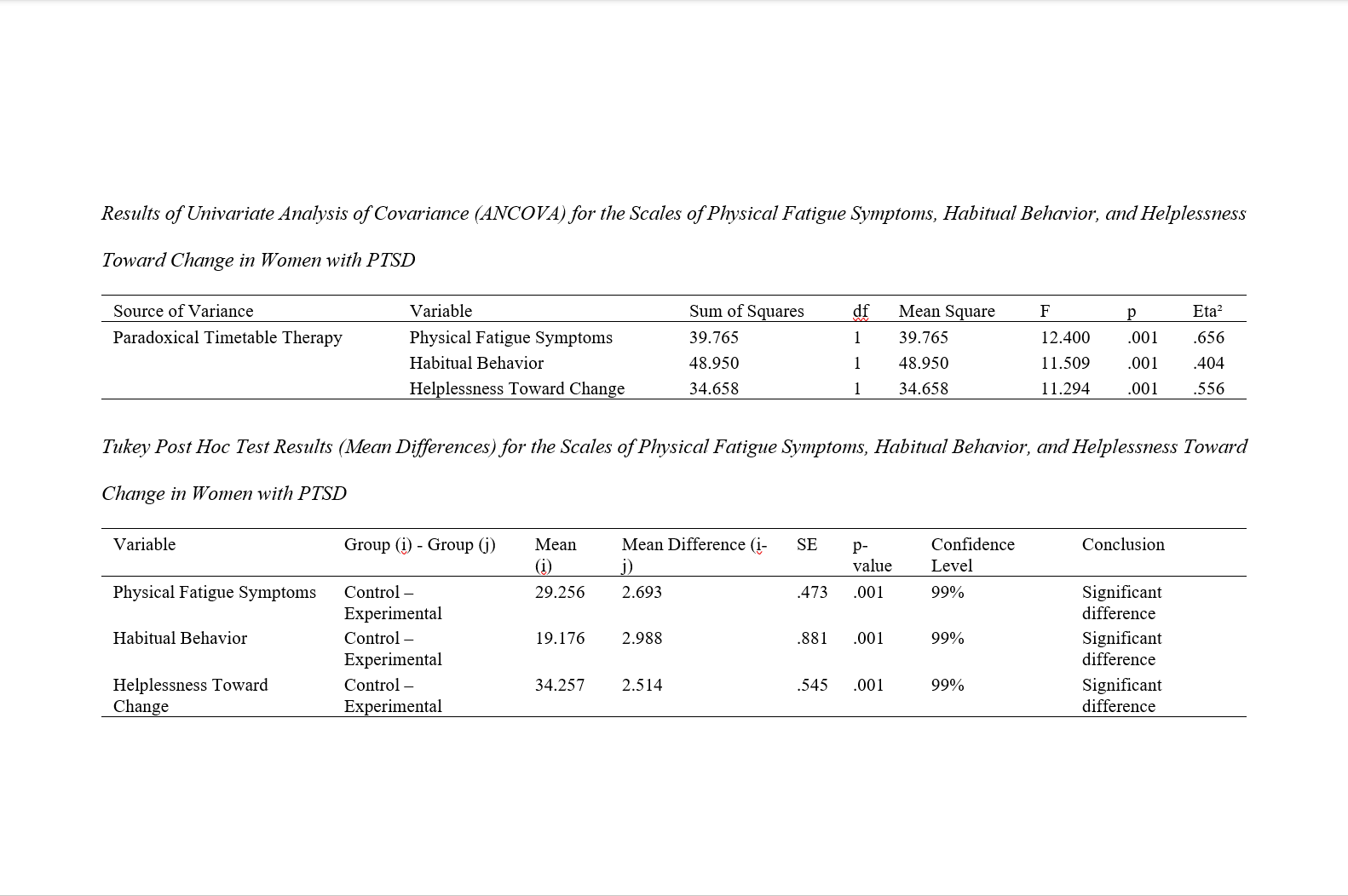
The present study aimed to determine the effectiveness of paradoxical timetable therapy on physical fatigue symptoms, habitual behavior, and helplessness toward change in women diagnosed with post-traumatic stress disorder (PTSD). This research employed a quasi-experimental method using a pretest-posttest design with two groups. The statistical population included all women in Tehran diagnosed with PTSD who sought psychological treatment at the Amin Psychological Counseling Center in 2024. In this study, 24 individuals were selected through purposive non-random sampling and then randomly assigned to two groups: 12 participants in the experimental group and 12 in the control group. The experimental group participated in six 60-minute sessions of paradoxical timetable therapy. Ultimately, after attrition, 11 participants successfully completed the intervention. The control group did not receive any intervention. Notably, in order to equate the sample sizes, the number of dropouts in the experimental group was randomly mirrored in the control group by removing participants. This study utilized the Physical Fatigue Symptoms Questionnaire, the Reflective Thinking Scale, and the Jones Irrational Beliefs Questionnaire as research instruments. The collected data were analyzed using multivariate analysis of covariance (MANCOVA) and univariate analysis of covariance (ANCOVA). The results indicated a statistically significant difference in post-test mean scores between the experimental and control groups. Paradoxical timetable therapy significantly improved physical fatigue symptoms, habitual behavior, and helplessness toward change in women diagnosed with PTSD.
Downloads
References
Abramson, L. Y., Seligman, M. E. P., & Teasdale, J. D. (2002). Learned helplessness in humans: Critique and reformulation. Journal of abnormal psychology, 87, 49-74. https://doi.org/10.1037/0021-843X.87.1.49
Alizadeh Akbari, A., & Garzin Motaii, F. Z. (2024). The Relationship of Emotion Regulation Strategies and Learned Helplessness with Marital Burnout Based on the Mediating Role of Attachment Styles in Divorced Individuals. Sixth International and Seventh National Conference on New Findings in Management, Psychology, and Accounting,
Azizi-Aram, S., & Basharpour, S. (2019). The Role of Rumination, Emotional Regulation, and Stress Reactivity in Predicting Anxiety Related to the Coronavirus (COVID-19) in Nurses. Nursing Management Quarterly, 9(3), 8-18. https://ijnv.ir/article-1-729-fa.html
Babaei, V., Aboualmali Hosseini, K., & Habib Mohammad, B. (2023). Investigating the Effectiveness of Paradoxical Time Management Therapy on Anxiety Sensitivity and Attention Focus in Individuals with Social Anxiety Disorder. Psychological Sciences Journal, 22(125), 983-967. https://psychologicalscience.ir/article-1-2074-fa.html
Basharat, M. A. (2019a). The Application of Paradoxical Therapy for Treating Body Dysmorphic Disorder: A Case Study. Psychological Sciences Journal, 19(95), 1387-1371. https://psychologicalscience.ir/article-1-1025-fa.html
Basharat, M. A. (2019b). Assessing the Effectiveness of Paradoxical Therapy on Social Anxiety Disorder: A Case Study. Psychological Sciences Journal, 18(76), 396-383. https://psychologicalscience.ir/article-1-383-fa.html
Basharat, M. A., Ramesh, S., & Noq, H. (2017). The Role of Worry, Anger Rumination, and Social Loneliness in Predicting Adjustment to Heart Disease. Cardiology and Vascular Nursing Journal, 6(4), 6-15. https://journal.icns.org.ir/article-1-485-fa.html
Calhoun, P. S., Beckham, J. C., & Bosworth, H. B. (2014). Caregiver burden and psychological distress in partners of veterans with chronic posttraumatic stress disorder. Journal of Traumatic Stress, 15, 205-212. https://doi.org/10.1023/A:1015251210928
Canova, V., Lederer Schläpfer, H., Piso, R. J., Droll, A., Fenner, L., Hoffmann, T., & et al. (2020). Transmission risk of SARS-CoV-2 to healthcare workers: observational results of a primary care hospital contact tracing. Swiss Medical Weekly, 150(1718). https://doi.org/10.4414/smw.2020.20257
da Silva, F. C., & Neto, M. L. (2021). Psychiatric symptomatology associated with depression, anxiety, distress, and insomnia in health professionals working in patients affected by COVID-19: A systematic review with meta-analysis. Progress in Neuro-Psychopharmacology and Biological Psychiatry, 104, 110057. https://doi.org/10.1016/j.pnpbp.2020.110057
de Roos, C., Offermans, J., Bouwmeester, S., Lindauer, R., & Scheper, F. (2025). Preliminary efficacy of eye movement desensitization and reprocessing for children aged 1.5–8 years with PTSD: a multiple baseline experimental design (N=19). European Journal of Psychotraumatology, 16(1), 2447654. https://doi.org/10.1080/20008066.2024.2447654
Evans, L., McHugh, T., Hopwood, M., & Watt, C. (2019). Chronic posttraumatic stress disorder and family functioning of Vietnam veterans and their partners. Australian & New Zealand Journal of Psychiatry, 37(6), 765-772. https://doi.org/10.1080/j.1440-1614.2003.01267.x
Ghadimi Nouran, M., Shafie Abadi, A., Khodabakhshi Koulaei, A., & Asgari, M. (2019). Developing a Therapeutic Protocol Based on the Paradoxical Time Management Model and Assessing Its Effectiveness on Binge Eating Disorder in Women. Journal title, 14(2), 81-94. https://rph.khu.ac.ir/article-1-3869-en.html
Gharehbaghy, F., & Tavakoli, H. (2019). Early maladaptive schemas, irrational beliefs about relationship and marriage instability. Analytical Psychology Quarterly, 10(36). http://psy.journals.iau-garmsar.ac.ir/article_668804_e136c0831bb1e9d79d99ab06a7ba945e.pdf
Maleki, M., Mohagheghi, H., & Nabizadeh, S. (2019). Predicting the Tendency to Risky Behaviors Based on Anger Rumination and Emotional Expression. Thought and Behavior, 13(52), 7-16. https://www.sid.ir/paper/365836/fa
Mohammadi, Z., Soleimani, A., Fathi Ashtiani, A., Ashrafi, E., & Mokhaberi, K. (2019). Comparing the Effectiveness of Paradoxical Time Management Therapy, Exposure Therapy, Response Prevention, and Medication on Reducing Symptoms in Patients with Obsessive-Compulsive Disorder. Disability Studies Journal, 9(63), 63. https://jdisabilstud.org/browse.php?a_id=1637&sid=1&slc_lang=fa
Nikan, A., Lotfi Kashani, F., Vaziri, S., & Mojtabai, M. (2021). Comparing Paradoxical Time Management and Cognitive Behavioral Therapy on Worry and Rumination in Individuals with Social Anxiety. Psychology Growth, 10(1), 1-14. https://frooyesh.ir/article-1-2739-fa.html
Orcutt, H. K., King, L. A., & King, D. W. (2021). Male-perpetrated violence among Vietnam veteran couples: Relationship with veteran's early life characteristics, trauma, and PTSD symptomatology. Journal of Traumatic Stress, 16(4), 381-390. https://doi.org/10.1023/A:1024470103325
Rostami, M., Bulut, S., Coelho, O., & Riyono, B. (2024). Living with Fibromyalgia: A Phenomenological Study of Pain, Fatigue, and Coping. Journal of Personality and Psychosomatic Research (JPPR), 2(1), 16-23. https://doi.org/10.61838/kman.jppr.2.1.4
Salehi Afshar, M., Mohammadi, A., & Haghighat, S. (2024). Presenting a Structural Model of School Bonding Based on Psychosocial Atmosphere with the Mediation of Reflective Thinking in High School Students. Journal of Psychological Dynamics in Mood Disorders (PDMD), 3(1), 100-111. https://doi.org/10.22034/pdmd.2024.450933.1072
Shareh, H., & Robati, Z. (2021). Effect of Cognitive-Behavioral Group Therapy on Pain Self-efficacy, Fatigue, Life Expectancy and Depression in Patients With Multiple Sclerosis: A Randomized Controlled Clinical Trial. Iraninan Psychiatry and Clinical Psychology, 26(4), 418-431. https://www.magiran.com/paper/2276453
Sheerin, C. M., Brick, L. A., Nugent, N. R., & Amstadter, A. B. (2019). Genetic Studies of PTSD and Substance Use Disorders: Background, Developments, and Future Directions. Posttraumatic Stress and Substance Use Disorders: Routledge. https://doi.org/10.4324/9781315442648-15
Soukhtanlou, M., Pourhosein, R., & Afrooz, G. (2024). Developing and Compiling a Mindfulness-Based Stress Reduction Program and Evaluating its Effectiveness on Relieving Chronic Pain in the Elderly: A Case Series. Journal of Assessment and Research in Applied Counseling (JARAC). https://journals.kmanpub.com/index.php/jarac/article/view/3300
Timouri, Z., Mojtabai, M., Reza Zadeh, S. M., & Rafiei Zadeh, A. (2021). Effectiveness of Compassion-Focused Couple Therapy on Anger Rumination and Marital Intimacy in Women Affected by Infidelity. Family and Health Journal, 11(4), 11-26. https://julistb.sinaweb.net/article_251451.html
Watson, P., & Osborne, A. (2025). Being a Military Child in Denmark: Young People’s Experiences of Living With a Parent With PTSD. PLOS Ment Health, 2(1), e0000144. https://doi.org/10.1371/journal.pmen.0000144
Wei, R.-j., & Chen, Y. (2022). The Associations of Family Functioning With Learned Helplessness: A Moderated Mediating Model. https://doi.org/10.2991/978-94-6463-064-0_114
Wu, S. S., & Tu, C.-C. (2019). The Impact of Learning Self-Efficacy on Social Support Towards Learned Helplessness in China. Eurasia Journal of Mathematics Science and Technology Education. https://doi.org/10.29333/ejmste/115457
Downloads
Additional Files
Publication Timeline
- Submitted
- Revised
- Accepted
License
Copyright (c) 2025 Hananeh Saki (Author); Mahnaz Askarian (Corresponding Author); Mehryar Anasseri (Author)

This work is licensed under a Creative Commons Attribution-NonCommercial 4.0 International License.