Examining The Relationship Between Academic Procrastination, Self-Compassion, and Epistemological Beliefs in High School Students
DOI:
https://doi.org/10.61838/kman.fct.psynexus.3.15Keywords:
Academic procrastination, self-compassion, epistemological beliefs, self-regulation, high school studentsAbstract
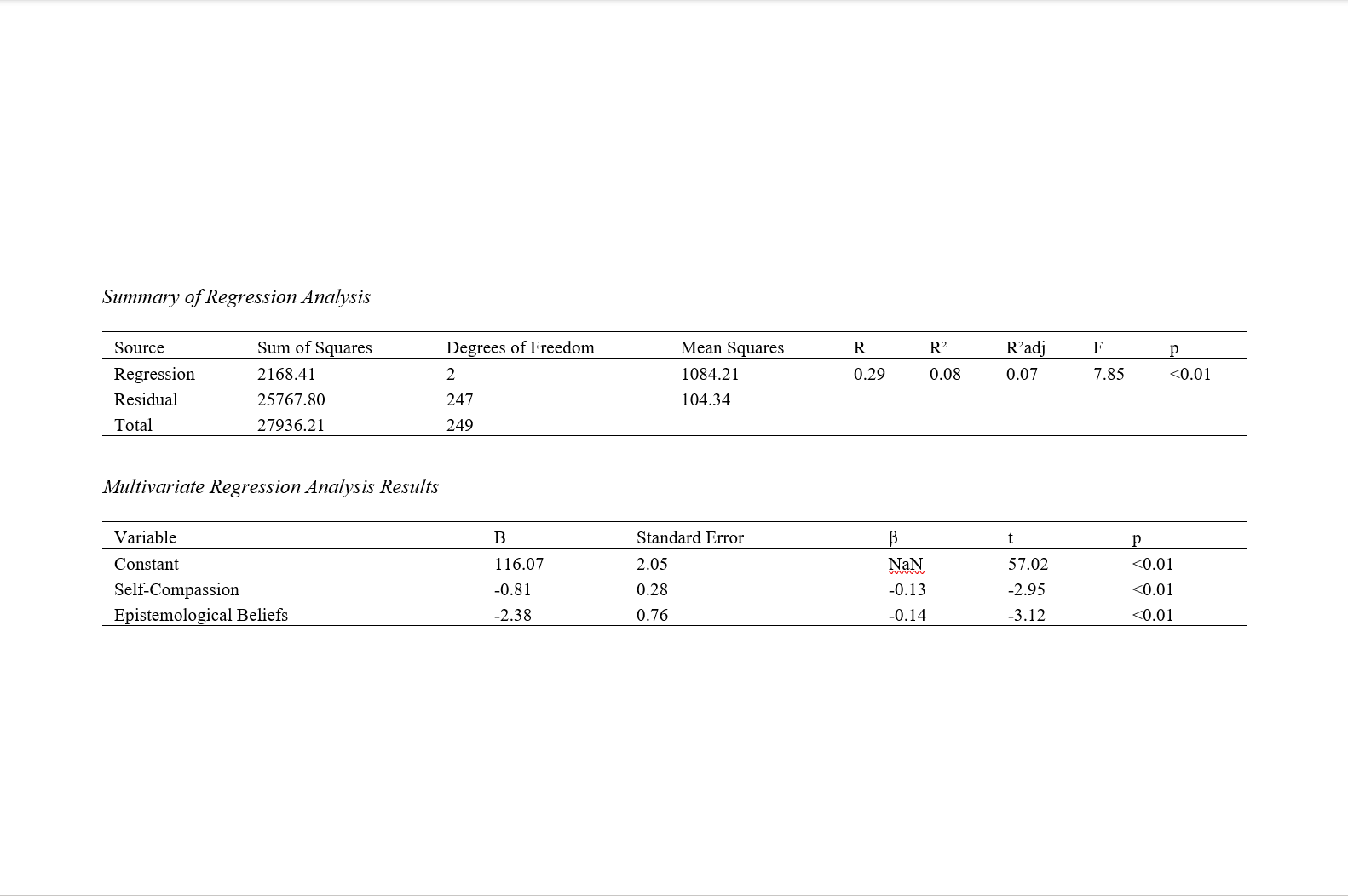
This study aimed to examine the relationship between academic procrastination, self-compassion, and epistemological beliefs among high school students to determine whether self-compassion and epistemological beliefs predict academic procrastination. The study employed a correlational research design, with a sample consisting of 250 senior high school students from District 1 of the Tabriz Department of Education in the 2023-2024 academic year. Participants were selected using a non-random convenience sampling method. Data were collected using the Tuckman Procrastination Scale (1989), the Self-Compassion Scale – Short Form (Raes et al., 2011), and the Schommer Epistemological Beliefs Questionnaire (1990). Pearson correlation analysis was conducted to examine the relationships between the variables, and multiple regression analysis was performed to assess the predictive power of self-compassion and epistemological beliefs on academic procrastination. The results indicated that self-compassion and epistemological beliefs had weak but statistically significant correlations with academic procrastination (r = -0.12, p < 0.01; r = 0.13, p < 0.01, respectively). However, the multiple regression analysis revealed that neither self-compassion (B = -0.13, p < 0.01) nor epistemological beliefs (B = -0.12, p < 0.01) were significant predictors of academic procrastination. The overall regression model was not statistically significant (F(2, 247) = 7.85, p < 0.01), suggesting that self-compassion and epistemological beliefs do not independently explain variations in academic procrastination. Although self-compassion and epistemological beliefs were correlated with academic procrastination, they did not significantly predict procrastination in this sample. The findings suggest that academic procrastination is influenced by more complex psychological and contextual factors.
Downloads
References
Abdolshahi, H. R., & Mehdi Reza, S. (2019). The relationship between self-compassion and procrastination: The mediating role of shame and guilt. Journal of Fundamentals of Mental Health, 21(4), 233-239. https://doi.org/10.22038/jfmh.2019.14398
Alipour, F., Farid, A., & Mosleh, S. Q. (2024). The model of academic procrastination based on academic self-handicapping and perfectionism with the mediating role of students' sense of competence. Research in cognitive and behavioral sciences, 13(2), 1-20. https://cbs.ui.ac.ir/article_27778_en.html?lang=fa
Ayata, S. (2024). Contributions of Epistemological Beliefs on Energy Literacy in Lower-Secondary School Students in Turkey. Journal of Baltic Science Education, 23(3), 421-431. https://doi.org/10.33225/jbse/24.23.421
Barutçu Yıldırım, F., & Demir, A. (2019). Self-Handicapping Among University Students: The Role of Procrastination, Test Anxiety, Self-Esteem, and Self-Compassion. Psychological Reports, 123(3), 825-843. https://doi.org/10.1177/0033294118825099
Bråten, I., & Strømsø, H. I. (2004). Epistemological beliefs and implicit theories of intelligence as predictors of achievement goals. Contemporary Educational Psychology, 29(4), 371-388. https://www.sciencedirect.com/science/article/pii/S0361476X03000675
Cristea, M. (2023). Epistemological Beliefs as a Predictor of Metacognitive Awareness: Pre-University Teaching Practice Implications. https://doi.org/10.15405/epes.23056.13
Einabad, Z. S., Dorban, G., & Nainian, M. (2017). The Mediating Role of Self-Compassion in the Relationship Between Anxiety and Procrastination. Zahedan Journal of Research in Medical Sciences, 19(9). https://doi.org/10.5812/zjrms.11773
Elhamifar, A., Mehdinezhad, v., & Farnam, A. (2019). The Effect of Critical Thinking on Metacognitive Knowledge and Epistemological Beliefs of High School Students [Research Article]. Iranian Journal of Educational Sociology, 2(3), 47-55. https://doi.org/10.29252/ijes.2.3.47
Jiang, Y., Wang, J., Bonner, P., & Yau, J. (2021). A Cross-Cultural Study of Relationships Between Epistemological Beliefs and Self-Regulated Learning Strategies. Electronic Journal of Research in Educational Psychology. https://doi.org/10.25115/ejrep.v19i54.3896
Joojam, P., & Safarpour-Dehkordi, S. (2024). The Effect of Cognitive and Metacognitive Strategies on Self-Concept and Academic Procrastination in Middle School Students. Excellence in Education Quarterly, 3(2), 6-10.
Kamali Zarch, M., Zare, H., & Alavi Langeroudi, S. (2013). Effectiveness of critical thinking training on epistemological beliefs of students. Social Cognition, 1(2), 14-31. https://sc.journals.pnu.ac.ir/article_300.html?lang=en
Karvan, F. (2024). Explaining Ideas in Women's Artistic Manuscripts Based on Scientific Epistemological Beliefs with the Mediating Role of Cognitive Load in Architectural Design Education. Women in Culture and Art, 16(1), 61-84. https://doi.org/10.22059/jwica.2024.362411.1943
Lodewyk, K. R. (2007). Relations among epistemological beliefs, academic achievement and task performance in secondary school students. Educational Psychology, 27(3), 307-327. https://doi.org/10.1080/01443410601104080
Mahvash, M., Yamini, M., & Mahdian, H. (2024). Comparing the Effectiveness of Instructional Mental Imagery and Tolerance of Ambiguity Training on Students' Academic Procrastination [Research Article]. Iranian Journal of Educational Sociology, 7(1), 10-20. https://doi.org/10.61838/kman.ijes.7.1.2
Mansouri, K., Ashouri, A., Gharraee, B., & Farahani, H. (2021). Prediction of decisional procrastination based on fear of failure, self-compassion and intolerance of uncertainty in students [Research]. Shenakht Journal of Psychology and Psychiatry, 8(4), 51-62. https://doi.org/10.32598/shenakht.8.4.51
Xu, B. (2023). Improvement of Academic Procrastination among High School Students through Psychological Resilience Group Counseling. Journal of Education and Educational Research, 4(1), 101-103. https://doi.org/10.54097/jeer.v4i1.10211
Yang, X., Liu, R. D., Ding, Y., Hong, W., & Jiang, S. (2023). The relations between academic procrastination and self-esteem in adolescents: A longitudinal study. Current Psychology, 42(9), 7534-7548. https://doi.org/10.1007/s12144-021-02075-x
Zarei, L., & Khoshouei, M. S. (2023). Relationship of academic procrastination with metacognitive beliefs, emotion regulation and tolerance of ambiguity in university students. Quarterly Journal of Research and Planning in Higher Education, 22(3), 113-130. https://journal.irphe.ac.ir/article_702906_en.html
Downloads
Additional Files
Publication Timeline
- Submitted
- Revised
- Accepted
Issue
Section
Categories
License
Copyright (c) 2025 Nasrin Ghorbani Afkhami (Author); Marziyeh Alivandi Vafa (Corresponding Author); Roghayeh kiyani, Amir Panahali (Author)

This work is licensed under a Creative Commons Attribution-NonCommercial 4.0 International License.