Understanding the Role of Role Clarity in Mediating the Relationship Between Workload and Burnout
DOI:
https://doi.org/10.61838/kman.ooc.psynexus.3.8Keywords:
Workload, Role Clarity, BurnoutAbstract
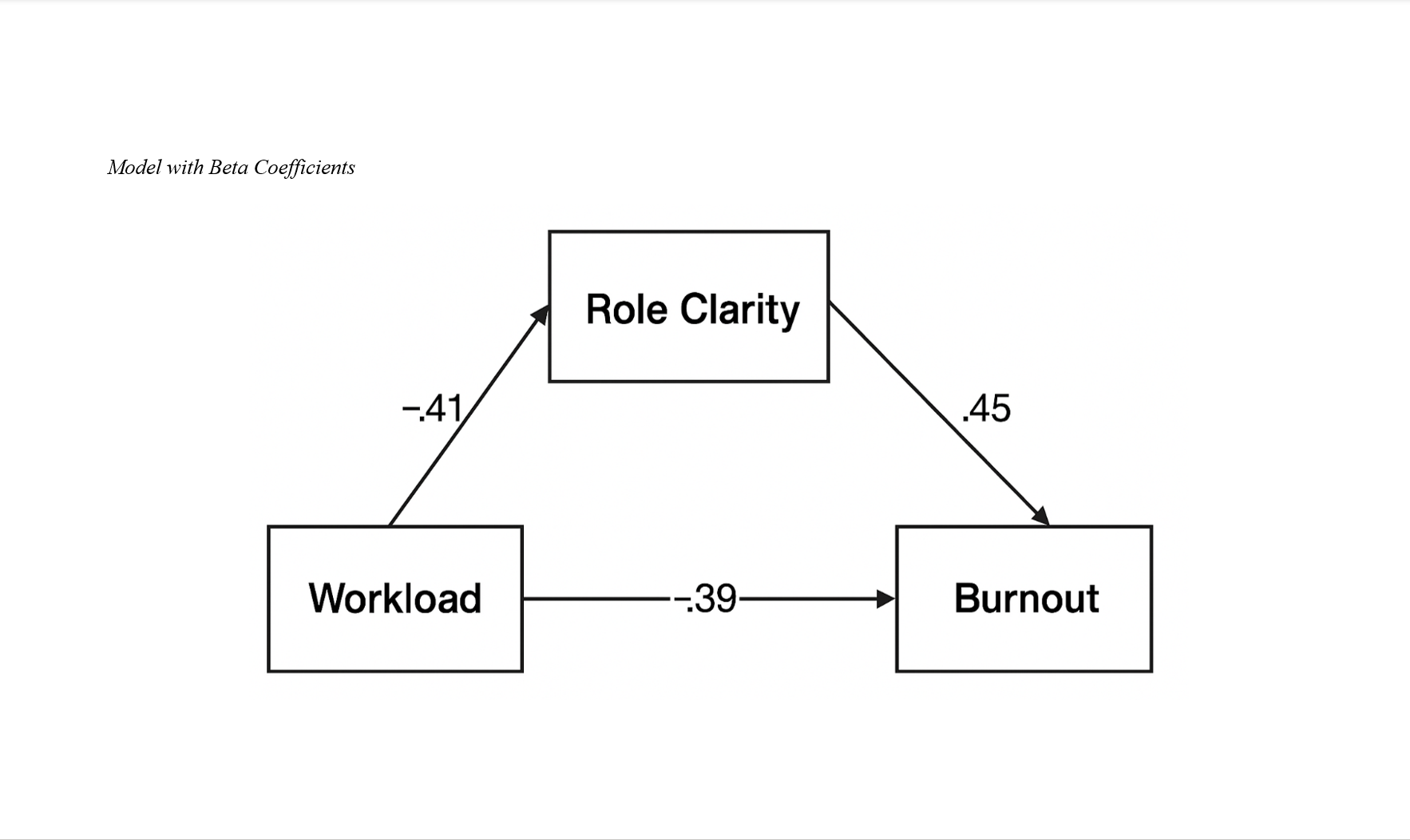
The present study aimed to examine the mediating role of role clarity in the relationship between workload and work burnout among employees in Romania. This research adopted a descriptive correlational design. A total of 400 full-time employees from various sectors in Romania participated in the study, selected based on the Morgan and Krejcie sample size table. Data were collected using standardized questionnaires: the Quantitative Workload Inventory (QWI) for workload, the Role Clarity subscale of the Role Conflict and Ambiguity Scale for role clarity, and the Maslach Burnout Inventory – General Survey (MBI-GS) for work burnout. Descriptive statistics and Pearson correlation analyses were conducted using SPSS-27 to explore the relationships among the variables. Structural Equation Modeling (SEM) was employed in AMOS-21 to assess the mediating effect of role clarity on the link between workload and burnout, and to evaluate the overall fit of the proposed model. The results revealed that workload was positively correlated with burnout (r = .53, p < .001) and negatively correlated with role clarity (r = –.41, p < .001). Role clarity was also negatively associated with burnout (r = –.46, p < .001). The structural model demonstrated good fit indices (χ²/df = 2.08, CFI = .96, TLI = .95, RMSEA = .052). SEM analysis confirmed that role clarity significantly mediated the relationship between workload and burnout, with both direct (β = .45, p < .001) and indirect effects (β = .16, p < .001) being statistically significant. These findings suggest that high workload increases burnout levels, but the presence of clear role expectations can mitigate this effect. Enhancing role clarity within organizations may serve as a critical strategy for reducing employee burnout and improving workplace well-being.
Downloads
References
Ali, A. (2025). Emotional Intelligence Nexus With Job Stress, and Burnout in Khyber Pakhtunkhwa Public Sector: Mediated Self-Efficacy. CRSSS, 3(1), 2432-2444. https://doi.org/10.59075/rhrr4r89
Annisa, A. S. S., Saleh, L. M., Naiem, F., Russeng, S. S., Wahyu, A., Riskiyani, S., & Anwar, A. A. (2024). The Effect of Workload on Work Productivity Through Job Stress in Air Traffic Controller (ATC) Employees at Makassar International Airport Sultan Hasanuddin Makassar. Journal of Law and Sustainable Development, 12(1), e2764. https://doi.org/10.55908/sdgs.v12i1.2764
Behera, S. K. (2025). From Pressure to Performance: An Analytical Approach to the Impact of Workplace Stressors on Employee Health and Productivity. Jier, 5(1). https://doi.org/10.52783/jier.v5i1.2165
Bhandesa, W. M., & Wibawa, I. M. A. (2022). Role of Job Satisfaction and Job Stress in Mediate the Effect of Organizational Justice on Deviant Behavior in the Workplace. International Research Journal of Management It and Social Sciences, 9(4), 639-655. https://doi.org/10.21744/irjmis.v9n4.2145
Heo, A. R., & Park, H. (2024). Pathways Linking Organizational Support and Affective Commitment: The Mediating Roles of Role Ambigu. The Korean Association of Governance Studies, 34(3), 93-130. https://doi.org/10.26847/mspa.2024.34.3.93
Hisbih, T. A., Fitriani, L. K., & Supriatna, O. (2023). Pengaruh Beban Kerja, Stres Kerja Terhadap Turnover Intention Karyawan Dengan Workplace Wellbeing Sebagai Variabel Mediasi. Entrepreneur Jurnal Bisnis Manajemen Dan Kewirausahaan, 4(03), 109-125. https://doi.org/10.31949/entrepreneur.v4i03.5701
Hou, M., Chen, Y., Yao, N., Xiao, Y., Ju, Y., Liu, B., Liao, M., Jin, L., & Zhang, Y. (2023). The Impact of Stress on Work Engagement and Workplace Creativity of Hospital Administrators: The Mediating Role of Somatic Symptoms and Sleep Disturbance. https://doi.org/10.21203/rs.3.rs-3422747/v1
Kang, T., Li, Y., Guo, J., Ma, X., Hiramoni, F. A., Ahmed, M. Z., Jobe, M. C., & Ahmed, O. (2022). The Relationship Between College Graduate’s Dual Self-Consciousness and Job Search Clarity: The Mediating Role of Perceived Stress. International Journal of Mental Health Promotion, 24(2), 207-217. https://doi.org/10.32604/ijmhp.2022.019745
Kim, M. Y., Kim, J. H., & Choi, S. J. (2022). Mediating Effects of Role Clarity Between Clinical Decision-Making Abilities and Job Stress for Advanced Practice Nurses at Tertiary Hospitals. Journal of Korean Critical Care Nursing, 15(2), 27-38. https://doi.org/10.34250/jkccn.2022.15.2.27
Lai, Y., Gao, G., & Du, B. (2024). The Mediating Role of Perceived Emotional Intelligence: Examining the Impact of Affective Job Satisfaction on Organizational Identification Among Chinese Technological Workers. Frontiers in psychology, 15. https://doi.org/10.3389/fpsyg.2024.1285853
Le, T. T., Tran, H. L., Hòa, N. Đ., Le, D. Q., Nguyen, V. H., & Lan, H. (2022). The Influence of Sports Activities on Workplace Productivity in Vietnam: The Mediating Role of Stress Management and Work-Life Balance. American Journal of Health Behavior, 46(6), 740-752. https://doi.org/10.5993/ajhb.46.6.16
Madden, S. K., Blewitt, C., Hill, B., O’Connor, A., Meechan, D., & Skouteris, H. (2022). ‘It's Just the Nature of the Work’: Barriers and Enablers to the Health and Well‐being of Preconception, Pregnant and Postpartum Working Women in a Community Service Organisation. Health & Social Care in the Community, 30(6). https://doi.org/10.1111/hsc.14093
Manolache, M., & Epuran, G. (2023). The Mediating Impact of Goal–Role Clarity on the Relationship Between Feedback–Seeking Behavior and Goal Orientations With Job Satisfaction Intrinsic Cognitions and Person–Organization Fit. Sustainability, 15(17), 12776. https://doi.org/10.3390/su151712776
Mehmood, S., Aziz, A., & Husin, N. S. (2023). Does Work Stress &Amp; Workplace Incivility Influence Employee Turnover Intentions? Mediating Role of Work-Family Conflict. International Journal of Social Sciences and Economic Review, 01-14. https://doi.org/10.36923/ijsser.v5i2.177
Mosahab, R., & Mosahab, A. (2022). The Effects of Workplace Discrimination on Job Stress and Depression Among Nurses: A Test of Mediation. Global journal of health science, 14(10), 1. https://doi.org/10.5539/gjhs.v14n10p1
Mozgovoy, V. (2021). Psychological Climate’s Effect on Stress Among Public Servants. Academy of Management Proceedings, 2021(1), 16026. https://doi.org/10.5465/ambpp.2021.16026abstract
Mukhtar, S., & Ibrahim, M. b. (2024). The Impact of Workplace Inequality on Job Crafting: Moderating Role of Work Social Support and Workplace Resilience in Mitigating the Effect of Psychological Stress: An Analysis of Academia. Administrative and Management Sciences Journal, 3(1), 144-156. https://doi.org/10.59365/amsj.3(1).2024.136
Rosander, M. (2021). Mental Health Problems as a Risk Factor for Workplace Bullying: The Protective Effect of a Well-Functioning Organization. Annals of Work Exposures and Health, 65(9), 1096-1106. https://doi.org/10.1093/annweh/wxab040
Rožman, M., Oreški, D., & Tominc, P. (2023). Artificial-Intelligence-Supported Reduction of Employees’ Workload to Increase the Company’s Performance in Today’s VUCA Environment. Sustainability, 15(6), 5019. https://doi.org/10.3390/su15065019
Şeşen, H., & Ertan, Ş. S. (2021). The Effect of the Employee Perceived Training on Job Satisfaction: The Mediating Role of Workplace Stress. European Journal of Training and Development, 46(9), 953-973. https://doi.org/10.1108/ejtd-01-2021-0014
Silaban, A., Siagian, N., Sitorus, S. A., & Medrofa, D. (2024). Impact of Management Control Systems on Managerial Job Satisfaction and Stress in Local Government: The Mediating Role of Organizational Commitment. International Journal of Economics Development Research (Ijedr), 5(6), 5430-5451. https://doi.org/10.37385/ijedr.v5i6.6323
Suprapto, J. C., Marshanda, P., Nandela, F. B., & Siddiq, D. M. (2024). The Impact of Work-Life Balance, Work Safety, and Workload on Employee Retention in Indonesia's Port Industry. International Journal Of Humanities Education And Social Sciences (IJHESS), 4(1). https://doi.org/10.55227/ijhess.v4i1.1080
Tang, X., & Li, X. (2021). Role Stress, Burnout, and Workplace Support Among Newly Recruited Social Workers. Research on Social Work Practice, 31(5), 529-540. https://doi.org/10.1177/1049731520984534
Tun, N. A., Mon, K. L., Hone, S., Lat, T. W., & Win, H. H. (2024). Work Stress, Workplace Violence, Job Satisfaction and Their Effects on Turnover Intention Among Midwife and Public Health Supervisor II in Myanmar. International Journal of Community Medicine and Public Health, 11(10), 3770-3778. https://doi.org/10.18203/2394-6040.ijcmph20242853
Wang, J., Huang, Y., Wang, S., Zhang, Z., He, Y., Wang, X., & Guo, H. (2023). The Impact of Workplace Violence on Job Burnout Among Chinese Correctionalofficers: the Chain Mediating Effects of Stress and Insomnia. https://doi.org/10.21203/rs.3.rs-3502752/v1
Wang, J., Huang, Y., Wang, S., Zhang, Z., He, Y., Wang, X., & Guo, H. (2024). The Impact of Workplace Violence on Job Burnout Among Chinese Correctional Officers: The Chain Mediating Effects of Stress and Insomnia. BMC public health, 24(1). https://doi.org/10.1186/s12889-024-18048-1
Wlazło, M., Łaskawiec-Żuławińska, D., Grajek, M., & Korzonek-Szlacheta, I. (2024). Job Burnout Among Healthcare Workers—The Impact of the COVID-19 Pandemic. Appl. Psychol. Res., 3(1), 359. https://doi.org/10.59400/apr.v3i1.359
Zaheer, M. A., Raza, M. A., Manzoor, M., & Raja, U. A. (2024). Is Role Clarity and Workplace Autonomy the Key Dilemma for Multinational Telecommunication Organizations in Developing Countries? Upravlenets, 15(2), 48-65. https://doi.org/10.29141/2218-5003-2024-15-2-4
Zhao, Z., Gao, H., Chen, F., & Dong, H. (2025). The mediating effect of job burnout on perceived stress and presenteeism among geriatric caregivers in long-term care facilities. Geriatric Nursing, 61, 538-543. https://doi.org/10.1016/j.gerinurse.2024.12.007
Zheng, L. (2025). Leader–employee Perfectionism (In)congruence and Role Clarity: A Role Theory Approach to Employee Workplace Well-Being. Personnel Review. https://doi.org/10.1108/pr-04-2024-0349
Zong, B., Zhang, L., Chu, X., & Qu, J. (2021). Does Positive Workplace Gossip Help Socialize Newcomers? A Dual‐pathway Model Based on Network Ties. PsyCh Journal, 10(5), 767-776. https://doi.org/10.1002/pchj.468
Downloads
Additional Files
Publication Timeline
- Submitted
- Revised
- Accepted
Issue
Section
License

This work is licensed under a Creative Commons Attribution-NonCommercial 4.0 International License.