Exploring How Work-Life Balance and Meaningful Work Predict Employee Retention
DOI:
https://doi.org/10.61838/kman.ooc.psynexus.3.7Keywords:
Employee retention, meaningful work, work-life balance, organizational commitmentAbstract
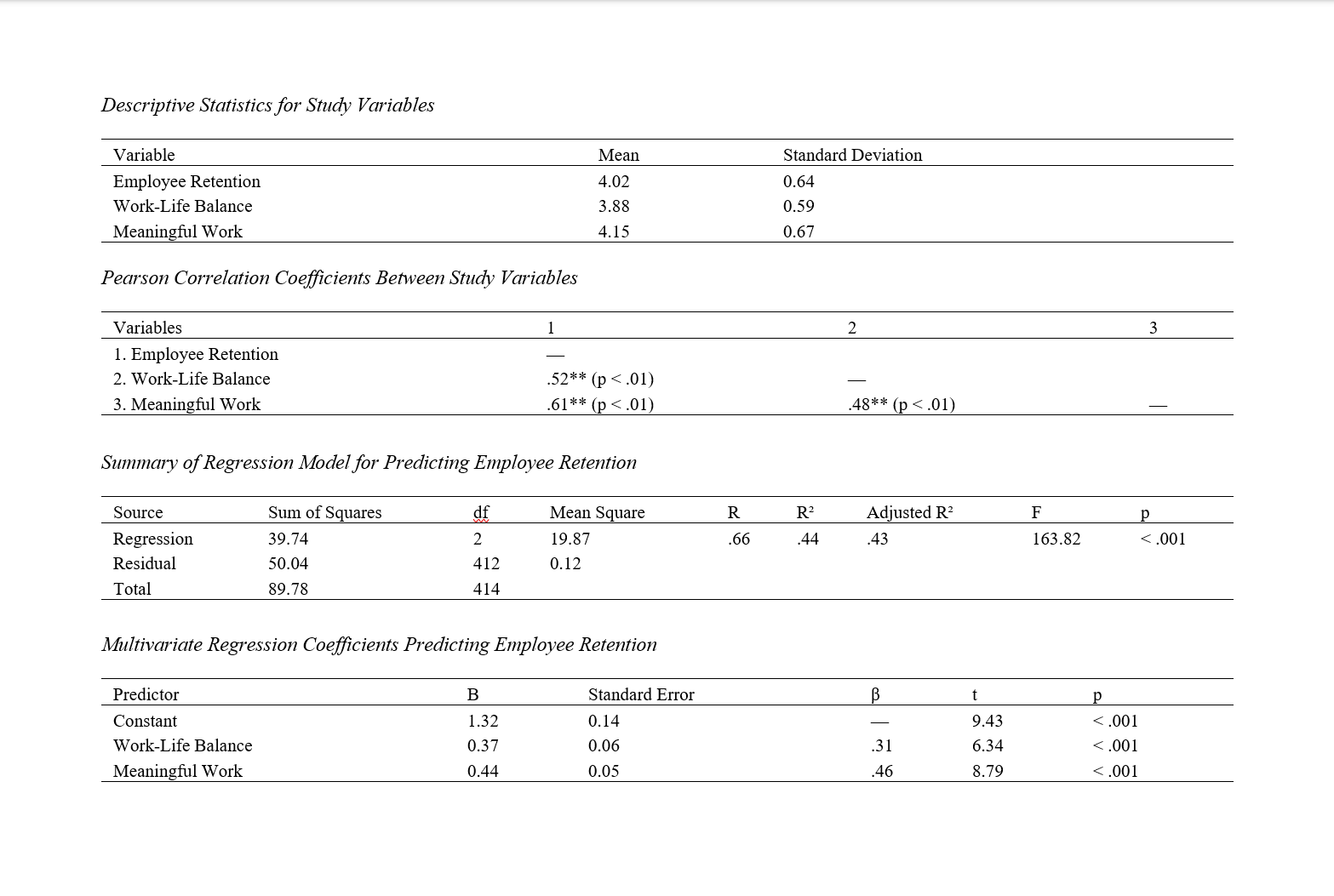
This study aimed to investigate the predictive roles of work-life balance and meaningful work in explaining employee retention among Malaysian employees. The research utilized a correlational descriptive design to examine the relationships between the variables. A total of 415 full-time employees from various organizations across Malaysia participated in the study. The sample size was determined based on the Morgan and Krejcie sample size table and selected through simple random sampling. Standardized tools were employed to assess employee retention, work-life balance, and meaningful work. Data were analyzed using SPSS version 27, applying descriptive statistics, Pearson correlation coefficients to examine bivariate relationships, and multiple linear regression analysis to determine the predictive value of the independent variables. Descriptive statistics showed favorable perceptions across all three variables, with mean scores of 4.02 (employee retention), 3.88 (work-life balance), and 4.15 (meaningful work). Pearson correlation results indicated significant positive relationships between employee retention and both work-life balance (r = .52, p < .01) and meaningful work (r = .61, p < .01). The multiple regression model was significant, F(2, 412) = 163.82, p < .001, accounting for 44% of the variance in employee retention (R² = .44). Both predictors were significant, with meaningful work (β = .46, p < .001) emerging as a stronger predictor than work-life balance (β = .31, p < .001). The findings underscore the critical role of both meaningful work and work-life balance in fostering employee retention, with meaningful work demonstrating greater predictive strength. Organizations aiming to reduce turnover should prioritize creating purpose-driven work environments alongside supportive work-life practices.
Downloads
References
Amodia, J. B., & Visitacion, R. H. (2025). The Influence of Two-Factor Theory on Employee Retention: The Mediating Role of Organizational Citizenship Behavior and the Moderating Role of Leader-Member Exchange in Business Management. Jembar, 2(2). https://doi.org/10.61511/jembar.v2i2.2025.1388
Basher, F., Rahman, B., Hossain, M. M., & Islam, M. A. (2024). Impact of Job Meaningfulness on Employee Retention: Antecedent and Outcome of Person-Organization Fit and Person Job Fit. Journal of Infrastructure Policy and Development, 8(11), 7326. https://doi.org/10.24294/jipd.v8i11.7326
Boikanyo, D. H., & Naidoo, M. (2023). The Influence of Organisational Support, Advancement, Meaningfulness and Psychological Safety on Employee Engagement in a Petrochemical Organisation. WSEAS Transactions on Business and Economics, 20, 1100-1109. https://doi.org/10.37394/23207.2023.20.98
Durairaj, S. (2024). The Effect of AI (Artificial Intelligence) in Employee Performance Evaluation on Employee Retention in the Information Technology Sector. 88-108. https://doi.org/10.2991/978-94-6463-433-4_8
Hasan, H., Nikmah, F., & Wahyu, E. E. (2022). The Impact of Meaningful Work and Work Engagement on Bank Employees’ Performance. International Journal of Research in Business and Social Science (2147-4478), 11(3), 161-167. https://doi.org/10.20525/ijrbs.v11i3.1699
Heath, M., Williams, E. N., & Luse, W. (2022). Breaches and Buffers: Can Meaningful Work Impact Turnover During COVID-19 Pandemic? Review of managerial science, 18(1), 83-104. https://doi.org/10.1007/s11846-022-00612-x
Janssen, J. L., Lysova, E. I., Wickert, C., & Khapova, S. N. (2022). Employee Reactions to CSR in the Pursuit of Meaningful Work: A Case Study of the Healthcare Industry. Frontiers in psychology, 13. https://doi.org/10.3389/fpsyg.2022.969839
Kuancintami, A., & Heryjanto, A. (2023). Increase Employee Retention: Impact Work-Life Balance, Meaningful Work, and Job Satisfaction Towards Turnover Intention. Jurnal Indonesia Sosial Sains, 4(11), 1099-1113. https://doi.org/10.59141/jiss.v4i11.920
Lutfia, L., Akilie, A. H., Medira, S., & Charli, C. O. (2024). Pengaruh Pengembangan Karir Dan Perencanaan SDM Terhadap Kinerja Karyawan Melalui Motivasi Kerja Sebagai Variabel Intervening Pada Diperon Kelapa Sawit Brama Kumbara Pasaman Barat. Jumbiwira Jurnal Manajemen Bisnis Kewirausahaan, 3(2), 18-32. https://doi.org/10.56910/jumbiwira.v3i2.1574
Malik, P., & Malik, P. (2023). Should I Stay or Move On—examining the Roles of Knowledge Sharing System, Job Crafting, and Meaningfulness in Work in Influencing Employees' Intention to Stay. Journal of Organizational Effectiveness People and Performance, 11(2), 325-346. https://doi.org/10.1108/joepp-08-2022-0229
Marnoto, M., Supardi, S., & Soegiarto, I. (2024). Impact of Job Satisfaction, Transformational Leadership, and Work-Life Balance on Employee Performance: A Study in Technology Companies in Indonesia. International Journal of Business, Law, and Education, 5(1), 510-521. https://doi.org/10.56442/ijble.v5i1.414
Mosquera, P., Tigre, F. B., & Alegre, M. (2024). Overcoming Organizational Politics and Unlocking Meaningful Work Through Ethical Leadership. International Journal of Ethics and Systems. https://doi.org/10.1108/ijoes-04-2024-0108
O'Callaghan, M. (2024). The Impact of Procedural Justice on Employee Turnover Intentions and the Role of Two Mediators. Organization Management Journal, 21(2), 75-87. https://doi.org/10.1108/omj-03-2023-1822
Pratiwi, E. C., & Hariani, M. (2023). Pengaruh Lingkungan Kerja Dan Motivasi Kerja Terhadap Tingkat Retensi Karyawan Di Industri Jasa. Journal of Trends Economics and Accounting Research, 4(2), 563-568. https://doi.org/10.47065/jtear.v4i2.1012
Rinawati, R., Untajana, P. P., & Kopong, A. (2024). Innovative Human Resource Practices to Improve Work-Life Balance and Talent Retention: Strategic Review and Implementation. International Journal of Management Science and Information Technology, 4(2), 471-481. https://doi.org/10.35870/ijmsit.v4i2.3252
Shah, S. (2024). Effect of Psychological Empowerment on Employee Job Satisfaction of Nepalese Commercial Banks. Nep. J. Finance, 11(2), 224-241. https://doi.org/10.3126/njf.v11i2.68826
Siregar, T. P., Nasution, H., & Absah, Y. (2022). Analysis of the Effect of Work-Life Balance on Employee Engagement Employees PT. XYZ. International Journal of Research and Review, 9(7), 327-336. https://doi.org/10.52403/ijrr.20220737
Suprapto, J. C., Marshanda, P., Nandela, F. B., & Siddiq, D. M. (2024). The Impact of Work-Life Balance, Work Safety, and Workload on Employee Retention in Indonesia's Port Industry. International Journal Of Humanities Education And Social Sciences (IJHESS), 4(1). https://doi.org/10.55227/ijhess.v4i1.1080
Westover, J. (2025a). Finding Purpose at Work: How Leaders Can Help Their Team Discover Meaning. HCLReview, 17(2). https://doi.org/10.70175/hclreview.2020.17.2.6
Westover, J. (2025b). The Meaning of Work: Why "Meaning" May Be More Important Than "Purpose". HCLReview, 17(3). https://doi.org/10.70175/hclreview.2020.17.3.3
Widya, A., Ni Putu Putri Ayu, W., Pratiwi, K. A., & Muliati, N. K. (2023). Pengaruh Job Insecurity Terhadap Loyalitas Pegawai Dan Guru Pada SMP PGRI 9 Denpasar Dengan Kepuasan Kerja Sebagai Variabel Mediasi. Widya Manajemen, 5(2), 135-146. https://doi.org/10.32795/widyamanajemen.v5i2.4010
Zanabazar, A., Dugersuren, A., & Maligar, B. (2024). The Impact of Meaningful Work on Employee Engagement: The Case of Mongolian Kindergarten Teachers. Advances in Social Sciences Research Journal, 11(2), 520-531. https://doi.org/10.14738/assrj.112.16438
Zehra, F. (2025). Impact of Employee Benefits on Work Productivity and Retention. https://doi.org/10.5772/intechopen.1008338
Downloads
Additional Files
Publication Timeline
- Submitted
- Revised
- Accepted
Issue
Section
License

This work is licensed under a Creative Commons Attribution-NonCommercial 4.0 International License.