Career Transitions in Midlife: Exploring Meaning-Making and Role Adjustment
DOI:
https://doi.org/10.61838/kman.ooc.psynexus.3.6Keywords:
Midlife career transition, meaning-making, role adjustment, identity reconstructionAbstract
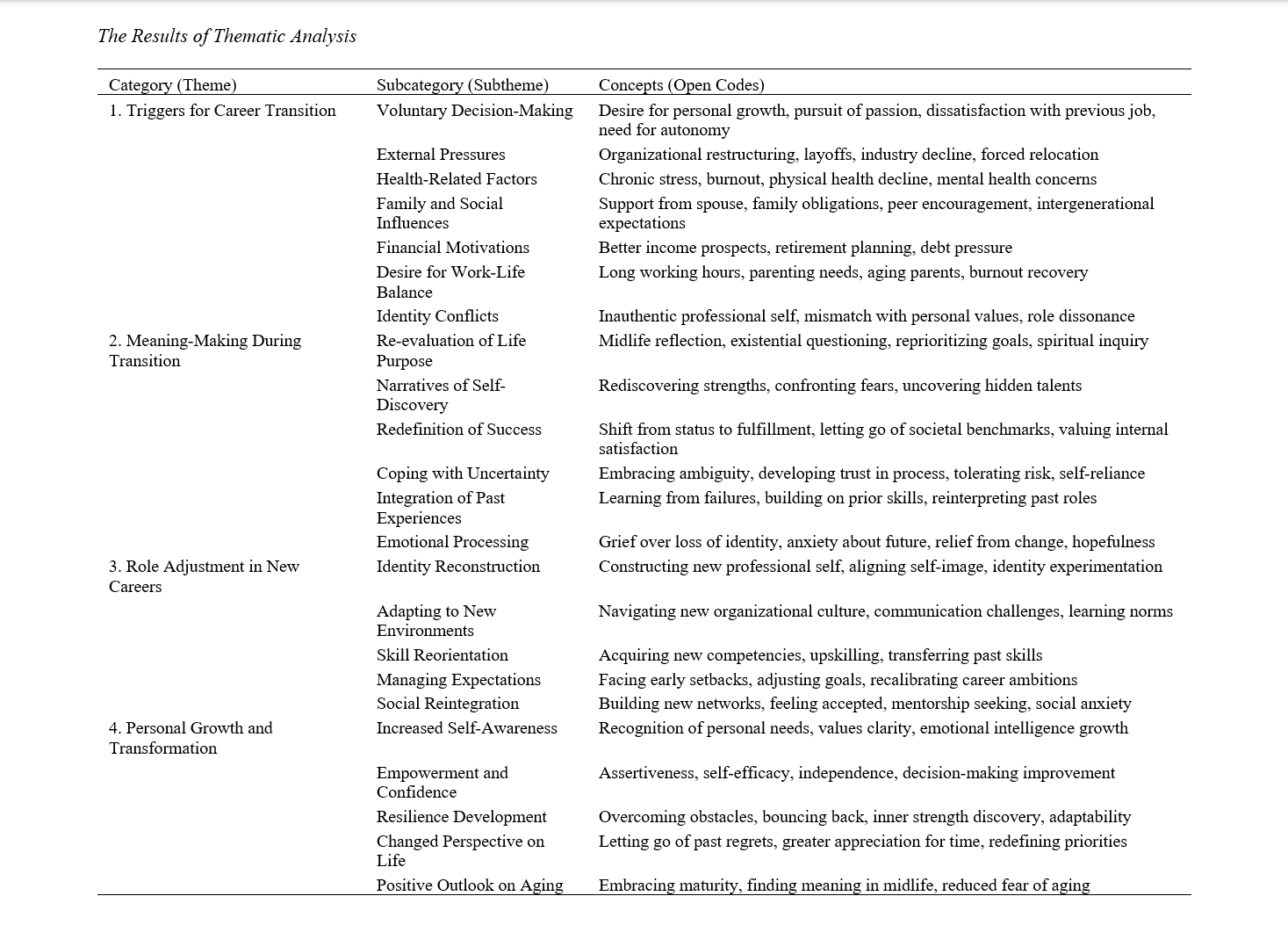
This study aimed to explore the lived experiences of individuals undergoing career transitions in midlife. The study employed a qualitative research design using semi-structured interviews with 27 participants aged 41 to 55 from various regions of India who had undergone significant career transitions within the past two years. Participants were recruited through purposive sampling, and data collection continued until theoretical saturation was reached. Interviews were conducted in English or Hindi, transcribed verbatim, and analyzed thematically using NVivo 12 software, following Braun and Clarke’s six-step approach. The research emphasized narrative richness and contextual understanding, and efforts were made to enhance credibility through member checking and reflexive journaling. Analysis revealed four main categories: Triggers for Career Transition, Meaning-Making During Transition, Role Adjustment in New Careers, and Personal Growth and Transformation. Participants reported diverse triggers including health challenges, organizational pressures, identity conflict, and a desire for work-life balance. Meaning-making processes involved re-evaluating life purpose, redefining success, and integrating past experiences. Role adjustment included identity reconstruction, acquiring new skills, and adapting to new work environments. Ultimately, participants described growth in self-awareness, resilience, and empowerment. These findings highlight that midlife career changes are deeply emotional, cognitively complex, and contextually influenced, often serving as transformative turning points. Midlife career transitions involve more than occupational change—they encompass shifts in identity, values, and life orientation. The study underscores the importance of recognizing the psychological and contextual dimensions of such transitions and calls for more responsive support systems, both organizational and societal, to facilitate healthy and purposeful change during this life stage.
Downloads
References
Bao, C., Yang, R., Pedersen, N. L., Xu, W., Xu, H., Song, R., Qi, X., & Xu, W. (2019). Overweight in Midlife and Risk of Cancer in Late Life: A Nationwide Swedish Twin Study. International journal of cancer, 144(9), 2128-2134. https://doi.org/10.1002/ijc.32005
Blodgett, J. M., Cooper, R., Davis, D., Kuh, D., & Hardy, R. (2021). Associations of Word Memory, Verbal Fluency, Processing Speed, and Crystallized Cognitive Ability With One-Legged Balance Performance in Mid- And Later Life. The Journals of Gerontology Series A, 77(4), 807-816. https://doi.org/10.1093/gerona/glab168
Cheng, G. J., Buchanich, J. M., Gary‐Webb, T. L., Mair, C., Shaaban, C. E., & Rosso, A. (2024). Midlife Neighborhood Socioeconomic Status and Cognitive Function in Late Life: Differences by Race. Innovation in Aging, 8(Supplement_1), 461-462. https://doi.org/10.1093/geroni/igae098.1501
Ganasarajah, S., Poromaa, I. S., Thu, W. P. P., Kramer, M. S., Logan, S., Cauley, J. A., & Yong, E. L. (2019). Objective Measures of Physical Performance Associated With Depression and/or Anxiety in Midlife Singaporean Women. Menopause the Journal of the North American Menopause Society, 26(9), 1045-1051. https://doi.org/10.1097/gme.0000000000001355
Hazzouri, A. Z. A., Vittinghoff, E., Hoang, T., Golden, S. H., Fitzpatrick, A. L., Zhang, A., & Yaffe, K. (2020). Association of Early Life BMI With Dementia Risk: Findings From a Pooled Cohort Analysis. Alzheimer S & Dementia, 16(S10). https://doi.org/10.1002/alz.037958
Henning, G., Kelle, N., & Infurna, F. J. (2022). Nine-Year Changes in Work Satisfaction in Midlife – The Role of Age and Flexible Goal Adjustment. https://doi.org/10.31234/osf.io/3zs5y
Horst, K., Cirino, N. H., & Adams, K. (2025). Menopause and Mental Health. Current Opinion in Obstetrics & Gynecology, 37(2), 102-110. https://doi.org/10.1097/gco.0000000000001014
John, A., Desai, R., Richards, M., Gaysina, D., & Stott, J. (2020). The Role of Cardiometabolic Risk in the Association Between Accumulation of Affective Symptoms Across Adulthood and Midlife Cognitive Function. Alzheimer S & Dementia, 16(S10). https://doi.org/10.1002/alz.047521
Jyväkorpi, S. K., Urtamo, A., Kivimäki, M., Salomaa, V., & Strandberg, T. (2020). Association of Midlife Body Composition With Old-Age Health-Related Quality of Life, Mortality, and Reaching 90 Years of Age: A 32-Year Follow-Up of a Male Cohort. American Journal of Clinical Nutrition, 112(5), 1287-1294. https://doi.org/10.1093/ajcn/nqaa230
Kang, S. J., Anda‐Duran, I. D., Alonso, C. F., Jin, X., Carmichael, O., & Bazzano, L. (2024). Higher Long-Term Fasting Glucose Variability From Childhood Is Associated With Poorer Cognitive Function in Midlife: The Bogalusa Heart Study. Circulation, 149(Suppl_1). https://doi.org/10.1161/circ.149.suppl_1.p270
Kang, S. J., Anda‐Duran, I. D., Moukaled, S., Fernandez, C., & Bazzano, L. (2023). Associations of Body Mass Index Variability From Childhood and Midlife Class II and Class III Obesity. Circulation, 147(Suppl_1). https://doi.org/10.1161/circ.147.suppl_1.p526
Kasani, S. H., Dolatshahi, M., Naghashzadeh, M., Commean, P. K., Rahmani, F., Liu, J., Lloyd, L., Nguyen, C., Hantler, N., McBee‐Kemper, A., Ly, M., Yu, G., Ippolito, J. E., Weeks, J. R., Ceriani, L., Sirlin, C. B., Morris, J. C., Benzinger, T. L., & Raji, C. A. (2024). Hepatic Fat Is Related to Neurodegeneration in Midlife Obesity. Alzheimer S & Dementia, 20(S2). https://doi.org/10.1002/alz.091562
Khoudary, S. R. E., Chen, X., Nasr, A., Shields, K. J., Barinas‐Mitchell, E., Janssen, İ., Everson‐Rose, S. A., Powell, L. H., & Matthews, K. A. (2019). Greater Periaortic Fat Volume at Midlife Is Associated With Slower Gait Speed Later in Life in Women: The SWAN Cardiovascular Fat Ancillary Study. The Journals of Gerontology Series A, 74(12), 1959-1964. https://doi.org/10.1093/gerona/glz095
Mehta, R. S., Lochhead, P., Wang, Y., Ma, W., Nguyen, L. H., Kochar, B., Huttenhower, C., Grodstein, F., & Chan, A. T. (2022). Association of Midlife Antibiotic Use With Subsequent Cognitive Function in Women. PLoS One, 17(3), e0264649. https://doi.org/10.1371/journal.pone.0264649
Mosconi, L., Williams, S., Carlton, C., Zarate, C., Boneu, C., Fauci, F., Ajila, T., Nerattini, M., Jett, S., Andy, C., Battista, M. T., Pahlajani, S., Osborne, J. R., Brinton, R. D., & Dyke, J. P. (2024). Sex-Specific Associations of Serum Cortisol With Brain Biomarkers of Alzheimer’s Risk. Scientific reports, 14(1). https://doi.org/10.1038/s41598-024-56071-9
Najar, J., Östling, S., Gudmundsson, P., Sundh, V., Johansson, L., Kern, S., Guo, X., Hällström, T., & Skoog, I. (2019). Cognitive and Physical Activity and Dementia. Neurology, 92(12). https://doi.org/10.1212/wnl.0000000000007021
Parker‐Allotey, N. A., Bennett, E., Lynch, K. M., Xu, X., Whitsel, E. A., Smith, R. L., Stewart, J. D., Qi, Y., Park, E. S., Wei, J., & Power, M. C. (2022). Association of Residential Road Proximity With Cognitive Decline and Dementia: The Atherosclerosis Risk in Communities (ARIC) Study. Alzheimer S & Dementia, 18(S11). https://doi.org/10.1002/alz.060869
Saint-Maurice, P. F., Sampson, J. N., Michels, K. A., Moore, S. C., Loftfield, E., McClain, K. M., Mb, C., Trabert, B., & Matthews, C. E. (2021). Physical Activity From Adolescence Through Midlife and Associations With Obesity and Endometrial Cancer Risk. Cancer Epidemiology Biomarkers & Prevention, 30(4), 807-807. https://doi.org/10.1158/1055-9965.epi-21-0216
Saint‐Maurice, P. F., Sampson, J. N., Michels, K. A., Moore, S. C., Loftfield, E., McClain, K. M., Cook, M. B., Trabert, B., & Matthews, C. E. (2021). Physical Activity From Adolescence Through Midlife and Associations With Body Mass Index and Endometrial Cancer Risk. JNCI cancer spectrum, 5(4). https://doi.org/10.1093/jncics/pkab065
Stewart, A., Barinas‐Mitchell, E., Matthews, K. A., Khoudary, S. R. E., Magnani, J. W., Jackson, E. A., & Brooks, M. M. (2019). Social Role–Related Stress and Social Role–Related Reward as Related to Subsequent Subclinical Cardiovascular Disease in a Longitudinal Study of Midlife Women: The Study of Women's Health Across the Nation. Psychosomatic Medicine, 81(9), 821-832. https://doi.org/10.1097/psy.0000000000000733
Stewart, A., Magnani, J. W., Barinas‐Mitchell, E., Matthews, K. A., Khoudary, S. R. E., Jackson, E. A., & Brooks, M. M. (2020). Social Role Stress, Reward, and the American Heart Association Life’s Simple 7 in Midlife Women: The Study of Women’s Health Across the Nation. Journal of the American Heart Association, 9(24). https://doi.org/10.1161/jaha.120.017489
Yang, R., Pedersen, N. L., Bao, C., Xu, W., Xu, H., Song, R., Qi, X., & Xu, W. (2019). Type 2 Diabetes in Midlife and Risk of Cerebrovascular Disease in Late Life: A Prospective Nested Case−control Study in a Nationwide Swedish Twin Cohort. Diabetologia, 62(8), 1403-1411. https://doi.org/10.1007/s00125-019-4892-3
Downloads
Additional Files
Publication Timeline
- Submitted
- Revised
- Accepted
Issue
Section
License

This work is licensed under a Creative Commons Attribution-NonCommercial 4.0 International License.