Impact of a Digital Health Coaching Program on Self-Efficacy and Medication Adherence in Diabetic Patients
DOI:
https://doi.org/10.61838/kman.hp.psynexus.3.16Keywords:
Digital health coaching, self-efficacy, medication adherence, type 2 diabetesAbstract
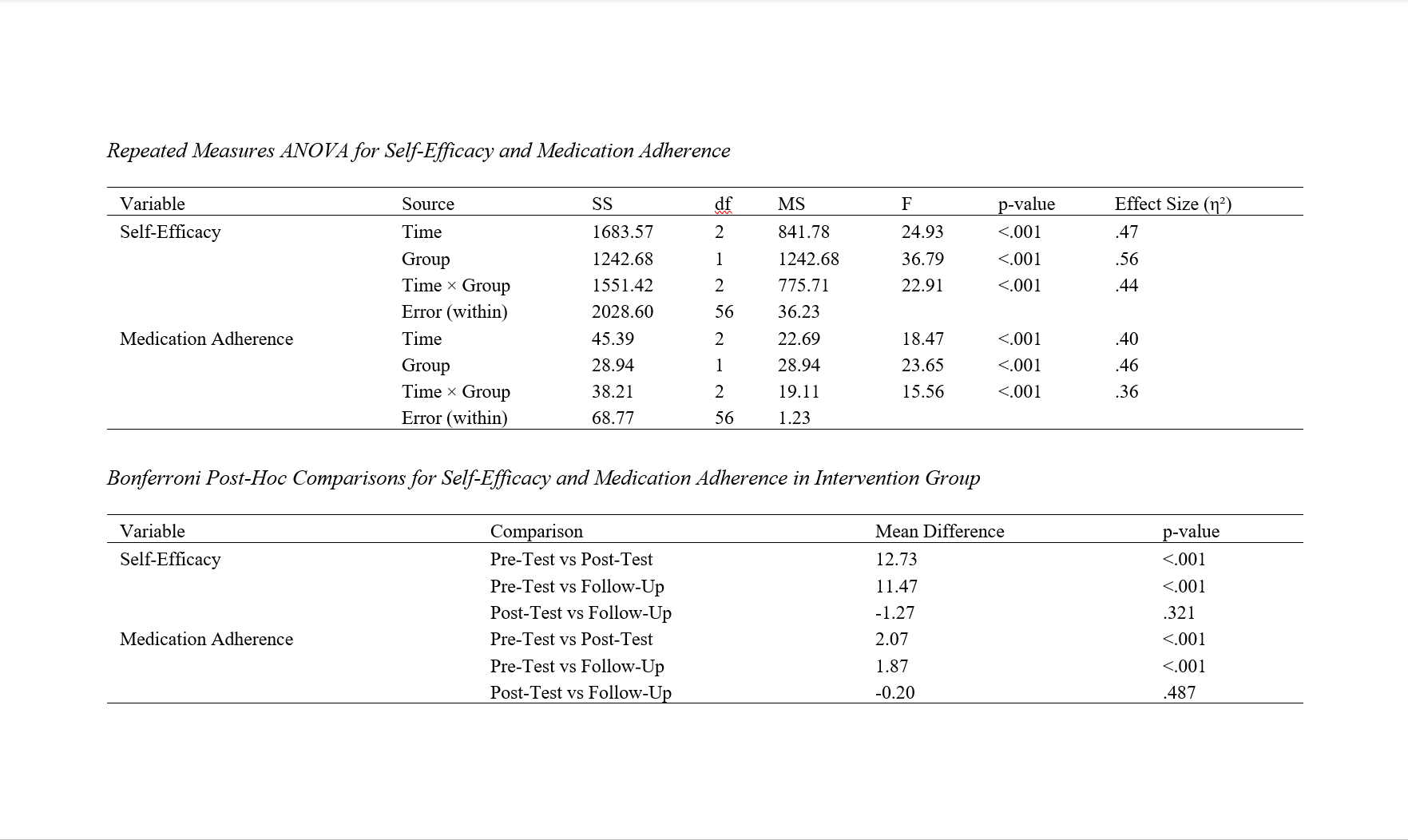
This study aimed to evaluate the effectiveness of a digital health coaching program in improving self-efficacy and medication adherence among patients with type 2 diabetes in Malaysia. A randomized controlled trial design was employed with 30 adult participants diagnosed with type 2 diabetes, recruited from healthcare centers in Malaysia. Participants were randomly assigned to an intervention group (n = 15), which received a 12-session digital health coaching program, or a control group (n = 15), which received standard care. The intervention was delivered over a period of 12 weeks, with a follow-up assessment conducted five months after baseline. Self-efficacy was measured using the Diabetes Management Self-Efficacy Scale (DMSES), and medication adherence was assessed using the Morisky Medication Adherence Scale (MMAS-8). Data were analyzed using repeated measures ANOVA and Bonferroni post-hoc tests through SPSS-27. Descriptive results showed that the intervention group experienced a marked improvement in self-efficacy from pre-test (M = 52.47, SD = 6.21) to post-test (M = 65.20, SD = 5.38), which was sustained at follow-up (M = 63.93, SD = 5.67). Similarly, medication adherence in the intervention group increased from pre-test (M = 5.27, SD = 1.01) to post-test (M = 7.33, SD = 0.87) and remained high at follow-up (M = 7.13, SD = 0.92). Repeated measures ANOVA indicated significant time × group interaction effects for both self-efficacy (F(2, 56) = 22.91, p < .001) and medication adherence (F(2, 56) = 15.56, p < .001). Bonferroni post-hoc comparisons confirmed significant improvements in the intervention group over time, with no significant changes observed in the control group. The findings suggest that a structured digital health coaching program is an effective and sustainable approach to enhance self-efficacy and medication adherence in patients with type 2 diabetes, offering a scalable solution for improving diabetes self-management in diverse healthcare settings.
Downloads
References
Ahn, Y. C., Kim, Y. S., Kim, B. K., Ryu, J. M., Kim, M. S., Kang, M., & Park, J. (2023). Effectiveness of Non-Contact Dietary Coaching in Adults With Diabetes or Prediabetes Using a Continuous Glucose Monitoring Device: A Randomized Controlled Trial. Healthcare, 11(2), 252. https://doi.org/10.3390/healthcare11020252
Almulhim, A. N., Alhowaish, A., Madani, A., AlQaddan, M., Altuwalah, A. S., & Goyder, E. (2024). Feasibility and Acceptability of a Tailored Health Coaching Intervention to Improve Type 2 Diabetes Self-Management in Saudi Arabia: A Mixed-Methods Randomised Feasibility Trial. BMJ open, 14(5), e078631. https://doi.org/10.1136/bmjopen-2023-078631
Almulhim, A. N., Goyder, E., & Caton, S. J. (2022). Assessing the Feasibility and Acceptability of Health Coaching as a New Diabetes Management Approach for the People With Type 2 Diabetes in Saudi Arabia: A Protocol for a Mixed Methods Feasibility Study. International journal of environmental research and public health, 19(22), 15089. https://doi.org/10.3390/ijerph192215089
Attipoe, A., Santi, A., Verrue, C., Delhaye, N., Willaert, M., Tomas, M., & Philippe, G. (2023). Therapeutic Impact of an Intervention Associating Pharmacist Counseling and the Use of a Mobile Health Application for Type 2 Diabetes Patients. International Journal of Integrated Care, 23(S1), 345. https://doi.org/10.5334/ijic.icic23463
Avalos, M. R. A., Patel, A., Duru, H., Shah, S., Rivera, M., Sorrentino, E., Dy, M., Sarkar, U., Nguyen, K., Lyles, C. R., & Aguilera, A. (2023). Implementation of a Technology-Enabled Diabetes Self-Management Peer Coaching Intervention for Patients With Poorly Controlled Diabetes: Quasi-Experimental Case Study (Preprint). https://doi.org/10.2196/preprints.54370
Avalos, M. R. A., Patel, A., Duru, H., Shah, S., Rivera, M. M., Sorrentino, E., Dy, M., Sarkar, U., Nguyen, K., Lyles, C. R., & Aguilera, A. (2024). Implementation of a Technology-Enabled Diabetes Self-Management Peer Coaching Intervention for Patients With Poorly Controlled Diabetes: Quasi-Experimental Case Study. Jmir Diabetes, 9, e54370. https://doi.org/10.2196/54370
Azelton, K. R., Crowley, A. P., Vence, N., Underwood, K., Morris, G., Kelly, J. H., & Landry, M. J. (2021). Digital Health Coaching for Type 2 Diabetes: Randomized Controlled Trial of Healthy at Home. Frontiers in Digital Health, 3. https://doi.org/10.3389/fdgth.2021.764735
Badpar, S., Bakhtiarpour, S., Heidari, A., & Moradimanesh, F. (2019). Causal Model of Self-care Based on Social Support and Health Literacy Through Self-efficacy in Managing Diabetes in Diabetic Patients [Research]. Journal of Diabetes Nursing, 7(2), 752-763. http://jdn.zbmu.ac.ir/article-1-349-en.html
Cedarbaum, J., Brown, B., Wilson, S., Mase, R., & Heisler, M. (2021). Characterizing Autonomy Supportiveness in Diabetes Peer Health Coaches. Michigan Journal of Medicine, 5(0). https://doi.org/10.3998/mjm.1432
Di, S., Petch, J., Gerstein, H. C., Zhu, R., & Sherifali, D. (2022). Optimizing Health Coaching for Patients With Type 2 Diabetes Using Machine Learning: Model Development and Validation Study. Jmir Formative Research, 6(9), e37838. https://doi.org/10.2196/37838
Gershkowitz, B. D., Hillert, C. J., & Crotty, B. H. (2020). Digital Coaching Strategies to Facilitate Behavioral Change in Type 2 Diabetes: A Systematic Review. The Journal of Clinical Endocrinology & Metabolism, 106(4), e1513-e1520. https://doi.org/10.1210/clinem/dgaa850
Huang, J., Ding, S., Xiong, S., & Liu, Z. (2021). Medication Adherence and Associated Factors in Patients With Type 2 Diabetes: A Structural Equation Model. Frontiers in Public Health, 9. https://doi.org/10.3389/fpubh.2021.730845
Idris, M. Y., Alema‐Mensah, E., Olorundare, E., Mohammad, M., Brown, M., Ofili, E., & Pemu, P. (2020). Exploring the Discursive Emphasis on Patients and Coaches Who Participated in Technology-Assisted Diabetes Self-Management Education: Clinical Implementation Study of Health360x (Preprint). https://doi.org/10.2196/preprints.23535
Jafarzadeh, N., Mirzahoseini, H., & Monirpour, N. (2022). The effectiveness of self-efficacy-based motivational interview on increasing medication adherence in women with type-2 diabetes. Applied Family Therapy Journal (AFTJ), 3(3), 508-519. https://doi.org/10.61838/kman.aftj.3.3.29
Kumar, G. V., Aghili, S. M., & Zaree, M. (2022). The Effectiveness of Mindfulness-Based Stress Reduction Training on Adherence to Medication and Proper Food Consumption in Patients with Diabetes Type 2. Iranian Journal of Health Psychology; Vol, 5(2). https://ijohp.journals.pnu.ac.ir/article_8890_e7b62c877f7c4215debc64caf91b34cd.pdf?lang=fa
Kusumaningrum, N. S. D., Asmara, F. Y., & Nurmalia, D. (2022). Healthcare Professionals’ Opinions Regarding Health Coaching for Patients With Diabetes: A Pilot Exploration in Indonesia. Belitung Nursing Journal, 8(1), 67-74. https://doi.org/10.33546/bnj.1970
Kwan, Y. H., Yoon, S., Tai, B. C., Tan, C. S., Phang, J. K., Tan, W. B., Tan, N. C., Tan, C. Y. L., Koot, D., Quah, Y. L., Teo, H. H., & Low, L. L. (2024). Empowering Patients With Comorbid Diabetes and Hypertension Through a Multi-Component Intervention of Mobile App, Health Coaching and Shared Decision-Making: Protocol for an Effectiveness-Implementation of Randomised Controlled Trial. PLoS One, 19(2), e0296338. https://doi.org/10.1371/journal.pone.0296338
Lara-Cinisomo, S., Loret de Mola, J. R., Flores-Carter, K., Tabb, K. M., & Roloff, K. (2022). Prenatal Depressive Symptoms, Self-Rated Health, and Diabetes Self-Efficacy: A Moderated Mediation Analysis. International journal of environmental research and public health, 19(20).
Lin, C. L., Huang, L. C., Chang, Y.-T., Chen, R. Y., & Yang, S. H. (2021). Effectiveness of Health Coaching in Diabetes Control and Lifestyle Improvement: A Randomized-Controlled Trial. Nutrients, 13(11), 3878. https://doi.org/10.3390/nu13113878
Malkani, S., Haas, R., Shah, V., McElnea, W., Piz, L., Barry, C., Sharma, H., Pugliese, G., & Lebel, S. (2024). 1048-P: A Financially Sustainable "Pharmacist Plus" Care Model Shows Superior Diabetes Outcomes. Diabetes, 73(Supplement_1). https://doi.org/10.2337/db24-1048-p
Martin, M., Patterson, J., Allison, M., O’Connor, B. B., & Patel, D. (2020). The Influence of Baseline Hemoglobin A1c on Digital Health Coaching Outcomes in Adults With Type 2 Diabetes: Real-World Retrospective Cohort Study (Preprint). https://doi.org/10.2196/preprints.24981
Morgan, S. P., Moreno, M., Abukhalaf, D., Yan, K., Dandamrongrak, C., Morgan, H., Menon, U., & Szalacha, L. A. (2024). Subjective Experiences of Spanish-Speaking Patients Residing in the United States With Low English Proficiency Learning to Manage Their Diabetes: A Qualitative Study. Journal of Transcultural Nursing, 35(5), 325-332. https://doi.org/10.1177/10436596241253865
Patil, S. J., Tallon, E. M., Wang, Y., Nayyar, M., Hodges, K. L., Phad, A., Rodriguez, E., & Gefter, L. (2022). Effect of Stanford Youth Diabetes Coaches' Program on Youth and Adults in Diverse Communities. Family & community health, 45(3), 178-186. https://doi.org/10.1097/fch.0000000000000323
Racey, M., Jovkovic, M., Alliston, P., Ali, M. U., & Sherifali, D. (2022). Diabetes Health Coach in Individuals With Type 2 Diabetes: A Systematic Review and Meta Analysis of Quadruple Aim Outcomes. Frontiers in Endocrinology, 13. https://doi.org/10.3389/fendo.2022.1069401
Sadri Damirchi, E., & Samadifard, H. (2019). Predicting of Life Expectancy in Diabetic Patients Based on Self-efficacy, Self-esteem and Perceived Social Support. The Horizon of Medical Sciences, 25(2), 85-92. https://doi.org/10.32598/hdq.4.2.85
Setyawati, A., Jafar, N., Yusuf, S., & Aminuddin, A. (2024). Enhancing Diabetes Management: Nurse-Led Coaching at PROLANIS Diabetes Club. Abdimas Jurnal Pengabdian Masyarakat Universitas Merdeka Malang, 9(2), 350-360. https://doi.org/10.26905/abdimas.v9i2.12433
Sharp, L. K., Biggers, A., Perez, R., Henkins, J., Tilton, J., & Gerber, B. S. (2021). A Pharmacist and Health Coach–Delivered Mobile Health Intervention for Type 2 Diabetes: Protocol for a Randomized Controlled Crossover Study. Jmir Research Protocols, 10(3), e17170. https://doi.org/10.2196/17170
Downloads
Additional Files
Publication Timeline
- Submitted
- Revised
- Accepted
Issue
Section
License

This work is licensed under a Creative Commons Attribution-NonCommercial 4.0 International License.