How Cognitive Avoidance and Perfectionism Predict Anxiety in Therapy-Seeking Adults
DOI:
https://doi.org/10.61838/kman.cp.psynexus.3.10Keywords:
Cognitive Avoidance, Perfectionism, Anxiety, Therapy-Seeking AdultsAbstract
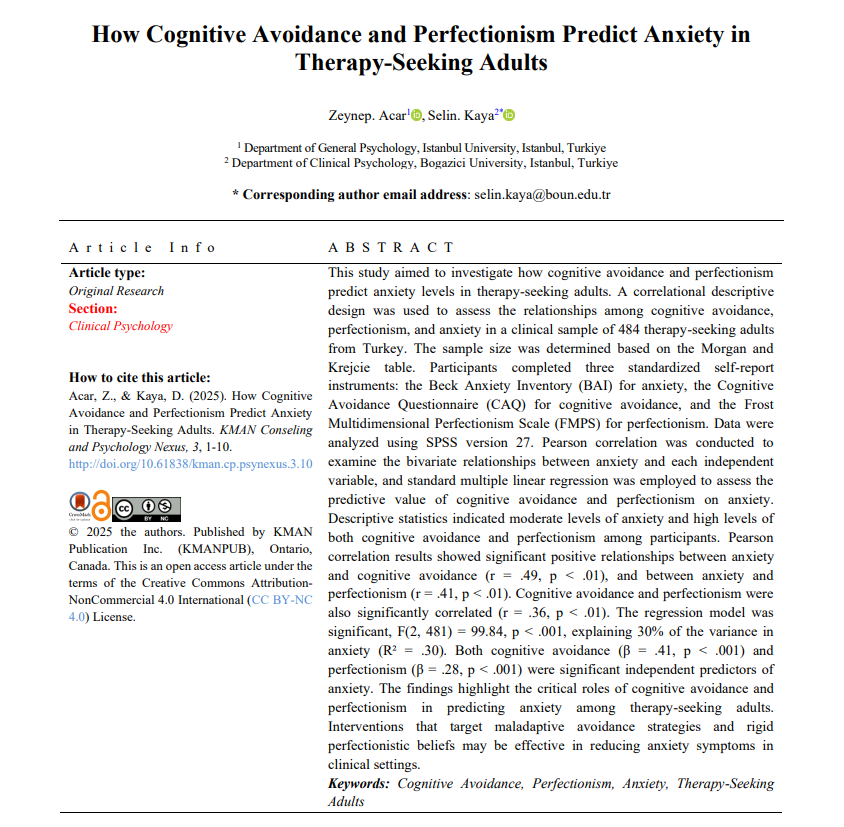
This study aimed to investigate how cognitive avoidance and perfectionism predict anxiety levels in therapy-seeking adults. A correlational descriptive design was used to assess the relationships among cognitive avoidance, perfectionism, and anxiety in a clinical sample of 484 therapy-seeking adults from Turkey. The sample size was determined based on the Morgan and Krejcie table. Participants completed three standardized self-report instruments: the Beck Anxiety Inventory (BAI) for anxiety, the Cognitive Avoidance Questionnaire (CAQ) for cognitive avoidance, and the Frost Multidimensional Perfectionism Scale (FMPS) for perfectionism. Data were analyzed using SPSS version 27. Pearson correlation was conducted to examine the bivariate relationships between anxiety and each independent variable, and standard multiple linear regression was employed to assess the predictive value of cognitive avoidance and perfectionism on anxiety. Descriptive statistics indicated moderate levels of anxiety and high levels of both cognitive avoidance and perfectionism among participants. Pearson correlation results showed significant positive relationships between anxiety and cognitive avoidance (r = .49, p < .01), and between anxiety and perfectionism (r = .41, p < .01). Cognitive avoidance and perfectionism were also significantly correlated (r = .36, p < .01). The regression model was significant, F(2, 481) = 99.84, p < .001, explaining 30% of the variance in anxiety (R² = .30). Both cognitive avoidance (β = .41, p < .001) and perfectionism (β = .28, p < .001) were significant independent predictors of anxiety. The findings highlight the critical roles of cognitive avoidance and perfectionism in predicting anxiety among therapy-seeking adults. Interventions that target maladaptive avoidance strategies and rigid perfectionistic beliefs may be effective in reducing anxiety symptoms in clinical settings.
Downloads
References
Broman‐Fulks, J. J., Bergquist, J. J., Hall, C. A., Thomas, K., & Kelso, K. C. (2023). Incremental Validity of Cognitive-Behavioral Therapy and Acceptance and Commitment Therapy Mechanisms for Anxiety and Panic Symptomology. Journal of Cognitive Psychotherapy, 37(1), 43-62. https://doi.org/10.1891/jcpsy-d-20-00056
Chursina, A. (2023). The Impact of Romantic Attachment Styles on Jealousy in Young Adults. Psychology in Russia State of Art, 16(3), 222-232. https://doi.org/10.11621/pir.2023.0315
Cookson, C., Luzón, O., Newland, J., & Kingston, J. (2019). Examining the Role of Cognitive Fusion and Experiential Avoidance in Predicting Anxiety and Depression. Psychology and Psychotherapy Theory Research and Practice, 93(3), 456-473. https://doi.org/10.1111/papt.12233
Elvis, H. J. J. (2018). Selective Antecedents of Competitive State Anxiety Dimensions During High Stakes in Elite Competition. American Journal of Sports Science, 6(3), 88. https://doi.org/10.11648/j.ajss.20180603.14
Farris, S. G., Thomas, J. G., Abrantes, A. M., Lipton, R. B., Burr, E. K., Godley, F. A., Roth, J., Pavlović, J., & Bond, D. S. (2019). Anxiety Sensitivity and Intentional Avoidance of Physical Activity in Women With Probable Migraine. Cephalalgia, 39(11), 1465-1469. https://doi.org/10.1177/0333102419861712
Graham, B. M., Weiner, S. N., & Li, S. H. (2020). Gender Differences in Avoidance and Repetitive Negative Thinking Following Symptom Provocation in Men and Women With Spider Phobia. British Journal of Clinical Psychology, 59(4), 565-577. https://doi.org/10.1111/bjc.12267
Hobbs, S. D., Bederian‐Gardner, D., Ogle, C. M., Goodman, G. S., Hastings, P. D., Cordòn, I. M., Bakanosky, S., Lawler, M. J., Chae, Y., & Narr, R. (2019). Psychological Security in at-Risk Youth: Attachment, Emotion Regulation, and PTSD Symptom Severity. International Journal on Child Maltreatment Research Policy and Practice, 2(1-2), 17-36. https://doi.org/10.1007/s42448-019-00015-8
Hope, D. A., Heimberg, R. G., & Turk, C. L. (2019). Starting Our Journey Together From the Same Place. 21-48. https://doi.org/10.1093/med-psych/9780190247638.003.0002
Ibili, G. (2025). Maladaptive Perfectionism Can Explain the Inverse Relationship Between Dispositional Mindfulness and Procrastination. PLoS One, 20(2), e0318845. https://doi.org/10.1371/journal.pone.0318845
Jain, T., Shukla, R., & Panwar, N. (2024). Decoding Cognitive Control and Cognitive Flexibility as Concomitants for Experiential Avoidance in Social Anxiety. Psychological Reports. https://doi.org/10.1177/00332941241268625
Johnson, S. U., & Hoffart, A. (2019). Moderators and Predictors of Outcome in Metacognitive and Cognitive Behavioural Therapy for Co‐morbid Anxiety Disorders. Clinical Psychology & Psychotherapy, 26(4), 399-408. https://doi.org/10.1002/cpp.2361
Jung, S., Sindermann, C., Yang, H., Elhai, J. D., & Montag, C. (2022). Anxiety-Related Coping Styles and Individual Differences in Primary Emotional Systems Against the Background of Affective Neuroscience Theory: A Study Using Samples From Germany and China. Trends in Psychology, 31(4), 740-756. https://doi.org/10.1007/s43076-022-00161-y
Khosravi, R., Mohammadi, E., Esmaeili, N., & Zandi, H. (2023). Perfectionism and Writing Anxiety as Predictors of Iranian EFL Learners’ Performance in IELTS Writing Module: A Multi-Dimensional Perspective. Frontiers in Education, 8. https://doi.org/10.3389/feduc.2023.1108542
Killough, C., Runyan, J. W., Bishop, B., Sedillo, D., Benally, R., & Brakey, H. R. (2025). Integrating Culture Into Care: Leveraging Community Engagement to Address Anxiety in a Rural Community. Health Promotion Practice. https://doi.org/10.1177/15248399241311284
Lou, W., Zhang, Y., & Zhuang, M. (2024). The Influence of Perfectionism on Subjective Well-Being of College Students: The Mediating Effect and Intervention of Self-Compassion. International Journal of Advanced Research, 12(12), 347-361. https://doi.org/10.21474/ijar01/20031
Mendes, R., Martins, S., & Fernandes, L. (2019). Adherence to Medication, Physical Activity and Diet in Older Adults With Diabetes: Its Association With Cognition, Anxiety and Depression. Journal of Clinical Medicine Research, 11(8), 583-592. https://doi.org/10.14740/jocmr3894
Poncy, G. (2017). Maladaptive Humor Styles as Mediators of the Relationship Between Attachment Insecurity and Emotion Regulation. Humor - International Journal of Humor Research, 30(2), 147-168. https://doi.org/10.1515/humor-2016-0096
Pradhan, L., Adhikari, P., Shah, K. R., Bhusal, S., Oli, K., Khanal, P., & Singh, A. K. (2025). Social Media Addiction and Its Association With Sleep Quality and Anxiety: A School-Based Cross-Sectional Study From Nepal. https://doi.org/10.21203/rs.3.rs-5783624/v1
Rajapakse, R. (2024). The Multifaceted Nature of Perfectionism: Causes, Impacts, and Interventions. https://doi.org/10.31219/osf.io/ezs28
Scotta, A. V., Cortez, M. V., & Miranda, A. R. (2022). Insomnia is associated with worry, cognitive avoidance and low academic engagement in Argentinian university students during the COVID-19 social isolation. Psychology, Health & Medicine, 27(1), 199-214. https://doi.org/10.1080/13548506.2020.1869796
Shi, C., Du, X., Chen, W., & Ren, Z. (2024). Predictive Roles of Cognitive Biases in Health Anxiety: A Machine Learning Approach. Stress and Health, 40(5). https://doi.org/10.1002/smi.3463
Sohn, J. N. (2022). Predictors of Anxiety and Depression in Korean Adults During COVID-19 Pandemic. The Journal of Korean Academic Society of Nursing Education, 28(3), 328-339. https://doi.org/10.5977/jkasne.2022.28.3.328
Soltani, E., Hosseini, Z. S., & Naghizadeh, P. (2018). Relationship Between Experiential Avoidance and Cognitive Fusion to Social Interaction Anxiety in Students. Shiraz E-Medical Journal, 19(6). https://doi.org/10.5812/semj.62496
Stein, J. B., Fiori, K. L., & Murphy, B. (2022). Exploring the Direct and Indirect Effects That Network-Based Measures Share With Measures and Outcomes of Attachment Theory. 78, 11-37. https://doi.org/10.5840/pcaa2022783
Sunggingwati, D. (2018). Writing Anxiety and Its Causes of Pre-Service Teachers in an EFL Context: Preliminary Study. https://doi.org/10.2991/icedutech-17.2018.7
Tahoon, R. (2023). Differences in Cognitive Avoidance, Anger Rumination, and the General Anxiety in Light of the Gender and Emotional Regulation Disturbance Among Undergraduate Students. Sage Open, 13(4). https://doi.org/10.1177/21582440231187281
Wang, L., Zhang, S., & Naeem, S. B. (2024). Modeling the Predictors of Health Information Avoidance Behavior: Implications From the Stimulus Organism Response (S-O-R) Theory. Journal of Librarianship and Information Science. https://doi.org/10.1177/09610006241290265
Wang, W. (2025). The Mediating Role of Behavioral Systems in Linking Physical Activity and Anxiety Symptoms in College Students. Scientific reports, 15(1). https://doi.org/10.1038/s41598-025-91294-4
White, R., Livingston, L. A., Taylor, E., Close, S. A. D., Shah, P., & Callan, M. J. (2022). Understanding the Contributions of Trait Autism and Anxiety to Extreme Demand Avoidance in the Adult General Population. Journal of Autism and Developmental Disorders, 53(7), 2680-2688. https://doi.org/10.1007/s10803-022-05469-3
Кудинов, С. И., Burtsev, A. O., Kudinov, S. S., Maryin, M. I., & Khanalieva, D. (2022). Subjective Predictors of Cadets’ Behavior Patterns in Situation of Cognitive Dissonance. Psychology and Law, 12(2), 161-177. https://doi.org/10.17759/psylaw.2022120212
Downloads
Additional Files
Publication Timeline
- Submitted
- Revised
- Accepted
License

This work is licensed under a Creative Commons Attribution-NonCommercial 4.0 International License.