Effectiveness of Trauma-Informed Art Therapy on Dissociation and Self-Esteem
DOI:
https://doi.org/10.61838/kman.cp.psynexus.3.9Keywords:
Trauma-informed art therapy, dissociation, self-esteem, randomized controlled trial, expressive arts therapyAbstract
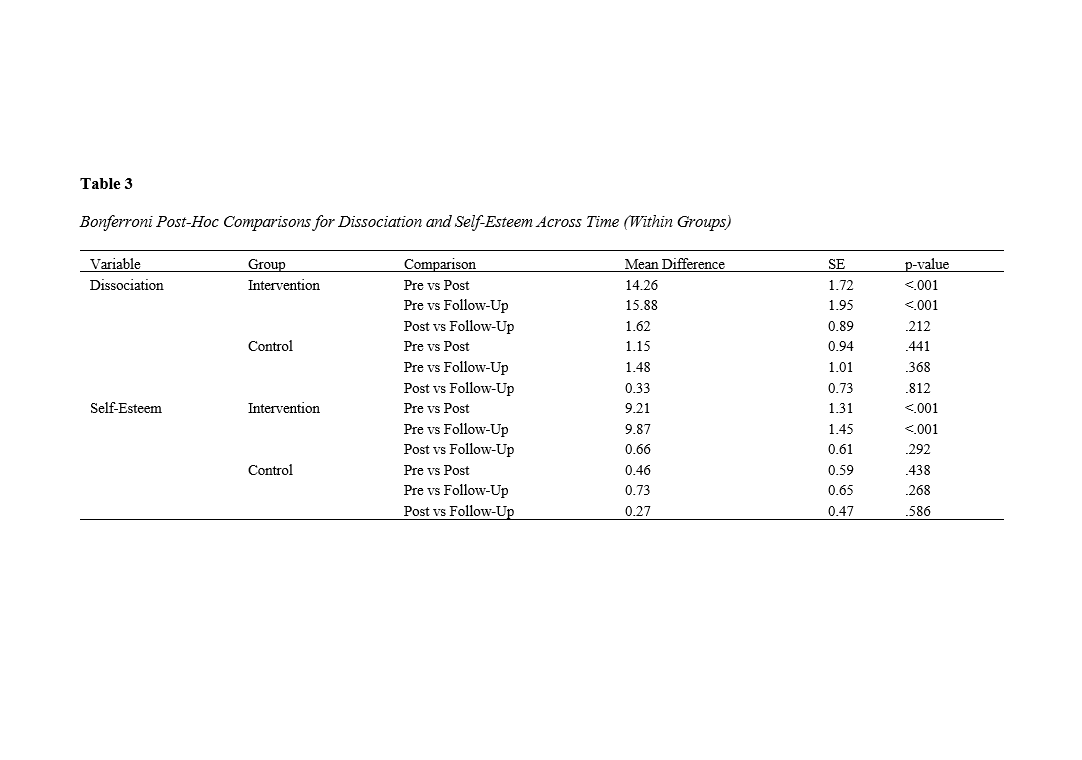
This study aimed to evaluate the effectiveness of trauma-informed art therapy in reducing dissociative symptoms and enhancing self-esteem in individuals with trauma histories. A randomized controlled trial was conducted with 30 participants from Indonesia who had experienced psychological trauma. Participants were randomly assigned to either an intervention group (n = 15), which received eight weekly sessions of trauma-informed art therapy, or a control group (n = 15), which received no intervention. Each session lasted 75 to 90 minutes and was designed to promote emotional safety, self-expression, and identity integration through structured art-making activities. Assessments were conducted at three time points: pre-intervention, post-intervention, and five-month follow-up. Dissociation was measured using the Dissociative Experiences Scale (DES), and self-esteem was assessed using the Rosenberg Self-Esteem Scale (RSES). Data were analyzed using repeated measures ANOVA and Bonferroni post-hoc tests in SPSS-27. Results indicated significant time-by-group interaction effects for both dissociation (F(2,56) = 28.47, p < .001, η² = .52) and self-esteem (F(2,56) = 36.09, p < .001, η² = .55). Participants in the intervention group demonstrated a substantial reduction in dissociative symptoms from pre-test (M = 52.67, SD = 6.45) to post-test (M = 38.41, SD = 5.88) and follow-up (M = 36.79, SD = 6.12). Similarly, self-esteem significantly increased from pre-test (M = 19.26, SD = 3.78) to post-test (M = 28.47, SD = 4.10) and follow-up (M = 29.13, SD = 3.95). No significant changes were observed in the control group across time points. Trauma-informed art therapy is an effective intervention for reducing dissociative symptoms and improving self-esteem among individuals with trauma histories. The intervention’s effects were maintained at five-month follow-up, indicating its potential as a sustainable therapeutic approach.
Downloads
References
Aydn, H. (2024). Influence of Art Therapy on Emotional Expression in Trauma Survivors in Turkey. International journal of psychology, 9(4), 1-14. https://doi.org/10.47604/ijp.2870
Baggerly, J., & Thomas, D. A. (2021). Trauma-Informed Play Therapy Supervision. 210-234. https://doi.org/10.4018/978-1-7998-4628-4.ch013
Hart, O. v. d., Groenendijk, M., González, A., Mosquera, D., & Solomon, R. M. (2013). Dissociation of the Personality and EMDR Therapy in Complex Trauma-Related Disorders: Applications in the Stabilization Phase. Journal of EMDR Practice and Research, 7(2), 81-94. https://doi.org/10.1891/1933-3196.7.2.81
Heijman, J., Wouters, H., Schouten, K. A., & Haeyen, S. (2024). Effectiveness of Trauma-Focused Art Therapy (TFAT) for Psychological Trauma: Study Protocol of a Multiple-Baseline Single-Case Experimental Design. BMJ open, 14(1), e081917. https://doi.org/10.1136/bmjopen-2023-081917
Hereld, D. C., & Yoshizawa, M. (2023). Use of Music Videos in the Treatment of Complex Trauma. Music and Medicine, 15(1). https://doi.org/10.47513/mmd.v15i1.856
J, K. S. (2024). Art as a Form of Communication for Trauma Survivors. Rijre, 4(2), 6-11. https://doi.org/10.59298/rijre/2024/42611
Kim, N., & Lim, N.-Y. (2023). A Consensual Qualitative Research on Art Therapists’ Experiences of Art Therapy Process With Child and Adolescent Clients Who Have Experienced Complex Trauma. Korean Association for Qualitative Inquiry, 9(1), 211-233. https://doi.org/10.30940/jqi.2023.9.1.211
King, J. L. (2021). Art Therapy, Trauma, and Neuroscience. https://doi.org/10.4324/9781003196242
King, J. L., & Strang, C. E. (2024). Art Therapy and the Neuroscience of Trauma. https://doi.org/10.4324/9781003348207
Lemche, E., Surguladze, S., Brammer, M., Phillips, M. L., Sierra, M., David, A. S., Williams, S., & Giampietro, V. (2013). Dissociable Brain Correlates for Depression, Anxiety, Dissociation, and Somatization in Depersonalization-Derealization Disorder. CNS Spectrums, 21(1), 35-42. https://doi.org/10.1017/s1092852913000588
M, N. A. (2024). The Future of Art Therapy in Mental Health Treatment. Rojphm, 4(1), 68-71. https://doi.org/10.59298/rojphm/2024/416871
Maddox, G. A., Bodner, G. E., Christian, M. W., & Williamson, P. (2024). On the Effectiveness of Visual Arts Therapy for Traumatic Experiences: A Systematic Review and Meta‐Analysis. Clinical Psychology & Psychotherapy, 31(4). https://doi.org/10.1002/cpp.3041
Mazzeo, G., & Bendixen, R. (2022). Community-Based Interventions for Childhood Trauma: A Scoping Review. Otjr Occupational Therapy Journal of Research, 43(1), 14-23. https://doi.org/10.1177/15394492221091718
Nielsen, F., Feijo, I., Renshall, K., & Starling, J. (2021). Family Art Therapy: A Contribution to Mental Health Treatment in an Adolescent Inpatient Setting. Australian and New Zealand Journal of Family Therapy, 42(2), 145-159. https://doi.org/10.1002/anzf.1449
Phuttharo, P. (2025). Solution-Focused Therapy Program on Self-Esteem and Depression in Thai Older Adults With Major Depressive Disorder: A Quasi-Experimental Study. Prijnr, 29(2), 326-342. https://doi.org/10.60099/prijnr.2025.272331
Quinn, P. O. (2025). Art Therapy’s Engagement of Brain Networks for Enduring Recovery From Addiction. Frontiers in Psychiatry, 15. https://doi.org/10.3389/fpsyt.2024.1458063
Salmi, R. (2021). Art Therapy for People With Mental Illness: Overview of the Evidence From Empirical Research on the Effectiveness of the Treatment. International Journal of Art and Design, 5(1), 34-47. https://doi.org/10.24191/ijad.v5i1.2603
Sigal, N., & Rob. (2021). Dual Perspectives on Art Therapy and EMDR for the Treatment of Complex Childhood Trauma. International Journal of Art Therapy, 26(1-2), 37-46. https://doi.org/10.1080/17454832.2021.1906288
Sikkema, K. J., Rabie, S., King, A., Watt, M. H., Mulawa, M. I., Andersen, L. S., Wilson, P. A., Marais, A., Ndwandwa, E.-S., Majokweni, S., Orrell, C., & Joska, J. A. (2022). ImpACT+, a Coping Intervention to Improve Clinical Outcomes for Women Living With HIV and Sexual Trauma in South Africa: Study Protocol for a Randomized Controlled Trial. Trials, 23(1). https://doi.org/10.1186/s13063-022-06655-5
Subagyo, W., & Wahyuningsih, D. (2024). The Effect of Horticultural Therapy on Increased Self-Esteem for Mental Disorders in the Community. Iium Medical Journal Malaysia, 23(01). https://doi.org/10.31436/imjm.v23i01.2337
Sunderland, N., Stevens, F., Knudsen, K., Cooper, R., & Wobcke, M. (2022). Trauma Aware and Anti-Oppressive Arts-Health and Community Arts Practice: Guiding Principles for Facilitating Healing, Health and Wellbeing. Trauma Violence & Abuse, 24(4), 2429-2447. https://doi.org/10.1177/15248380221097442
Syam, R., Jamil, N. A. Q., Tahir, F. S. H., & Febriani, P. (2023). The Effectiveness of Art Therapy as a Therapeutic Method in Reducing Children's Mental Trauma in Broken Home Adolescents. Journal of Correctional Issues, 6(2), 479-486. https://doi.org/10.52472/jci.v6i2.393
Villetto, D. A., & Villetto, K. (2023). The History of Trauma Treatment Intervention and the Movement Into Creative Arts Therapy. 162-183. https://doi.org/10.4018/978-1-6684-7856-1.ch008
Woollett, N., & Berman, H. (2024). Training Art Therapists for Social Justice UJ Conference Overview Opening Address. Sajat, 2(1), 14-20. https://doi.org/10.36615/amp3hr57
Wymer, B., Ohrt, J. H., Morey, D. A. J., & Swisher, S. (2020). Integrating Expressive Arts Techniques Into Trauma-Focused Treatment With Children. Journal of Mental Health Counseling, 42(2), 124-139. https://doi.org/10.17744/mehc.42.2.03
Downloads
Additional Files
Publication Timeline
- Submitted
- Revised
- Accepted
License

This work is licensed under a Creative Commons Attribution-NonCommercial 4.0 International License.