Comparison of the Effectiveness of Transactional Analysis Therapy and Acceptance and Commitment Therapy on Sexual Function, Body Image, and Self-Silencing in Overweight Infertile Women
DOI:
https://doi.org/10.61838/kman.cp.psynexus.3.21Keywords:
Transactional Analysis Therapy, Acceptance and Commitment Therapy, Sexual Function, Body Image, Self-Silencing, Infertility, Overweight WomenAbstract
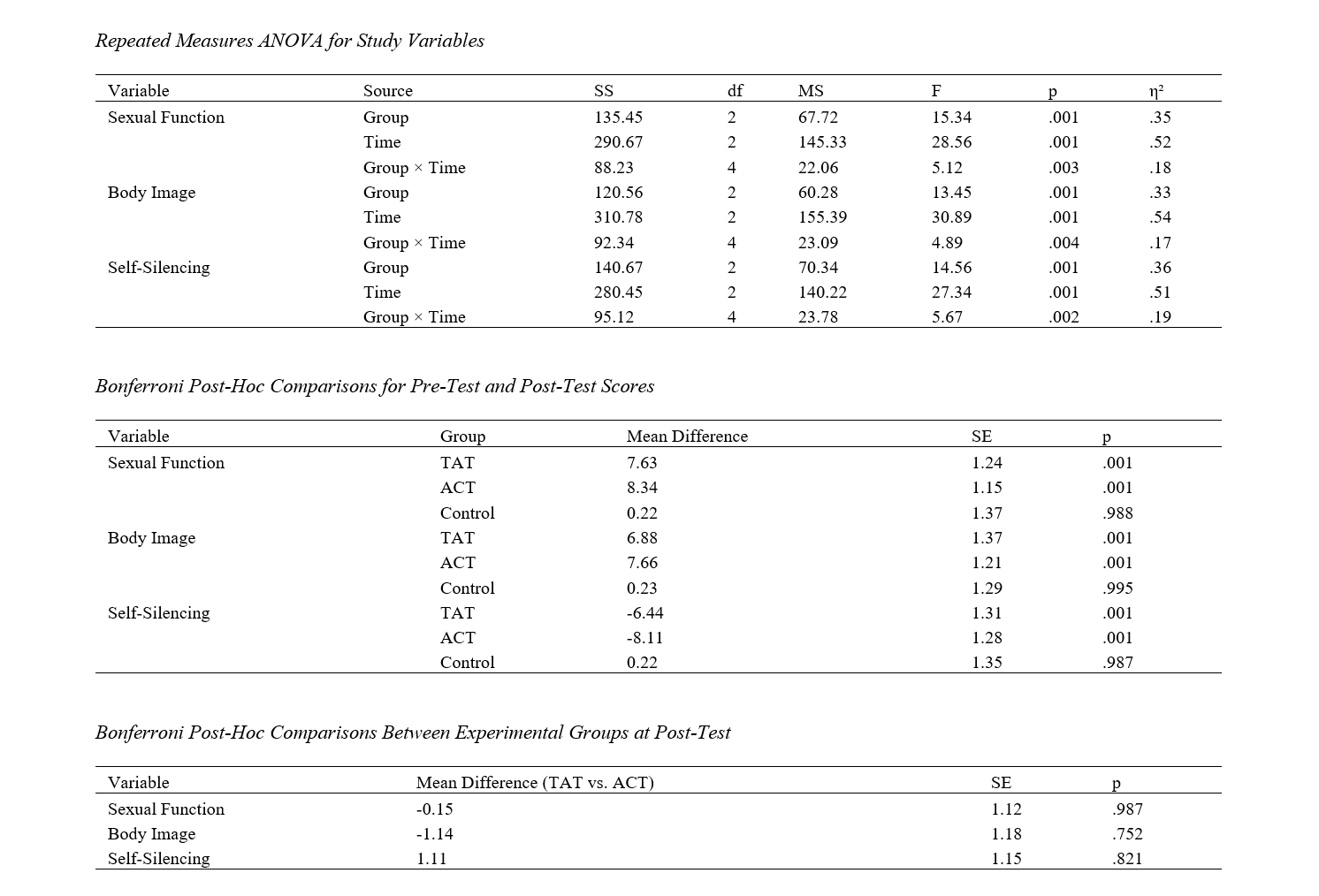
This study aimed to compare the effectiveness of Transactional Analysis Therapy (TAT) and Acceptance and Commitment Therapy (ACT) in improving sexual function, body image, and self-silencing in overweight infertile women. A randomized controlled trial (RCT) was conducted with 45 overweight infertile women recruited from fertility clinics in Tehran. Participants were randomly assigned to three groups: TAT (n = 15), ACT (n = 15), and a control group (n = 15). Both experimental groups underwent 12 weekly therapy sessions, while the control group received no psychological intervention. The Female Sexual Function Index (FSFI), Multidimensional Body-Self Relations Questionnaire-Appearance Scales (MBSRQ-AS), and Silencing the Self Scale (STSS) were administered at pre-test, post-test, and three-month follow-up. Data were analyzed using repeated measures ANOVA and Bonferroni post-hoc tests in SPSS-27. Both TAT and ACT significantly improved sexual function and body image while reducing self-silencing from pre-test to post-test (p < .001), with improvements largely maintained at follow-up. The ANOVA results confirmed significant time and group effects for all variables, and post-hoc comparisons showed that both interventions were superior to the control group. However, no significant differences were found between TAT and ACT in terms of their effectiveness (p > .05). These findings suggest that both therapies offer comparable psychological benefits for overweight infertile women. The results indicate that both TAT and ACT are effective interventions for addressing sexual dysfunction, body image dissatisfaction, and self-silencing in overweight infertile women. Given their comparable effectiveness, therapy selection should be tailored to individual preferences and treatment goals.
Downloads
References
Aghili, M., & Kashiri, S. (2022). The Effectiveness of Acceptance and Commitment-Based Therapy on Uncertainty Intolerance, Turmoil Tolerance, and Sexual Function in Betrayed Women [Research --- Open Access, CC-BY-NC]. The Neuroscience Journal of Shefaye Khatam, 10(3), 57-67. https://doi.org/10.52547/shefa.10.3.57
Aghjane, F., Dortaj, F., Delavar, A., Navaby nzhad, S., & Mardane rad, M. (2021). Development and Effectiveness Evaluation of a Group Treatment Package based on Transactional Analysis and Acceptance and Commitment Therapy on Aspects of Self-compassion in Girls with Emotional Breakdown Experience. Journal of Clinical Psychology, 13(3), 1-18. https://doi.org/10.22075/jcp.2021.20145.1859
Ahmadi, A. (2024). Predictors of Impulsiveness: The Roles of Sleep Quality and Body Image Dissatisfaction in Physically Disabled Adolescent Girls. Psychological Research in Individuals with Exceptional Needs, 2(2), 28-35. https://journals.kmanpub.com/index.php/prien/article/view/3343
Alikhah, S., Akbari, B., & Abolghasemi, A. (2023). The effectiveness of acceptance and commitment approach on quality of life and body image in patients with skin disorders by modulating emotional reactivity. Journal of Adolescent and Youth Psychological Studies (JAYPS), 4(7), 88-97. https://doi.org/10.61838/kman.jayps.4.7.10
Amiri, M., Khosh Akhlagh, H., Sajadian, P. S., & Rezaie Jamalouei, H. (2023). The effectiveness of treatment based on acceptance and commitment on sexual performance and emotional safety in men with cardiovascular disease. Applied Family Therapy Journal (AFTJ), 4(4), 520-535. https://doi.org/10.61838/kman.aftj.4.4.29
Arıkan, F., Kartöz, F., Karakuş, Z., Altınışık, M., Özer, Z., & Korcum Şahin, A. F. (2024). Body image and social appearance anxiety in patients with cancer undergoing radiotherapy: Across-sectional study. BMC Psychol, 12(1), 363. https://doi.org/10.1186/s40359-024-01856-w
Daneshnia, F., Taghavi, D., & Heidari, D. (2021). The Effectiveness of Acceptance and Commitment Therapy on Pain Catastrophizing and Body Image Concerns in Women with Breast Cancer. Analytical-Cognitive Psychology Quarterly, 11(43), 1-12. https://sanad.iau.ir/journal/psy/Article/679422?jid=679422
Dehghani, A., Dashtestan Nejad, A., Botshekan, Z., & Akhavan, S. (2020). The impact of acceptance-commitment and rumination on women's sexual function through distress tolerance. Journal of the School of Public Health and Institute of Public Health Research, 18(1), 61-72. https://sjsph.tums.ac.ir/browse.php?a_id=5862&sid=1&slc_lang=en
Ebrahimi, F., Barghi irani, Z., & Ali Akbari, M. (2023). Comparison of Cognitive-Behavioral Therapy and Acceptance and Commitment Therapy in Reducing Mood Swings, Sleep Quality and Sexual Performance in Postmenopausal Women. Health Psychology, 11(44), 73-88. https://doi.org/10.30473/hpj.2023.59513.5289
Fang, S., Ding, D., Ji, P., Huang, M., & Hu, K. (2022). Cognitive Defusion and Psychological Flexibility Predict Negative Body Image in the Chinese College Students: Evidence from Acceptance and Commitment Therapy. International journal of environmental research and public health, 19, 16519. https://doi.org/10.3390/ijerph192416519
Farahzadi, M., Maddahi, M. E., & Khalatbari, J. (2018). Comparison the Effectiveness of Group Therapy based on Acceptance and Commitment and Cognitive-Behavioral Group Therapy on the Body Image Dissatisfaction and Interpersonal Sensitivity in Women with the Body Image Dissatisfaction. Research in Clinical Psychology and Counseling, 7(2), 69-89. https://doi.org/10.22067/ijap.v7i2.65791
Fogelkvist, M., Gustafsson, S. A., Kjellin, L., & Parling, T. (2020). Acceptance and commitment therapy to reduce eating disorder symptoms and body image problems in patients with residual eating disorder symptoms: A randomized controlled trial. Body Image, 32, 155-166. https://doi.org/10.1016/j.bodyim.2020.01.002
Griffiths, C., Williamson, H., Zucchelli, F., Paraskeva, N., & Moss, T. (2018). A Systematic Review of the Effectiveness of Acceptance and Commitment Therapy (ACT) for Body Image Dissatisfaction and Weight Self-Stigma in Adults. Journal of Contemporary Psychotherapy. https://doi.org/10.1007/s10879-018-9384-0
Haghighi Cheli, A., Mohtashami, J., Zadehmodares, S., & Arabborzu, Z. (2019). The effect of transactional analysis group behavioral therapy on infertile women's marital satisfaction. Crescent Journal of Medical and Biological Sciences, 6, 375-380. http://cjmb.org/uploads/pdf/pdf_CJMB_320.pdf
Hasanzadeh, M., Akbari, B., & Abolghasemi, A. (2019). Efficiency of Acceptance and Commitment Therapy on Psychological Well-being and Sexual Function in Women with Infertility History [Original Research]. Avicenna Journal of Nursing and Midwifery Care, 27(4), 250-259. https://doi.org/10.30699/ajnmc.27.4.250
Hassannejad Emamchay, M., & Zabihi, R. (2024). The effect of a mindfulness-based stress reducing programme on tolerance of ambiguity, rumination, and metacognitive awareness in infertile women. British Journal of Guidance & Counselling, 52(2), 233-242. https://doi.org/10.1080/03069885.2021.1961209
Henry, R. (2023). Marital Satisfaction in Women Using Transactional Analysis. Hanoon Publishing.
Hill, M. L., Schaefer, L. W., Spencer, S. D., & Masuda, A. (2020). Compassion-focused acceptance and commitment therapy for women with restrictive eating and problematic body-checking: A multiple baseline across participants study. Journal of Contextual Behavioral Science, 16, 144-152. https://doi.org/10.1016/j.jcbs.2020.04.006
Kano, D. P. (2019). Self-silencing and rejection sensitivity in adolescent romantic relationships. Journal of youth and adolescence, 35(3), 435-443. https://doi.org/10.1007/s10964-006-9048-3
Khalatbari, J., Ahadi, H., Hatami, H., & Mohammadi, S. (2020). Comparison of the effectiveness of acceptance and commitment-based therapy, cognitive-behavioral therapy and spiritual therapy on perceived stress, body image and the quality of life of women with breast cancer. Thought and Behavior in Clinical Psychology, 15(55), 7-16. https://www.magiran.com/paper/2165675
Kiani Rad, M. (2024). Effectiveness of Cognitive Behavioral Therapy on Body Image Concern in Women with Depression Symptoms. Journal of Psychological Dynamics in Mood Disorders (PDMD), 3(1), 124-138. https://doi.org/10.22034/pdmd.2024.434757.1039
Merwin, R. M., Nikolaou, P., Moskovich, A. A., Babyak, M., Smith, P. J., & Karekla, M. (2023). Change in body image flexibility and correspondence with outcomes in a digital early intervention for eating disorders based on acceptance and commitment therapy. Body Image, 44, 131-135. https://doi.org/10.1016/j.bodyim.2022.12.010
Moghtaderi Esfahani, S., Nayeb Darban, N., Ghasemi, M., Ejlal Noubarian, M., & Alimardani, S. (2024). The Relationship between Sleep Quality and Sexual Function in Married Women: The Mediating Role of Stress. Psychology of Woman Journal, 5(4), 12-17. https://doi.org/10.61838/kman.pwj.5.4.2
Naseri, S. S., & AliMehdi, M. (2023). The effectiveness of acceptance and commitment therapy (ACT) on alexithymia, concern about body image and negative spontaneous thoughts in patients with diabetes in Gorgan city. Journal of Adolescent and Youth Psychological Studies, 4(9), 1-15. https://jayps.iranmehr.ac.ir/article-1-584-en.html
Parvaei, S., MamSharifi, P., & Shahamat Dehsorkh, F. (2023). Model of self-silencing and tendency to divorce with the mediating role of marital conflict in married women. Rooyesh, 12(9), 169-178. http://frooyesh.ir/article-1-4750-fa.html
Riahi, M. E., & Mahmoudabadi, Z. (2018). A Sociological Explanation of the Effect of Gender Roles on Depression with an Emphasis on the Concept of Self-Silencing. Applied Sociology. https://jas.ui.ac.ir/article_22580.html
Seyed Alitabar, S. H., & Goli, F. (2024). Exploring the Predictive Role of Body Image and Rumination on Somatic Symptom Severity: A Quantitative Analysis. International Journal of Body, Mind and Culture, 11(3), 193-200. https://doi.org/10.22122/ijbmc.v11i3.689
Thomas, K. K., & Bowker, J. C. (2015). Rejection Sensitivity and Adjustment during Adolescence: Do Friendship Self-Silencing and Parent Support Matter? Journal of Child and Family Studies, 24(3), 608-616. https://doi.org/10.1007/s10826-013-9871-6
Whiffen, V. E., Foot, M. L., & Thompson, J. M. (2007). Self-silencing mediates the link between marital conflict and depression. Journal of Social and Personal Relationships, 24(6), 993-1006. https://doi.org/10.1177/0265407507084813
Downloads
Additional Files
Publication Timeline
- Submitted
- Revised
- Accepted
License
Copyright (c) 2025 Amin Rafiepoor, Saranaz Moghimi (Corresponding Author); Fatemeh Karfeh Raveshi (Author)

This work is licensed under a Creative Commons Attribution-NonCommercial 4.0 International License.