
Identifying Indicators of Optimizing Learning Environments Using Artificial Intelligence in Curriculum Design
DOI:
https://doi.org/10.61838/kman.ec.psynexus.3.3Keywords:
Artificial , intelligence, curriculum , design, learning , environments , personalized , learning, AI , in , education, qualitative , researchAbstract
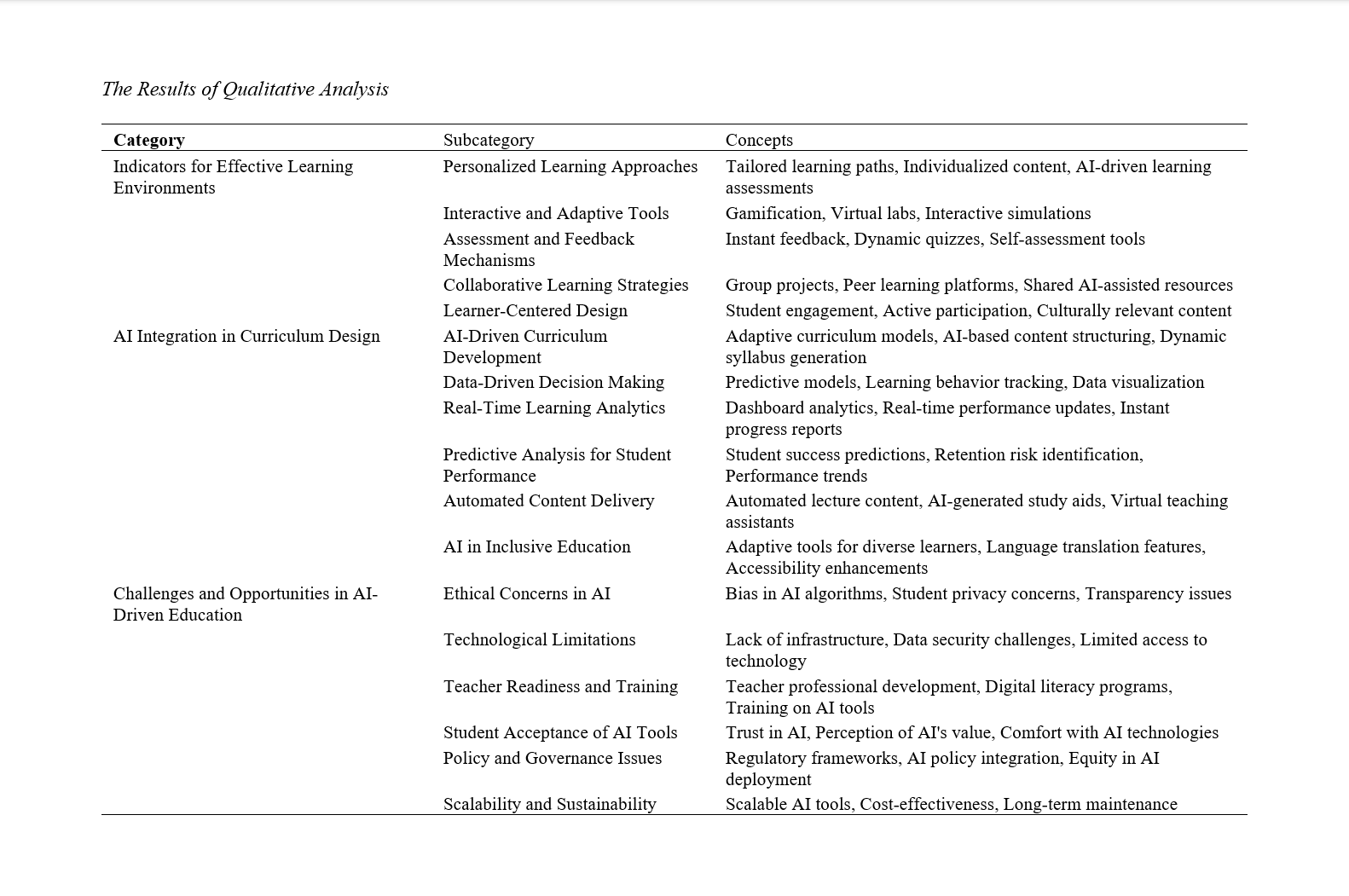
This study aimed to identify key indicators for optimizing learning environments through the integration of artificial intelligence (AI) in curriculum design. A qualitative research design was employed, involving semi-structured interviews with 25 participants from Tehran, Iran. The participants included educators, researchers, and practitioners with expertise in AI and education. Data collection continued until theoretical saturation was achieved, and the interviews were analyzed using thematic analysis with the aid of NVivo software. The analysis identified recurring themes, subthemes, and concepts relevant to AI integration in education. The study revealed three primary themes: (1) Indicators for effective learning environments, including personalized learning, interactive tools, and learner-centered design; (2) Integration of AI in curriculum design, highlighting the use of real-time analytics, predictive modeling, and automated content delivery; and (3) Challenges and opportunities, such as ethical concerns, technological limitations, and stakeholder readiness. Participants emphasized the transformative potential of AI in fostering inclusivity, improving educational efficiency, and addressing diverse learner needs. However, issues like algorithmic bias, data privacy, and inadequate infrastructure were identified as significant barriers to implementation. AI has the potential to revolutionize curriculum design by enabling personalized, inclusive, and adaptive learning environments. While the study underscores the importance of ethical frameworks, stakeholder collaboration, and teacher training, it also highlights the need for addressing technological and infrastructural challenges. Future research should focus on exploring the long-term impact of AI-driven curriculum design and expanding the scope to diverse educational contexts.
Downloads
Downloads
Additional Files
Publication Timeline
- Submitted
- Revised
- Accepted
Issue
Section
Categories
License
Copyright (c) 2025 Mehdi Akbarzadeh Sgay (Corresponding Author); Alireza Borji , Narges Bahramzadeh , Maryam Abedi , Saeed Golizadeh (Author)

This work is licensed under a Creative Commons Attribution-NonCommercial 4.0 International License.