The Structural Model of Perfectionism Based on Childhood Trauma: The Mediating Role of Difficulties in Emotion Regulation Among Individuals with Obsessive-Compulsive Personality Disorder
Keywords:
childhood trauma, perfectionism, emotion regulation difficulties, obsessive, compulsive personality disorderAbstract
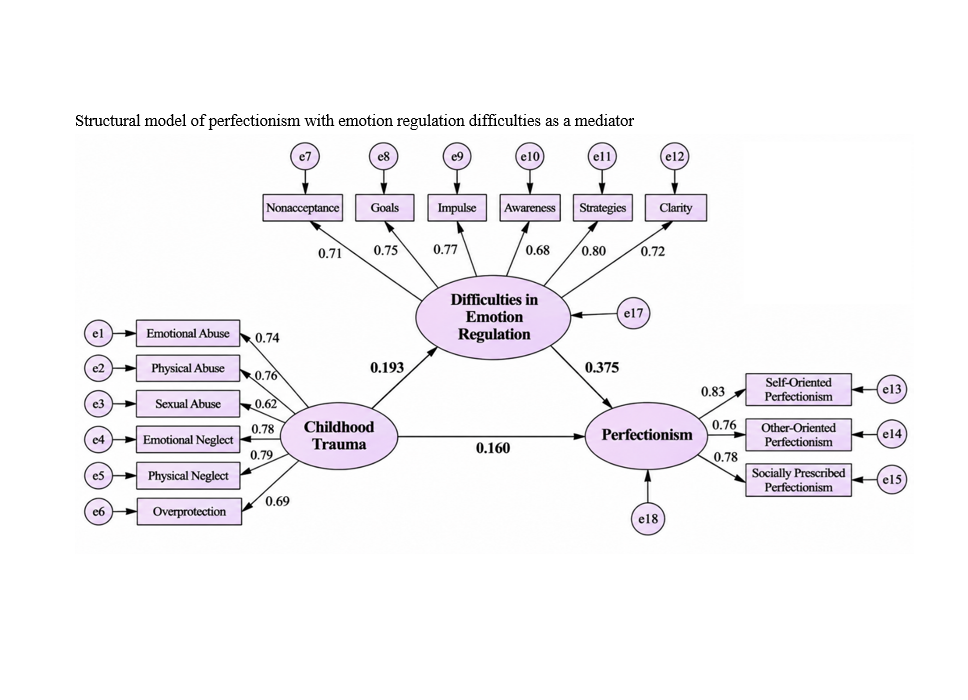
This study examined a structural model in which difficulties in emotion regulation mediated the association between childhood trauma and perfectionism among individuals with OCPD. Methods: A cross-sectional descriptive-correlational design with structural equation modeling was used. The source population comprised individuals with a clinical diagnosis of OCPD who attended treatment centers in Khorramabad, Iran, during 2024-2025. A convenience sample of 196 participants completed the Multidimensional Perfectionism Scale, the Childhood Trauma Questionnaire, and the Difficulties in Emotion Regulation Scale. Descriptive statistics, correlations, measurement-quality indices, and structural paths were evaluated. Childhood trauma was positively correlated with emotion-regulation difficulties (r=.234, p<.01) and perfectionism (r=.469, p<.01), and emotion-regulation difficulties were positively correlated with perfectionism (r=.354, p<.01). Childhood trauma significantly predicted emotion-regulation difficulties (β=.193, t=4.092, p=.001) and perfectionism (β=.160, t=3.962, p=.001). Emotion-regulation difficulties also predicted perfectionism (β=.375, t=7.650, p=.001). The indirect effect of childhood trauma on perfectionism through emotion-regulation difficulties was significant (β=.072, t=3.494, p=.001), indicating partial mediation. Childhood trauma may be linked to perfectionistic tendencies in OCPD both directly and through impaired emotion regulation. Interventions that address trauma-related emotional processing and regulation may therefore be relevant when treating rigid perfectionism in this population.
Downloads
References
Amini-Tehrani, M., Mazidi, M., Ranjbar, S., Ohan, J. L., Weinborn, M., & Naragon-Gainey, K. (2026). Meta-analysis of associations between childhood emotional abuse and adulthood emotion regulation. Clinical psychology review, 128, 102778. https://doi.org/10.1016/j.cpr.2026.102778
Armbruster-Genc, D. J. N., Spilger, E., & Basten, U. (2025). Emotion regulation after childhood maltreatment: Suppression tendency and reappraisal capacity. Child abuse & neglect, 166, 107511. https://doi.org/10.1016/j.chiabu.2025.107511
Cheli, S., MacBeth, A., Popolo, R., & Dimaggio, G. (2020). The intertwined path of perfectionism and self-criticism in a client with obsessive-compulsive personality disorder. Journal of Clinical Psychology, 76(11), 2055-2066. https://doi.org/10.1002/jclp.23051
Dobos, B., Piko, B. F., & Mellor, D. (2021). What makes university students perfectionists? The role of childhood trauma, emotional dysregulation, academic anxiety, and social support. Scandinavian journal of psychology, 62(3), 443-447. https://doi.org/10.1111/sjop.12718
Egan, S. J., Wade, T. D., & Shafran, R. (2011). Perfectionism as a transdiagnostic process: A clinical review. Clinical psychology review, 31(2), 203-212. https://doi.org/10.1016/j.cpr.2010.04.009
Flett, G. L., & Hewitt, P. L. (2020). Reflections on three decades of research on multidimensional perfectionism: An introduction to the special issue on further advances in the assessment of perfectionism. Journal of Psychoeducational Assessment, 38(1), 3-14.
Khosravani, V., Samimi Ardestani, S. M., Sharifi Bastan, F., & Malayeri, S. (2020). Difficulties in emotion regulation and symptom dimensions in patients with obsessive-compulsive disorder. Current Psychology, 39(5), 1578-1588.
O'Connor, D. B., Branley-Bell, D., Ferguson, E., Green, J. A., & O'Connor, R. C. (2026). Effects of childhood trauma and perfectionism on stress, mood, defeat and entrapment. European Journal of Personality. https://doi.org/10.1177/08902070261448997
Peter, L., Sitarski, E., Kobel, S., Wendt, J., Fegert, J. M., & Kohler-Dauner, F. (2026). Childhood emotional maltreatment and adult psychopathology: Evidence for emotion regulation as a mediating mechanism. Child abuse & neglect, 174, 107936. https://doi.org/10.1016/j.chiabu.2026.107936
Pinto, A., Teller, J., & Wheaton, M. G. (2022). Obsessive-compulsive personality disorder: A review of symptomatology, impact on functioning, and treatment. Focus, 20(4), 389-396. https://doi.org/10.1176/appi.focus.20220058
Razaghi, Z., Pakizeh, Z., & Seyed Alitabar, S. H. (2023). The relationship between ego strength, emotion regulation difficulties, and mindfulness in individuals with depression. Journal of Assessment and Research in Applied Counseling, 5(3), 119-126. https://doi.org/10.61838/kman.jarac.5.3.16
Redden, S. A., Mueller, N. E., & Cougle, J. R. (2023). The impact of obsessive-compulsive personality disorder in perfectionism. International Journal of Psychiatry in Clinical Practice, 27(1), 18-24. https://doi.org/10.1080/13651501.2022.2069581
See, C. C., Tan, J. M., Tan, V. S., & Sundermann, O. (2022). A systematic review on the links between emotion regulation difficulties and obsessive-compulsive disorder. Journal of psychiatric research, 154, 341-353.
Sher, A., Wootton, B. M., & Paparo, J. (2024). A preliminary investigation of the mediating roles of self-compassion and emotion dysregulation in the relationship between maladaptive perfectionism and obsessive-compulsive behaviors. Journal of Clinical Psychology, 80(3), 591-609. https://doi.org/10.1002/jclp.23640
Stoeber, J., & Otto, K. (2006). Positive conceptions of perfectionism: Approaches, evidence, challenges. Personality and Social Psychology Review, 10(4), 295-319. https://doi.org/10.1207/s15327957pspr1004_2
Warmingham, J. M., Duprey, E. B., Handley, E. D., Rogosch, F. A., & Cicchetti, D. (2023). Patterns of childhood maltreatment predict emotion processing and regulation in emerging adulthood. Development and Psychopathology, 35(2), 766-781. https://doi.org/10.1017/S0954579422000025
Downloads
Additional Files
Publication Timeline
- Submitted
- Revised
- Accepted