Prediction of Identity Instability Based on the Quality of Object Relations: The Mediating Roles of Mental Pain and Emotion Regulation Difficulties in Adolescents with Self-Injurious Behavior
Keywords:
identity instability, object relations, mental pain, emotion regulation difficulties, self, injurious behavior, adolescenceAbstract
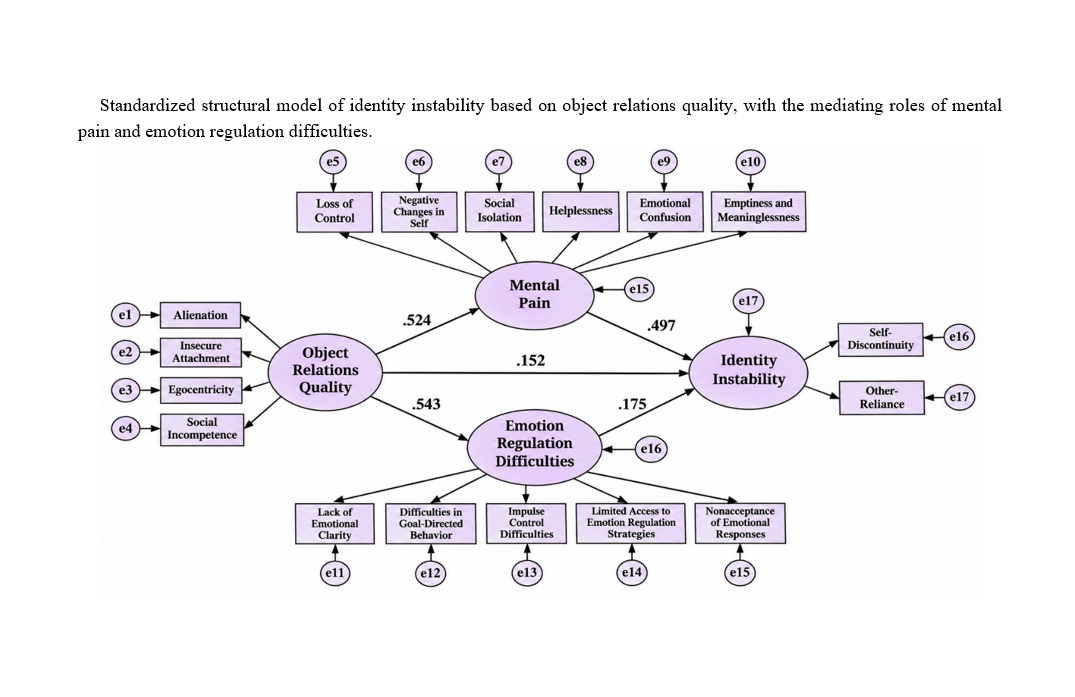
This study examined whether the quality of object relations predicts identity instability in adolescents with self-injurious behavior and whether mental pain and emotion regulation difficulties mediate this association. A descriptive-correlational design was used. Participants were 310 upper-secondary public-school students with self-injurious behavior in Gonbad-e Kavus during the 2024-2025 academic year, selected through cluster random sampling. Measures included the Identity Instability Scale, the Bell Object Relations Inventory, the Orbach and Mikulincer Mental Pain Scale, the 16-item Difficulties in Emotion Regulation Scale, and the Inventory of Statements About Self-Injury for identification of self-injurious behavior. Pearson correlations, path analysis, and bootstrap tests of indirect effects were performed. Object-relational disturbance correlated positively with identity instability (r = .474), mental pain (r = .531), and emotion regulation difficulties (r = .525; all p < .001). Direct paths from object relations to identity instability (β = .152, p = .028), mental pain (β = .524, p < .001), and emotion regulation difficulties (β = .543, p < .001) were significant. Mental pain (β = .497, p < .001) and emotion regulation difficulties (β = .175, p = .010) also positively predicted identity instability. Bootstrap analyses supported significant indirect effects through mental pain (β = .234, 95% CI [.143, .347], p = .008) and emotion regulation difficulties (β = .187, 95% CI [.097, .303], p = .007). Poorer object-relational quality may be associated with unstable identity both directly and through heightened psychological pain and impaired emotion regulation. These findings highlight relational and affect-regulatory processes as clinically relevant targets when assessing adolescents who engage in self-injurious behavior.
Downloads
References
Almurumudhe, L. K. A., Mahdad, A., Abdulkadhim Johni, A., & Yousefi, Z. (2024). The Mediating Role of Self-Esteem in the Relationship between Psychological Capital, Academic Engagement, and Academic Procrastination with Academic Performance among Students in Al-Diwaniyah, Iraq [Research Article]. Iranian Journal of Educational Sociology, 7(3), 1-9. https://doi.org/10.61838/kman.ijes.7.3.1
Babaei, F., Abdollahi, M., Amini Gilvani, M., & Masoomifard, M. (2024). The Mediating Role of Theory of Mind in the Relationship Between Executive Functions and Marital Burnout Using Structural Equation Modeling and Artificial Neural Networks (SEM-ANN). International Journal of Education and Cognitive Sciences, 5(4), 62-73. https://doi.org/10.61838/kman.ijecs.5.4.7
Bagheri Sheykhangafshe, F., Abbaspour, A., Savabi Niri, V., Bikas Yekani, M., & Keramati, S. (2024). The effectiveness of mindfulness-based cognitive therapy (MBCT) on alexithymia, pain intensity, and emotional regulation in children with irritable bowel syndrome. Journal of Child and Adolescent Mental Health, 11(2), 6. https://doi.org/10.61186/jcmh.11.2.7
Erikson, E. H. (1968). Identity: Youth and crisis. W. W. Norton.
Kernberg, O. F. (1984). Severe personality disorders: Psychotherapeutic strategies. Yale University Press.
Klonsky, E. D., & Glenn, C. R. (2009). Assessing the functions of non-suicidal self-injury: Psychometric properties of the Inventory of Statements About Self-Injury (ISAS). Journal of psychopathology and behavioral assessment, 31(3), 215-219. https://doi.org/10.1007/s10862-008-9107-z
Lechner, C. A. (2023). Development and validation of the Identity Instability Scale Alliant International University].
Malekzadeh, F. Z., Mohammadipour, M., & Jajarmi, M. (2026). Structural Model of Identity Instability Based on Object Relations and Childhood Trauma with the Mediating Role of Difficulties in Emotion Regulation in Adolescents with Self-Harming Behaviors. Iranian Journal of Neurodevelopmental Disorders, 5(3), 1-10. https://maherpub.com/index.php/jndd/article/view/762
Nock, M. K. (2010). Self-injury. Annual Review of Clinical Psychology, 6, 339-363. https://doi.org/10.1146/annurev.clinpsy.121208.131258
Normandin, L., Weiner, A., & Ensink, K. (2023). An Integrated Developmental Approach to Personality Disorders in Adolescence: Expanding Kernberg's Object Relations Theory. American Journal of Psychotherapy, 76(1), 9-14. https://doi.org/10.1176/appi.psychotherapy.20220023
Orbach, I., Mikulincer, M., Sirota, P., & Gilboa-Schechtman, E. (2003). Mental pain: A multidimensional operationalization and definition. Suicide and Life-Threatening Behavior, 33(3), 219-230. https://doi.org/10.1521/suli.33.3.219.23219
Painter, K., & Scannapieco, M. (2021). Children and Adolescents With Mental Illness and the Education System. https://doi.org/10.1093/oso/9780190927844.003.0018
Poshtareh, S., Ebrahimi Moghadam, H., Moradi, H., & allah. (2024). Modeling the Relationship Between Reality Testing and Object Relations with Psychological Well-being Through the Mediation of Defense Mechanisms in Grief Disorder. Journal of Adolescent and Youth Psychological Studies (JAYPS), 5(3), 147-158. https://doi.org/10.61838/kman.jayps.5.3.16
Sun, F., Li, H., Song, W., Bao, J., & Zhen, Z. (2022). Patterns of psychological pain and self-harm behaviors in adolescents. Suicide and Life-Threatening Behavior, 52(5), 1012-1023. https://doi.org/10.1111/sltb.12898
Tolan, Ö. Ç., & Dersuneli, Y. (2024). Examining the relationships between emotion regulation and non-suicidal self-injury behavior in adolescents: A systematic review. Turkish Journal of Child and Adolescent Mental Health, 31(2), 110-122. https://doi.org/10.4274/tjcamh.galenos.2022.74936
Torres, J., Chen, D., & Peixoto, B. (2025). Locus of Control and Its Relationship with Motivation: Mediated by Grit. Journal of Adolescent and Youth Psychological Studies (JAYPS). https://doi.org/10.61838/
Yenen Menderes, A. S., & Çuhadaroğlu, F. (2025). Impact of mentalization, identity diffusion and psychopathology on nonsuicidal self-injury among adolescents. Journal of adolescence, 97(2), 357-368. https://doi.org/10.1002/jad.12422
Zhang, H., Li, H., Jiang, C., Tu, Y., & Xi, M. (2025). The Relationship Between Self-Objectification and Adolescent Appearance Anxiety: A Mediated Model With Moderation. Actas espanolas de psiquiatria, 53(2), 359-365. https://doi.org/10.62641/aep.v53i2.1742
Downloads
Additional Files
Publication Timeline
- Submitted
- Revised
- Accepted