Prediction of Emotional and Behavioral Problems in Adolescents Based on Negative Meta-Emotion and Attachment Insecurity: The Mediating Role of Emotion Regulation
Keywords:
negative meta, emotion, attachment insecurity, emotion regulation, internalizing problems, externalizing problems, AdolescentsAbstract
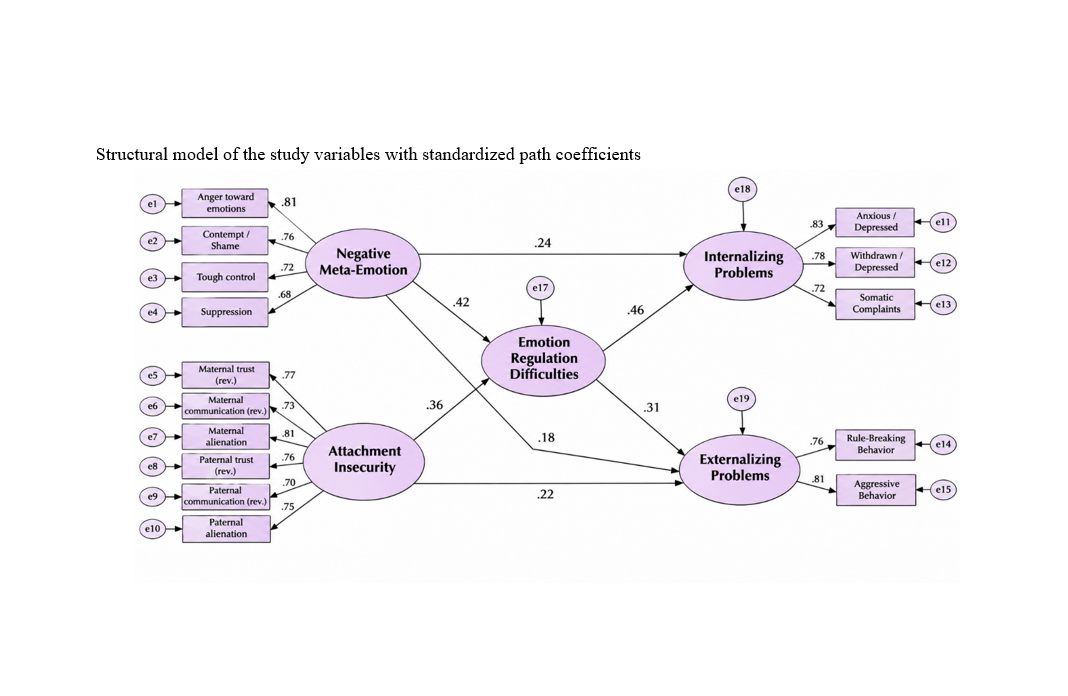
This study aimed to examine a structural model of emotional and behavioral problems in adolescents based on negative meta-emotion and attachment insecurity, with emotion-regulation difficulties as a mediating variable. This cross-sectional correlational study was conducted in Tehran, Iran, in 2026 among 420 adolescents aged 13–18 years selected through multistage cluster sampling. Negative meta-emotion, attachment insecurity, emotion-regulation difficulties, and internalizing and externalizing problems were assessed using validated self-report measures. Data were analyzed using SPSS version 22 and AMOS version 22. Confirmatory factor analysis and structural equation modeling were conducted, and indirect effects were examined using bootstrap analysis with 5,000 resamples. The structural model demonstrated acceptable fit (χ²/df = 2.38, CFI = .931, TLI = .923, RMSEA = .057, SRMR = .052). Negative meta-emotion (β = .42, p < .001) and attachment insecurity (β = .36, p < .001) were positively associated with emotion-regulation difficulties. Emotion-regulation difficulties predicted both internalizing (β = .46, p < .001) and externalizing problems (β = .31, p < .001). All four indirect pathways were significant. The model explained 43% of the variance in emotion-regulation difficulties, 52% in internalizing problems, and 34% in externalizing problems. Negative meta-emotion and attachment insecurity were associated with greater emotional and behavioral problems both directly and indirectly through emotion-regulation difficulties. Emotion regulation may represent an important psychological mechanism linking intrapersonal and relational vulnerabilities with adolescent adjustment.
Downloads
References
Cain, L., Strodl, E., & Howard, G. (2024). Targeting beliefs about emotions via meta-emotion therapy for adolescents with anxiety: A case series study. Journal of Contemporary Psychotherapy, 54, 133-142. https://doi.org/10.1007/s10879-023-09605-7
Compas, B. E., Jaser, S. S., Bettis, A. H., Watson, K. H., Gruhn, M. A., Dunbar, J. P., Williams, E., & Thigpen, J. C. (2017). Coping, emotion regulation, and psychopathology in childhood and adolescence: A meta-analysis and narrative review. Psychological bulletin, 143(9), 939-991. https://doi.org/10.1037/bul0000110
Cooke, J. E., Kochendorfer, L. B., Stuart-Parrigon, K. L., Koehn, A. J., & Kerns, K. A. (2019). Parent–child attachment and children’s experience and regulation of emotion: A meta-analytic review. Emotion, 19(6), 1103-1126. https://doi.org/10.1037/emo0000504
Fadaie, Z., Najafi, M., Habibi Asgarabad, M., & Besharat, M. A. (2009). Confirmatory factorial structure, reliability and validity of the Achenbach Youth Self-Report Scale (YSR): Monozygotic and dizygotic twins. Journal of Clinical Psychology, 1(1), 1-18. https://doi.org/10.22075/jcp.2017.1993
Groh, A. M., Roisman, G. I., van Ijzendoorn, M. H., Bakermans-Kranenburg, M. J., & Fearon, R. P. (2012). The significance of insecure and disorganized attachment for children’s internalizing symptoms: A meta-analytic study. Child development, 83(2), 591-610. https://doi.org/10.1111/j.1467-8624.2011.01711.x
Habibi Asgarabad, M., Salehi Yegaei, P., Seyed Yaghoubi Pour, N., Khodaie, E., Wilkinson, R. B., & Wiium, N. (2025). Maternal, paternal, and peer attachment and adolescent behavior problems: A validation study of the Inventory of Parent and Peer Attachment (IPPA-45). BMC psychology, 13, 1334. https://doi.org/10.1186/s40359-025-03643-7
Jesline, J., Romate, J., Diya, E., & Rajkumar, E. (2025). Mediating role of resilience on the relationship between meta emotions and emotional regulation among neglected adolescents. BMC psychology, 13, 622. https://doi.org/10.1186/s40359-025-02856-0
Kraft, L., & Kizil, J. (2026). Meta-emotion-regulation: A conceptual framework for influencing emotion regulation behaviour. Cognition and Emotion, 40(6), 1300-1312. https://doi.org/10.1080/02699931.2025.2560687
Lin, S. C., Kehoe, C., Pozzi, E., Liontos, D., & Whittle, S. (2024). Research review: Child emotion regulation mediates the association between family factors and internalizing symptoms in children and adolescents—A meta-analysis. Journal of Child Psychology and Psychiatry, 65(3), 260-274. https://doi.org/10.1111/jcpp.13894
Mitmansgruber, H., Beck, T. N., Höfer, S., & Schüßler, G. (2009). When you don’t like what you feel: Experiential avoidance, mindfulness and meta-emotion in emotion regulation. Personality and individual differences, 46(4), 448-453. https://doi.org/10.1016/j.paid.2008.11.013
Salavou, V., Papanikolaou, K., Pehlivanidis, A., & Giannakopoulos, G. (2026). Mentalization and emotion regulation in adolescent attachment: A scoping review. Children, 13(3), 420. https://doi.org/10.3390/children13030420
Seyed Alitabar, S. H. (2023). Cultural beliefs and family well-being: A narrative review. Journal of Psychosociological Research in Family and Culture, 1(2), 25-32. https://doi.org/10.61838/kman.jprfc.1.2.4
Seyed Alitabar, S. H. (2025). The biopsychosocial model in modern healthcare: Overcoming barriers to holistic patient care. International Journal of Body, Mind and Culture, 12(2), 1-4. https://doi.org/10.61838/ijbmc.v12i2.950
Seyed Alitabar, S. H. (2026). Adolescent mental health in contemporary Iran: A body–mind–culture perspective. International Journal of Body, Mind and Culture, 13(1), 1-3. https://doi.org/10.61838/ijbmc.v13i1.1346
Downloads
Publication Timeline
- Submitted
- Revised
- Accepted